Wednesday, August 15, 2018

DISCOVERY WORLD

My son and his family visited earlier this month, and during their stay we visited Discovery World, an interactive museum located in downtown Milwaukee.  The venue, which is housed in its own building on the shores of Lake Michigan, includes a curious mixture of exhibits and is pricy but is generally well done.  Many of its exhibits are a bit mature for my 3- and 5-year-old grandsons, but they took advantage of what they could absorb.

The museum includes a number of sections.  These include a small ship housed inside the building that can be explored, a nice diverse aquarium,  a crafts area, a series of hands-on exhibits that illustrate basic principles of physics and technology, such as momentum, pulleys and levers, and an area devoted to guitars (seemed incongruous, but there it was).  In addition, the museum serves as the home anchor for a reconstructed tall ship, the Denis Sullivan, which unfortunately was cruising out in the lake at the time of our visit.  

Here are some of the photos that I got.

First, a couple of shots of the building's exterior.


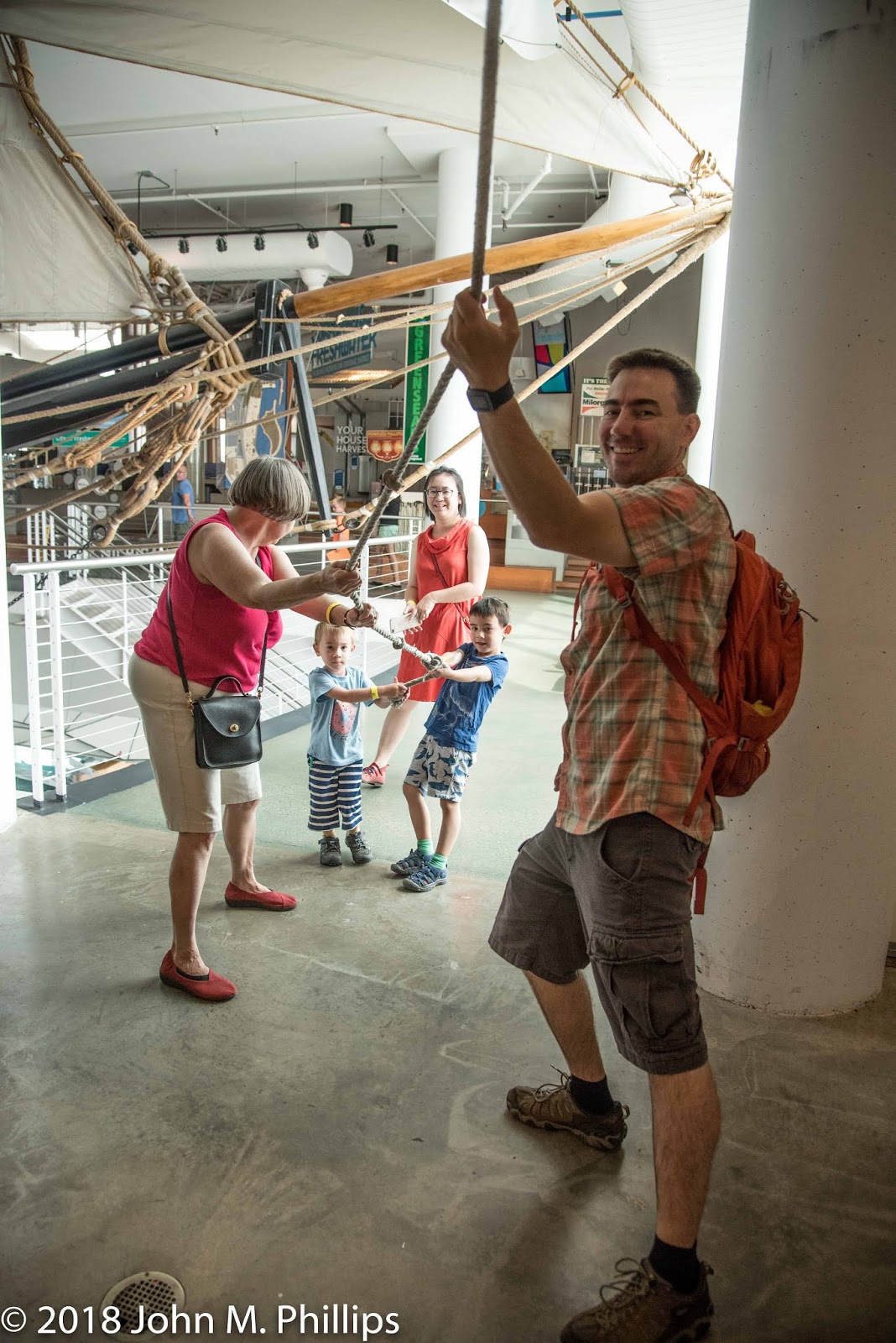
A shot of my family hoisting me by taking advantage of a pulley system.


Jellyfish in the fine aquarium, which included a section that allows the visitor to walk through a glass archway with fish swimming both on the sides and above.


The aquarium area also included a number of reptiles, including the following snake.


I'm not sure of the function of the following stylized sculpture, but it made an interesting subject to photograph.


Finally, a shot in the guitar section.  


In fairness, Les Paul, who was a long-term resident in the Milwaukee area before his death a few years ago, was a major innovator in guitar technology and construction, and the exhibit pays homage to his contributions.

The museum has a pleasant exterior, including an amphitheater that offered some interesting black & white opportunities.


John

Tuesday, July 31, 2018

ROADSIDE WEEDS

Several days ago, on one of my morning walks, I noticed some distinctive weeds along one of the quiet side roads on my route.  The sun was high enough to be backlighting the weeds, revealing their elaborate veining.  By the time I had finished my walk, the sun had gotten higher in the sky and, more importantly, a breeze had sprung up, making it problematic to try to photograph the weeds that morning.  However, a couple of days later, when the wind was again calm, I decided to revisit the weeds, before my morning walk, armed with my camera and macro lens.

This was a residential neighborhood, and while the weeds were quite close to the street, to shoot the them I technically had to stand in someone's yard.  Fortunately, it was early and no one came to ask what I was doing.  Not having the steadiest of hands, I took most, though not all, of the shots with the camera mounted on my tripod.

The morning was clear, but the sun had not yet risen above a nearby line of trees when I first got to the site.   The sun was not yet backlighting the weeds, and, as a consequence, the light for the early shots was what I would characterize as "flat."  Here is one of those early shots.


1/800 sec, f/6.3, ISO 1000

I worked on this shot for quite a while in post processing.  First, of course, I converted it to black & white and cropped the shot quite a lot.  Then I ramped up the contrast, which served to darken the background.  However, I thought this also made the veining look artificial.  The reason I held on to this shot was because of the strand of spiderweb that I discovered in post processing.  This was also early enough that there were still some dewdrops on the perimeters and in the weed's "crotch."

Once the sun made it above the line of trees, the backlighting of the weeds made a big difference in the overall dynamics of the images.  Here's a somewhat similar shot in terms of composition but that conveys a richer depth, both in the weed itself and in the background.


1/800 sec, f/8.0, ISO 800

Here is another shot in color that also illustrates the value of the having the right light.


1/800 sec, f/8.0, ISO 800

All of the shots were made with my 90 mm Tamron macro lens, which allows me to shoot at a very close range of just a few inches.  As a result, in both of the above shots, the backgrounds are pretty much totally blurred out, despite the aperture being in the midrange of f/6.3 or f/8.0.  That can make it easy to eliminate background distractions.  However, it also means that, because depth of field is so narrow, any significant changes in the distance between the object (the weed) and the camera will be reflected in loss of focus in parts of the subject.  That is why I was looking for weeds that presented a flat surface and tried to position my camera so that it was as close as possible to being perpendicular to the plane of the weed's surface.

Finally, following are a couple of shots taken at a somewhat longer range so as to feature more of the weed.


1/640 sec, f/3.2, ISO 100


1/640 sec, f/3.2, ISO 100

Because the distance between the camera and the subject was greater in these shots, I opened up the aperture to f/3.2 to eliminate any background distractions.  Note that portions of the subject are out of focus because they are not all in the same plane.  This is perhaps most noticeable in the black and white shot where parts of the plant on the left side of the image are curved away.  Even so, I thought the black and white in particular shows good three-dimentionality and is my favorite of the bunch.

One more comment: I probably spent nearly an hour taking close to 100 photos of these weeds.  Because of the morning dew, my shoes and my jeans from the knees down were soaked.  I kept fewer than a dozen photos from this shoot.  Still, I thought the session was a success.

Saturday, June 23, 2018

PIONEER VILLAGE SCENES

Pioneer Village is located northwest of Saukville, Wisconsin, about 30 miles north of Milwaukee.  It consists of perhaps 25 buildings from the late 19th century and very early 20th century that were disassembled and then reassembled on the grounds of Pioneer Village.  The grounds are compact, so it is easy to tour the site in a relatively short period of time.  I have visited the venue with my camera a few times in the past.  This was my first visit this year.  Here is some of what I came away with.

The first is a black & white of a wheelchair ramp along the side of one of the buildings.  Not great, but I liked the shot for the composition, including the shadows the railing was casting on the ramp.


Several of the reconstructed buildings were built of dovetailed timbers that had never been painted and show great weathering of the wood, as in the following shots.


I especially liked the composition of this second shot that featured both a window and the dovetailed timbers.

Associated with this same building was a wooden silo, which was interesting on the inside, looking up.


The following black & white of a corn crib was somewhat cliched, but I liked it anyway.


Many of the buildings, while structurally sound, exhibit deferred maintenance, including the following screen door, which I thought presented an interesting composition.


Here is another screen door shot that I have taken on previous visits but I still think is worthy for the unusual design of the corner panel that holds the screen in place.  I intentionally set the lens for a shallow depth of field and focused on the screen, leaving the scene behind out of focus.


All of the buildings at the venue are filled with artifacts from the same time period as the buildings.  Here are a couple of those.


The second shot isn't great, but the light coming through a side window was doing a great job of illuminating the wheel.

One of the featured buildings is a reconstructed train station, including a caboose.  The caboose apparently was part of the Milwaukee Road system, at one time a prominent Midwestern railway line, now defunct.


Speaking of signs, I enjoyed the following, even though in fine print it appears to have been created relatively recently.


The caboose is in fairly good shape, but it does include some paint failure, as in the following shot.


Ugly but interesting.

My favorite of this series, though, is a relatively simple shot of lace curtains in a window of one of the reconstructed homes on site.  There was an ample amount of light coming through the window, which made catching all of the lace in good focus a lot easier.


John


Sunday, May 20, 2018

STUDY IN RUST

With the weather finally getting warmer, recently I ventured out with my camera looking for something to shoot and stumbled across a metal sculpture outside the entrance to a building that was part of what had been the Schlitz brewery.  The brewery had closed years ago and the cluster of brewery buildings had fallen into disrepair until it was successfully converted to an office park several years ago.  Here is the sculpture, which stands perhaps 20 feet tall.


Not particularly impressive, but what caught my eye was the complex of rust circling the sculpture about 18 inches above the base.


Embarrassingly, even though I took a number of shots of the rust that first time, I wound up coming back another three times in an attempt to capture the texture as an abstract.  The rusted metal featured a number of defects--scratches and patches--that I didn't notice at first but that I felt were creating a distraction.  In short, there were a lot of wasted shots (nothing new there) that drew me back three more times, hoping to finally get it right.

The sheet metal of the sculpture was wrapped in a cylinder and the seam was then welded.  Here are a couple of shots that feature that weld.  I had tried setting the seam in the center but felt it worked better off to the side.


The remainder of the "keeper" shots featured one particular irregularity in the texture of the rust.  Here they are, generally in order of closeup.


Some of the shots for this post were made handheld, which necessitated ramping up the ISO to minimize motion blur.  For the last few images in this post, though, I did use a tripod and also employed my macro lens to maximize detail.

I realize that these shots are almost purely abstract, but I liked the complexity of the textures as well as the earth tones.

John

Tuesday, May 1, 2018

MILWAUKEE BREWERY CAMPUSES

Milwaukee is no longer the center of the brewery world.  I don't believe there are any breweries in Milwaukee that are still owned locally, other than small craft beer makers.  Two of the major breweries that were purchased years ago were Schlitz and Pabst.  After those breweries were bought out, the campuses remained vacant for years and suffered major deterioration.  However over perhaps the last 10 to 20 years, the campuses have been undergoing a renaissance, with former brewhouses and warehouses seeing renovation and occupation primarily by commercial tenants.

Last weekend I visited both campuses with my camera, something I have done before but not for a few years.  Here is what I got.

Not much caught my eye on the Pabst campus.  Here are a couple of shots of older buildings that feature the fine brick masonry that was prevalent a hundred years ago but is now largely a lost art.


One of the buildings has been converted into a hotel and bar, and, it being a sunny day, the shadows cast by some outdoor wireframe tables caught my eye.


Then it was on to the Schlitz campus.


The above was shot with my wide-angle lens, set at a wide open 15 mm, yielding some distortion that I sort of liked.


Laid out at the base of one of the buildings were some ceramic pieces that had been created over 100 years ago and fortunately had been preserved.


These pieces were perhaps 2 ft. by 5 ft.  I particularly liked the 1903 piece.

At the east end of the campus were a couple of smokestacks.  I  don't know if they are functional, but I thought they made a nice black & white study.


In front of one of the buildings was a cylindrical structure, a piece of art, I presume, that may have had a practical function at some point in the past.  This was a quiet Sunday afternoon, but I must have triggered some sort of security alert.  So as I was taking photos of the cylinder, a couple of security personnel came on the scene.  They asked me what the object was I was taking pictures of and what in particular I was photographing, and I had to confess that I had no clue what the object was but that I was interested in decrepitude and was taking pictures of the rust that the cylinder was exhibiting, as in the follow shot.  Then they left me alone.


There are parts of this shot that are something of a mess, but through post processing I was able to soften the image to give it an abstract impressionistic look.

Here is another detail shot of the same structure.


Finally, as with the Pabst campus, the Schlitz campus also features some interesting masonry.  Here first is some detail stonework at a corner of one of the building entrances that I converted to a black & white.


I also liked the stone masonry that featured larger stonework, as in the following photos.


© 2018 John M. Phillips