Thursday, January 1, 2015

FAVORITE PHOTOS: 2014

As I have done in prior years, I am including here a collection of my favorite photos from 2014.  This time I am simply going to show them in chronological order, beginning with a couple of pics I took in February while visiting our friends the Deans at their place in Captiva, Florida.

The first is of a colorful picket fence in "downtown" Captiva, really just a little crossroads on this largely linear island in southwest Florida.


I had tried to capture this fence by positioning the camera perpendicular to the fence, but those shots lost the depth gained by shooting the fence at an oblique angle.  Additionally, I liked the paint-spattered planking in the lower right corner.

I took the next shot while on a day cruise in Pine Island Sound north of Captiva.  Most of what I got on this cruise was pretty indifferent, but I did like a series of fish houses located in the sound.


I liked the negative space that this photo includes, creating a simplicity that helped to focus attention on the fish houses.  Conversion to black & white served to emphasize the houses' lines.

We spent four weeks in Austin, Texas in the spring.  I thought this nightclub sign spoke to Austin's active nightlife that we barely partook of.


I don't do much night photography, but it's surprising how well many of them turn out.  Maybe that's a lesson.

While in Texas we took a day trip to San Antonio, a visit that included tours of a number of the city's restored missions, including Mission Concepcion, where I took this shot.


If nothing else, the Texas state capitol is big, and I wound up going there at least three times to take photos.  I liked the following shot because of how I was able to convert the symmetry of the building's dome into asymmetrical arcs.


One of my visits to the capitol building was in the early evening, and I was able to catch one of the many live oaks in the extensive grounds around the capitol building just before I lost available light.


In this case I decided to crop the shot to within the field of the tree's gnarled limbs.

Later in the spring on one of our trips to see Geri's dad in the Twin Cities, I brought my camera on a visit to the Minnesota State Capitol and got this shot of archways on the building's ground level.


This was a particularly lucky shot as I did not have a tripod and took this handheld with a shutter speed of only 1/6 second.

And then there was the following shot of one of the many tanks located in the large petroleum depot on Milwaukee's far northwest corner.  I was lucky again to get this shot . . . before I got kicked off the premises by one of the depot's security guards.


I thought that the conversion of this shot to black & white and a ramping up of the contrast helped to create a mood that simply didn't exist with the color version of the image.

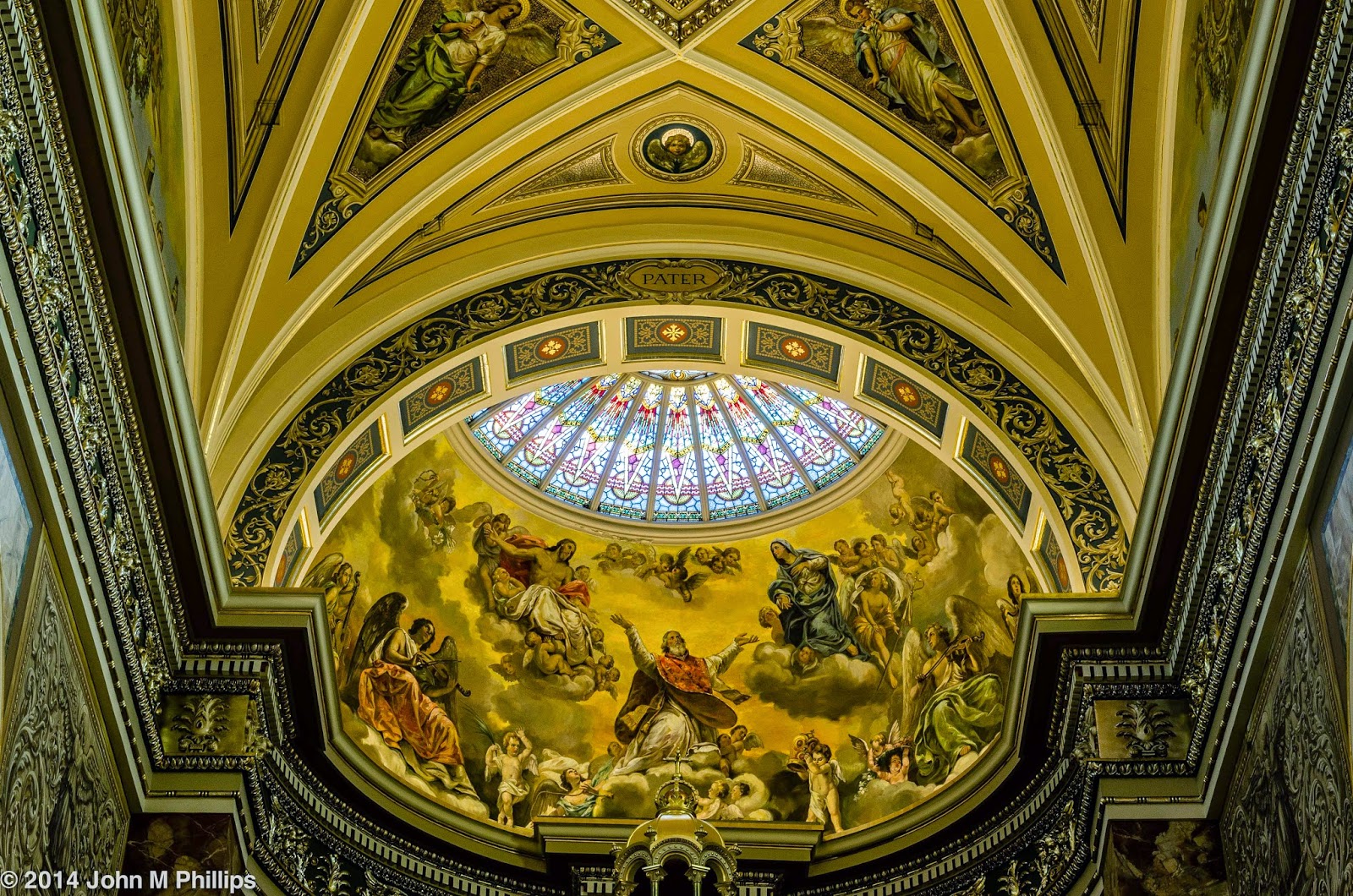
In May I learned of the St. Joseph Chapel situated in the complex of buildings housing the headquarters for the School Sisters of St. Francis order of nuns.  The chapel was beautiful and the sisters let me have it to myself for over an hour.  I was happy with a number of shots from that session.  Here is the one I chose for this post that featured the skylight of the ceiling of the chapel's apse.


In June we took a land tour and cruise in Alaska.  Here are a couple of highlights from the trip.  The first is one of many humpback whale breechings that I was fortunate to capture on our whale watching excursion in Juneau.


The second is a shot I took during our cruise through the Inner Passage.


I was just so impressed with how remote this land was, even though any number of cruise ships were plying the waters, my guess is that there was simply no one on any of these islands.

In reviewing my photography for this past year, I was surprised to see that I had little in the way of nature macro photography, and this shot of a poppy taken at the Mitchell Domes doesn't really qualify as macro, as I took it at distance with a telephoto, but I did like the composition.


Over Labor Day weekend we spent time with friends in the Spring Green area, where two of the couples have second homes.  We were fortunate (from a photographic point of view) to have fog one of the mornings, and I got this shot of a bucolic scene.


I thought the struggle between the fog and the morning sun helped to make this shot.  The lifting fog created an interesting negative space. 

Each September, Milwaukee puts on a "Doors Open" weekend when anyone interested (and especially photographers) are invited to tour various venues around the city that might not be accessible to the general public.  I took the following shot at the Old St. Mary's Catholic Church just west of the downtown area.  


I liked the juxtaposition of the two semicircular stained glass pieces, one over the exterior entrance to the foyer and the second over the entrance from the foyer into the nave.  Frankly, I thought the stained glass was undistinguished, particularly as to color, but I thought it made a much more powerful statement as a black & white abstract.  

In October we took a great trip to Portugal and Spain, and below are a number of the photos that I took on the trip.  The first is of the ceiling in the cathedral in Lisbon.  


Although the ceiling structure was the primary subject matter of the photo, I also liked that I was able to include the supporting pillar.

We spent two nights in Evora, Portugal, where we toured the city's cathedral.  Although it wasn't the largest religious venue that we visited, I thought in some ways it was the most beautiful.  Here is a shot of the ceiling about the cathedral's apse.


I spent quite a bit of time trying to figure out how to shoot the charming narrow streets in the old sections of the Portuguese and Spanish towns that we visited.  Along the way I realized that I needed to shoot these scenes in landscape orientation rather than portrait.  It also helped when I could include human figures in the shot, to provide perspective and context.  Those two factors worked in the shot below that I took in Carmona, Spain.


Of the major Spanish architectural masterpieces that featured a significant Arab influence, my favorite was the Mezquita in Cordoba.  Originally built in the late 10th century by the Arabs, it featured a stunning muslim shrine, known as a mihrab.  At first, I had the hope that I could get a "clean" shot of this shrine but in the end realized that the crowds in front of it actually added to the shot's compositional strength.


When the Christians retook southern Spain in the 15th century, forcing out the Arabs, they tore out the mosque located in the Mezquita and replaced it with a cathedral.  Yikes.  But actually it makes for an interesting lesson in the cultural history of the area.  And the cathedral is beautiful in its own right.  Following is a shot I took of one of the cathedral's ceilings.


A lot of my attempts at ceiling shots were less than great, but this one worked out in terms of how well I was able to center the camera on the floor underneath the center of the ceiling.  This was shot at f/5.6 with a shutter speed of 1/6 second.

On our trip we stayed two nights in Ronda, Spain, a beautiful mountain town situated about 40 miles from the Mediterranean coast.  The two photos I have included from that leg of the trip could be considered a matter of spotting what was available.  The first is of the hinge of a massive door that I spied on one of our walks around the town.


For whatever reason, I decided to crop this shot to within the iron hinge itself, rather than including a portion of the door as a border.  I think it worked, though.  The second photo is of a scene across a valley of a line of umbrella pines that were silhouetted against a more distant set of hills.


I suppose this shot could be from anywhere, but I did like the composition.  

During our time in Madrid we toured the Palacio Real (royal palace).  Its extreme opulence was difficult to capture, but I was happy with this shot taken from behind a sculpture in one of the main halls.


I thought the silhouetted figure added to the story of the scene.

I also took the following shot through windows overlooking one of the palace's courtyards.  I was drawn to the shot by the distortions that the old glass was creating in the facade across the courtyard and ended up liking this shot quite a bit.


On our final day in Madrid we took a walk through the city's largest park.  I was fascinated by the line of two-sided benches located in the center of one of the park's walks and took the following photo.


After our return I spent a very pleasant afternoon visiting the Minneapolis Institutes of Art on another of our trips to the Twin Cities to see Geri's dad.  Toward the end of our visit I spied an individual working on his smart phone in one of the museum's elevator foyers.


I liked that this shot somehow came out looking more like an oil painting than the candid photograph that it is.

In December I visited an old "friend," the abandoned Solvay coke plant, located in Milwaukee's Walker's Point, and took this shot of a clerestory window that had definitely seen better days, but whose decrepitude and graffiti had created an interesting abstract.


And finally, I would be remiss as a grandfather if I didn't include a photo of my grandson, Stanley, taken during our Christmas visit in Salt Lake City.


John

Tuesday, December 9, 2014

ST. JOSEPHAT'S IN POST PROCESSING

Last week I visited another old architectural friend, the Basilica of St. Josephat.  It's a gorgeous venue that I have shot several times previously.  I actually took about 50 shots during this visit, but I am only showing a handful of those here.  I have complained many times that shooting interiors poses special problems because of the light one must work with.  Those problems can be divided into two main categories, white balance and dynamic range.

White balance refers to the nature--primarily "warmth"--of the available light.  Incandescent light is much warmer, for example, that midday sunlight or fluorescent lighting.  This problem is fairly manageable if you shoot in RAW.  This is because in RAW the camera is simply recording the actual quality of light that strikes its sensor.  It is then up to post processing to modify that light to make the image look similar to how our eyes interpret the scene.  Put another way, our brains automatically interpret, say, incandescent light to make it "whiter" than it actually is.  A camera doesn't do that.  But we can tell the camera (or our computer in post processing) to make that interpretation.  In any event, in this instance white balance was not a major problem.

Dynamic range is more of a problem with interior spaces, particularly religious venues that often are lit almost entirely by the natural light streaming through the (often stained glass) windows.  As a consequence, the windows tend to be too bright and the interior surfaces too dark.  This is where a camera is no match for the human eye.  We can distinguish a much greater range of brightness than can a camera.  This means that a camera struggles where the image includes brightly lit windows alongside dimly lit interior surfaces.

In this post I decided to illustrate some of the challenges I encountered on my visit to St. Josephat's and how I tried to cope with those challenges by showing both "before" and "after" images.

Let me start with one of the ceiling shots I took.  One of the most prominent aspects of the basilica is its domed central ceiling.  But in this case I was focusing on a ceiling along one of the sides of the nave.  Here is the shot as taken.


I took this shot by placing the camera on the floor pointed up and triggering the shutter via remote.  Not a bad shot, really.  One of the issues I was struggling with was how much to rotate the camera so the rectangular ceiling was not "squared up."  In this case in post processing I decided to make fully vertical the up-and-down ribbing and have it bisect the image.  I also felt that the image was a little dull, so I increased the contrast somewhat.  Finally, I reduced the intensity of the the stained glass window in the lower left to gain a little definition there.  Here is the result.


Better, but not that much different.

Here is a second ceiling shot.


In this case the shot was not quite centered on the ceiling: There is more archway on the right than on the left.  Also, once again, I thought the image could use more contrast.  Here is the result.


I liked the result here, particularly because the central dome is just visible in the lower part of the image.

The third photo in this sequence, a shot of the apse ceiling, illustrates the problems with dynamic range.


There were a number of problems with this shot.  First, it is not quite symmetrical or level, so I had some leveling and cropping to do in post processing.  But more importantly the light coming through the apse ceiling window had "fooled" the camera into a shorter exposure.  As a result, even though the window is overexposed, the walls, particularly along the sides, are quite dark.  So in post processing I lowered the exposure of the window and increased the exposure on the walls.  I also stepped up the contrast a bit.  Here is the result.


The window is still a little bright, but overall a much improved image, I think.

The next shot was of a small cherub sitting above one of the confession booths along the side of the nave.


I admit that I took an embarrassing number of shots of this sculpture . . . and never did get it right.  The first thing I did was to shoot the cherub with the aperture wide open, to soften the background, in order to separate better the subject from the background.  But in this shot there is still confusion between the dark cherub and the relatively dark section behind the cherub's extended arm.  I should have moved to the left so that the cherub was positioned in front of the much brighter mural behind the cherub's wing in this shot.  But I failed to do that.  Moving further to the left would also have avoided the problem that this photo features the cherub "facing" out of the shot rather than into it.  What to do?  First, I cropped the image as a square to reduce the "facing" problem.  I also brightened up the sculpture, which was quite dim and lacked definition.  Here is the result.


The next shot was of the basilica's main rose window, which sits behind the pipe organ at the back of the choir loft.  This shot clearly illustrates the dynamic range problem I referenced earlier.


Even though the image appears significantly underexposed (and probably is at least to an extent) there was so much light coming through the window relative to the interior that parts of the window are "blown out," losing any usable definition.  In looking at a shot like this, you have to have some confidence that the information is there, it just has to be brought out.  For the most part, in post processing I reduced the brightness of the window while increasing the brightness of the interior surfaces.  Here is the result.


It may seem difficult to believe, but these are the same image.  Now the organ's features are clearly shown, including an array of horizontally projecting pipes appearing in front of the lower part of the window.  And there is archwork over the window now that serves to frame the scene.

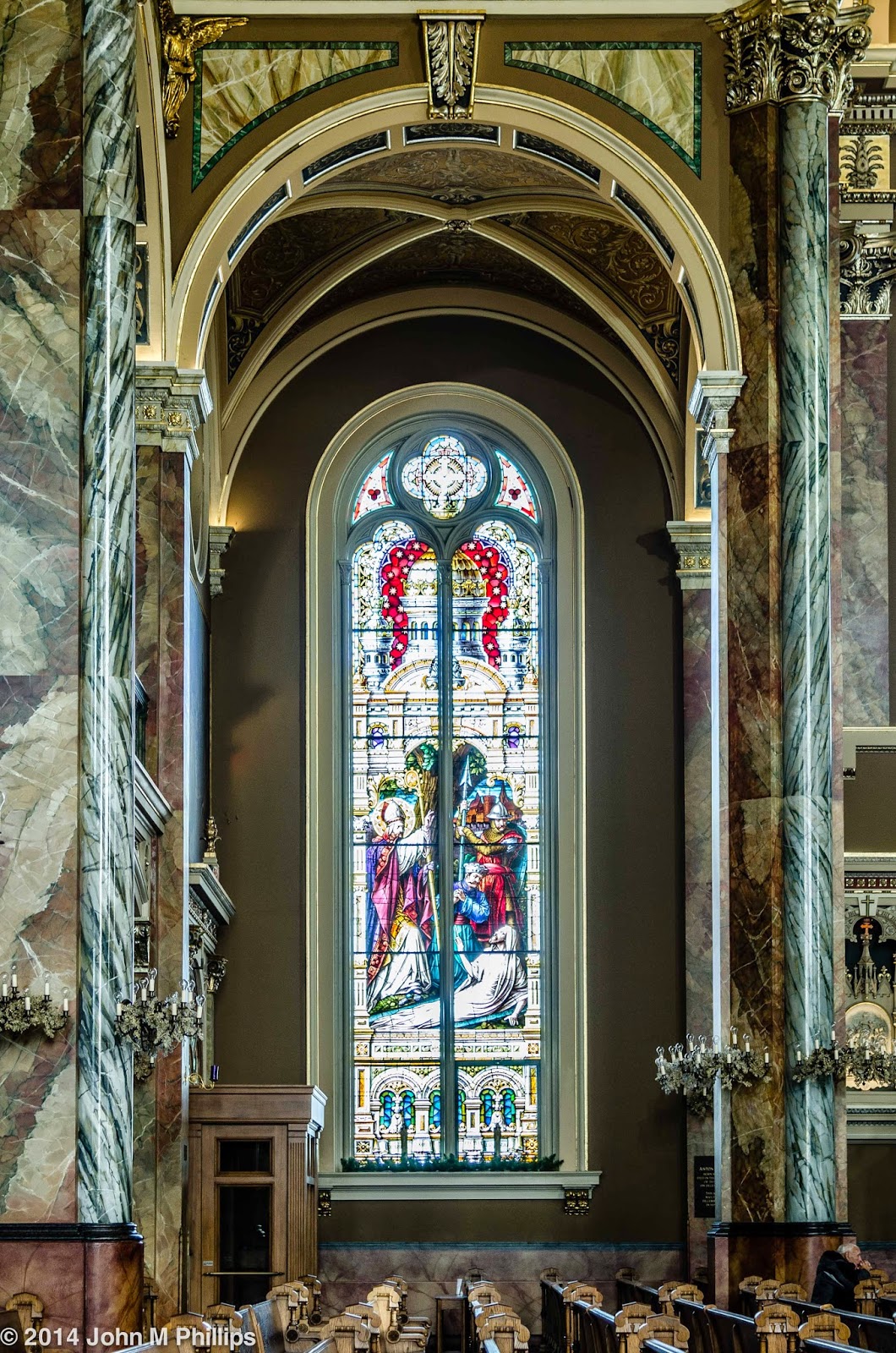
Finally, here is another shot of a vertical stained glass window.


In this case I wanted not just to feature the window but to provide context in the form of the pillars and archway surrounding the window.  But that meant having to deal with the dynamic range issue.  The shot isn't terrible, but the window is clearly too bright and the interior too dark.  There is also just a bit of a verticality issue.  Here is the result of post processing.


Again, both of these images are from the same shot.  One more thing: Because I was shooting up, this caused a perspective issue with the pillars seem to be leaning in slightly.  This is another fix I could make in post processing, with the pillars now appearing much closer to vertical.

Bottom line: Even though I need to do all that I can in setting up a shot to make my post processing job as easy as possible, it is surprising what can be accomplished with modern software, in my case Lightroom 5.

John

Tuesday, December 2, 2014

OLD FRIENDS

Maybe it was because the late fall weather had been so disagreeable or maybe it was because I kept thinking I could find something new to say about some of the local interior spaces I have shot in the past.  But whatever, recently I found myself returning to some architectural haunts I have photographed before . . . many times.  Old friends.

First up was the downtown branch of the Milwaukee Public Library.  What I found interesting was the fact that few if any of the visitors patronizing the library were paying any attention to the architectural features that the space offers.  And that surely had been my experience as well until I got interested in photography.  For that I am grateful.

The highlight of the entrance to the library is the rotunda ceiling, and I have shot it numerous times in the past.  Here is one of those shots that I take by setting the camera on the floor pointing up to the center of the ceiling.


I like the symmetry of this shot that I cropped as a square, but I keep regretting not having wider angle capabilities with the camera and lenses that I currently have.  One thing I decided to do was to rotate the camera 45 degrees to get the following.


Suddenly a lot more interesting, I think.  Sure, I had to give up the round features in two of the corners, but I've gained a lot more, I think in bringing in some of the side features.  Despite my best efforts, I didn't quite nail the positioning of the camera.  It's not as easy as it might seem, since the camera must not just be in the geographical center of the floor, it must also be pointed directly up.  So I needed to crop the shot slightly to make it fully symmetrical.  However, I realized that if I cropped the shot more narrowly, I could extend the ends just a bit more, making the shot a little more abstract.


Here are a couple more shots that emphasize the border between the rotunda dome and the side walls.


Again, I thought the narrow crop on this last shot helped to create an abstract quality that I was seeking.

Although the dome is the star of the show, some of the other architectural details are worthy also.


Next stop, the Cathedral of St. John the Evangelist.  These first shots are familiar ones, including the second floor archways above the side aisles at the back of the nave.


What I thought helped the above shot was the quality of light on the lowest of the arches.

There are a number of most unusual features in this church, including the fact that the pipe organ is at the front rather than the rear.  I took this shot with the intention of converting it to a black & white to emphasize the reflections off the cylindrical pipes.


I shot this as an asymmetrical image, but decided in post processing that it worked better when cropped symmetrically.

Among the church's more attractive features are the pairs of supporting pillars and arches along the side aisles, and I have shot them a number of times before.  This first shot below is very typical of the kind of composition I have used in the past, except, for some reason, my camera recorded the image as a black and white.  I decided it worked OK anyway.  Again, I was employing my camera-on-the-floor-pointing-up technique.


But I also decided to take another shot with the camera rotated about 45 degrees.


Once more, I thought I lost something but that I also gained something by this orientation.

One of the subjects I have worked on in the past has been that of a handsome statue along one of the sides of the nave.  Last time I realized I could get a much more interesting image by shooting the statue between one of the pairs of supporting pillars.


In this case, I moved close to the pillars, set the aperture wide open, and focused on the statue behind the pillars.  This served to blur out the pillars some, allow the statue to pop.

Stained glass windows can be very difficult photographic subjects.  First, they pose extreme dynamic range problems, since they can be very highly lit by exterior sunlight, while the surrounding interior can be very dimly lit.  There is also a great temptation simply to shoot the window, not leaving much in the ay of context.  Here I thought I was able to find an attractive way to frame one of the stained glass windows.


Never mind that there was a light fixture hanging in front of the window and that the arch crops out the upper portion of the window.

Finally, is a shot of the altar that sits nearly in the center of the nave.


In this case I darkened the background to set off the altar's white marble and ramped up the contrast, creating a chiaroscuro effect.

Then it was on to the Calatrava addition of the Milwaukee Art Museum.  But first a scene looking west down Wisconsin Avenue from the museum, showing off the eclectic nature of the Milwaukee architecture.


I walked over to the museum just as it was opening at 10 a.m. and had not realized that the museum raises the brise soleil at that time each day, so I happened to catch it in mid-rise in the following shot, something I didn't realize until I had downloaded the shots to my computer.  A little weird, maybe, but I liked the contrast between the light on the north and south sides of the structure.


I have photographed the interior of the Calatrava addition so many times that I find it difficult to find new compositions.  This first is simply a symmetrical shot looking up at the ceiling, not exactly unique, I'm afraid.


At least the fact that the next shot is asymmetrical makes it different.


Not bad, actually.

I wanted to catch some of the patrons and their reflections on the polished floor.


Didn't quite work.

In looking over the shots, I found that some of them were pretty standard, mundane really, but others at least are not cliched, not the sort of shots that the typical visitor might expect to come away with.

John