Wednesday, March 20, 2013

MUSTANG LIBRARY REVISITED

I had such a good time taking photos at the Scottsdale Mustang Library that I decided to return a few days later to see if I could better my prior shoot.  Not really, but it was still fun trying to take advantage of the library's lines and colors.

Here's a shot similar to one from my last visit that I thought worked particularly well.


I really like the patterns of shadows cast by the pergola above the entryway to the library.  So here's more of the same.


OK, so maybe this is a bit too much and too abstract.

And here are some wider angled exterior shots to take advantage of the building's colors and lines.


Finally, I took a few interior shots.  What caught my attention was a stunning brick mural of, what else, mustangs.


The mural was actually much larger than this, but I needed to limit the shot to a portion in order to eliminate anything extraneous, such as desks and other library stuff.

What made this even more interesting was that the mural is bas relief.  Ken Williams, the artist who created the mural in 1989, could have pre-designed the individual bricks and then had them put together in proper order to create the mural.  Alternatively, the may have "carved" the mural from a plain brick wall.

SCOTTSDALE ARABIAN LIBRARY

I have fallen in love with Scottsdale's libraries.  I have now been to four of the five branches and have taken numerous photos of each.  Of those four, the Civic Center branch is nice but the least distinctive.  (I have been told that the fifth branch is not architecturally interesting.)  I have already done a post on the Mustang branch (which I am going to add to) and will also do a post on the Appaloosa branch.  (For some reason the branches other than the Civic Center branch are named after types of horses.)

I was directed to the Arabian branch, as well as the Appaloosa branch, by a librarian at the Mustang branch, to whom I had indicated my interest in photography.  She told me that the exterior of the Arabian branch was clad in sheets of iron that had been allowed to rust and that it was otherwise architecturally interesting.  Here are a couple of early shots that I took.


Those are windows along the bottom of this last shot.

Frankly, it was difficult to capture the nature of the rusted cladding of the structure, particularly as set against the brilliant sunlight and clear dark blue of the late morning sky.

I also made some attempts at a close-ups of the texture of the metal . . . .


without a great deal of success.  The texture is interesting, but I feel there is insufficient variation in color to make this a stand-alone image.  (This photo is actually set on its side, as the seam in the metal was close to--but not exactly--vertical.  See below.)

What made the building more unusual was that the entryway consisted of a high-walled walkway that made a couple of sharp turns--intended to simulate a slot canyon.


And that it did.

The wall at the beginning of the "canyon" also included an interesting bas-relief sculpture (seen in one of the shots above) that I attempted to capture.


The "slot canyon" opened onto a pleasant courtyard area at the building's entrance that featured another interesting sculpture arrangement.


Here is a detail of part of that.


Another fascinating feature of this building is that none of the walls of the building is vertical; all are set at a slight angle.  Nor is the iron cladding set perpendicularly.  Initially, I tried to align the camera with the walls or the seams of the cladding but finally realized that nothing was either straight up and down or horizontal.  So in the end I just had to accept the lines for what they were.  And that just added to the structure's interest.  This is true of the inside as well as the outside, as the architect seems to have pieced the walls and ceiling together in whatever angles did the job, filling in gaps with glass.


I always ask for permission to take interior photographs, and one of the librarians assured me that it was OK and told me that it was common to see architecture students photographing the interior of this most unusual gem of a building in connection with their studies.

WILDLIFE WORLD ZOO

Phoenix actually has two zoos.  One is the Phoenix Zoo, a nonprofit facility that is centrally located and that I have reported on before (see post of 3/8/13).  The other is the Wildlife World Zoo, which is a for-profit facility located about 20 miles west of central Phoenix.  We decided to visit the WWZ on the advice of strangers whom we sat next to at a spring training game.

This zoo was interesting in that it gave us an opportunity to compare the two types of facilities.  The WWZ is smaller than the Phoenix Zoo but has packed in a lot of animals.  It has some features that are more attractive, including that the animals are generally viewable at closer range.  It also included a relatively large aquarium with some fairly exotic species on display and a "petting" area, where one can pet stingrays (which felt slimy, by the way) and starfish (which did not).  But here are some drawbacks.  There were no elephants, which are very labor-intensive to maintain, or large primates, such as chimps, baboons, or orangutans, which presumably are more difficult also to house.  In addition, although the zoo boasted thousands of animals, a large percentage were birds.  Moreover, the same species were housed in different enclosures in different parts of the facility, creating a little confusion.  And the grounds were generally not as well manicured as at the Phoenix Zoo.  The birds were noisy, particularly those in the macaw/parrot family, which was actually a nice thing, as it added to the "ambience."  This clearly was a place to view animals, not a facility for their study.

I took a lot of photos during our three-hour stay but would have to say that I was a bit disappointed with the results.  Again, for the usual reasons (read "excuses"):  Many of the exhibits were screened cages, which obscured the camera's view and confused its autofocus feature.  In addition, I had trouble with the lighting in the interior venues, particularly the aquarium.  In any event, here are some of the better shots that I got.

There was a flock of very dark colored flamingos near the entrance.


They must have been feasting on a lot of orange colored shellfish.

And, as I mentioned, there were plenty of parrots and macaws.


The aquarium included some interesting exotic species.


There was also a "Dragon World"--basically reptiles.


Although the zoo lacked elephants, it did have a nice white rhinoceros.


As usual, I found myself looking for the unusual close-up, and this shot of the rhino's ear came out well, I thought.

The primates we saw seemed unhappy behind their wire cages.


Two of the more interesting species were the warthogs . . .


(a face only a mother warthog could love)

. . . and the African spurred tortoises.


Wildlife World Zoo was quite a bit more expensive (50% higher) than the Phoenix Zoo.  With all the wire cages, I felt a bit uncomfortable with how the animals were presented, although they seemed to be in good physical health.  In sum, I would recommend the Phoenix Zoo over the WWZ.

Sunday, March 17, 2013

TALIESIN WEST SCULPTURES

Geri and I toured Taliesin West last week.  We really enjoyed the tour, as the guide was knowledgeable and engaging.   Frank Lloyd Wright's architectural heritage is familiar to us as Wisconsinites, and we have toured both Taliesin in Spring Green, Wisconsin, as well as various other Wright-designed structures in the Chicago area.  So Taliesin West felt very familiar and to my eye appears dated as well as a bit run down.  (One of the issues with his architecture is its high maintenance demands.)

Rather than focusing on the architecture itself--and I did take a fair number of photos of the buildings--I decided to feature the many interesting sculptures that graced the Taliesin West grounds.

Frank Lloyd Wright had acquired a number of pieces of ceramic Oriental art which have been largely restored and are scattered throughout the grounds.  Here are a couple of examples.


Many of the balance of sculptures are bronze works by Heloise Crista and most are very interesting.  Unfortunately, I did not have much time to try to capture those pieces because I had to keep up with the tour and discovered that I could not just wander the grounds following the tour to take more shots.  So this was all I could get.


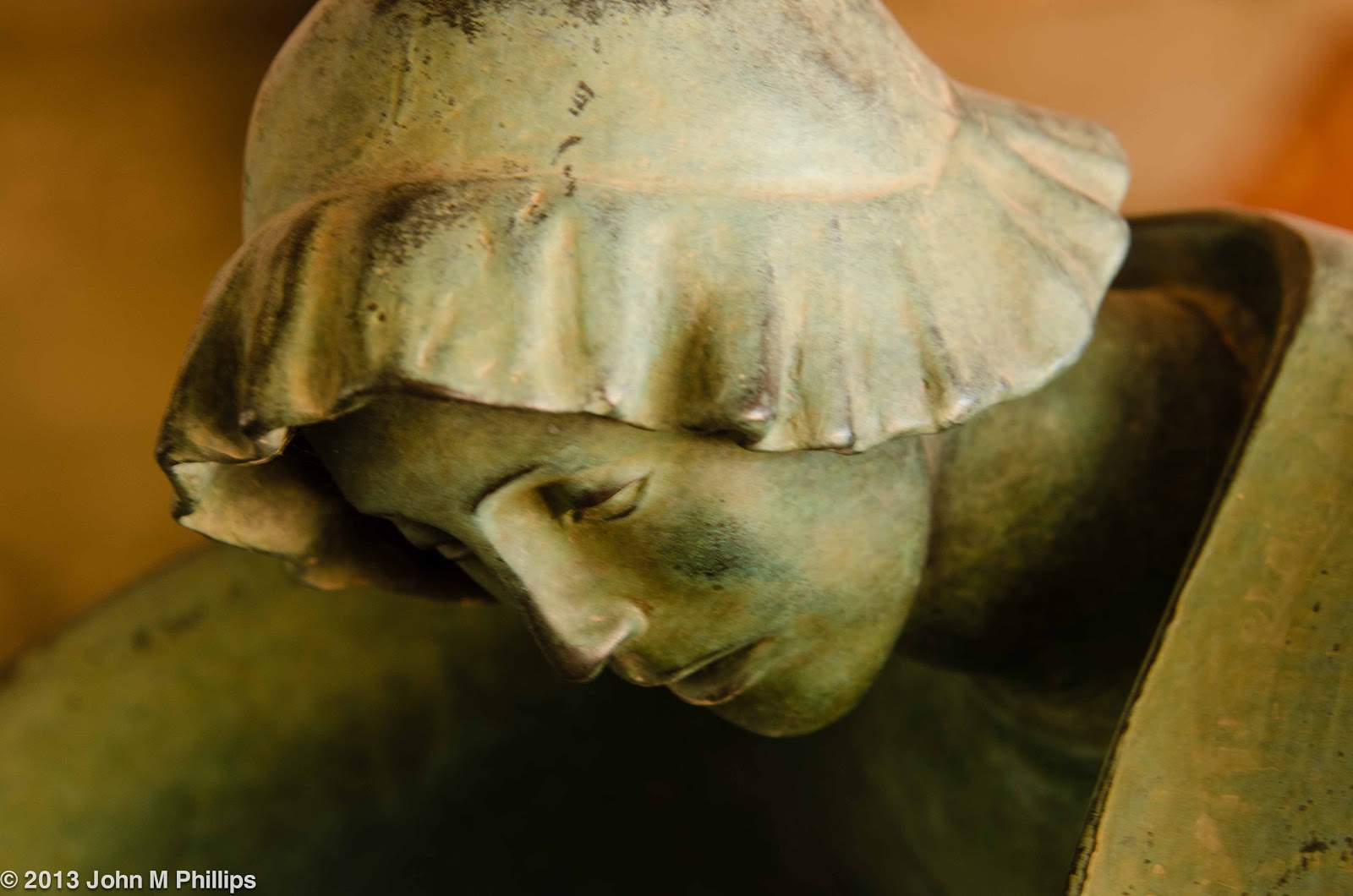
In reviewing my photos, I realized that the more effective photos were those featuring close-ups rather than attempting to capture the full sculpture.  In some cases I found myself in post processing cropping down the shot to feature what I considered to be the most dramatic aspects of the work, as in the following shots.


In reviewing these images, I am beginning to realize that my interest is in capturing the emotion contained in the sculpture's key details.

Saturday, March 16, 2013

PHOENIX ART MUSEUM

We had visited the Phoenix Art Museum last March, and I decided to make another visit this year.  My general impression of the museum is that it is a little light on traditional art for a metropolitan as large as Phoenix's and focuses on interesting contemporary art in part to compensate for this relative lack.  Having said that, the museum has a lot to offer.

I decided that this time around I would emphasize photos that I thought were interesting or that I especially enjoyed taking.

The main entrance provides a nice surprise--hundreds of models of butterflies glued to the walls . . .


including around some of the museum's exhibits.


A nice touch, I thought.

I did take some photos of the two-dimensional wall art.


Note that I included the card including the name of the artist and work in the above shot, something I am trying to remember to do.


I think the Christ child in the above painting looks a bit mature for his infant size.

My primary interest, though, has been in photographing three-dimensional art, as in the following.


The museum included an inviting courtyard that included a number of sculptures.  Here are a couple of the photos from that courtyard.


Most museums have a policy of allowing photos of items in their permanent collection but prohibiting photography of temporary exhibits.  As soon as I came back inside from the courtyard, a guard informed me that I should not have been photographing any of the sculptures.  Oh, well.  One of the best sections in the museum included contemporary art from Latin America.  Unfortunately, before I could take any photos of it, a guard reminded me that the exhibit was off limits for cameras.

Although much of what I photographed was representational (i.e., recognizable) a lot was pretty much abstract, including the following.


This item was actually much larger--and more of the same--and I chose to show just a portion.


The following, though quite abstract, appears to represent an eyeball.


The "Blob" was one of my favorites.  It consisted of some sort of amorphous plastic against which a video was projected, as shown below.


Here is a close-up of a palanquin.  Here I was more interested in showing some of the detail of artwork covering the palanquin than in showing the entire exhibit.


I chose to take this with a wide-open aperture of f/4 to eliminate background distractions.

The following is an installation by artist Cornelia Parker.  It consists of charred remains of a Texas church that had burned down after being struck by lightning.


The following item was quite large, perhaps eight feet high, and nearly black.  It was interesting but very difficult to capture.


My reflection is visible in the portion on the right and can also be seen--upside down--in the portion on the left.  It had some of the same characteristics as the "Bean" in Chicago's Milllenium Park.  Here is another shot of this object taken from a different angle.


The following item was interesting in large part because it was situated in front of another installation whose vivid colors added greatly to the overall effect.  The background object consisted of hundreds of thousands of index-card sized pieces of colored paper that are shown on edge


Finally, I found myself taking shots of some of the museum building's architectural details, including stairwells.  The following shot was of an open staircase that was faced with a clear reflective plastic panel.


The last three steps, which are at a right angle to the main staircase, along with a railing, are being reflected in the clear side panel.  This shot appeals to my sense of abstraction.

When I compared this post with my post from a year ago, I realized that there were many items in the prior post that I didn't see this year.  I thought I had pretty much covered the museum, but either I missed a large section or a number of items from last year were no longer on display.   But of course there were a lot of new items this time around as well.