Wednesday, November 21, 2012

HOLY HILL BASILICA: EXTERIOR

The Milwaukee area is home to two Roman Catholic basilicas, St. Josephat's on the south side of Milwaukee, which I have visited a couple of times to take photos, and Holy Hill, located about 30 miles northwest of downtown Milwaukee in Hubertus.  The basilica is located on one of the highest spots in southeastern Wisconsin and on a clear day can be seen from Milwaukee's downtown office buildings.  I can recall visiting the basilica not long after we moved to Milwaukee over 35 years ago and perhaps one other time.  Tuesday, November 20, was a warm and bright day, and I decided to pay another visit to the shrine that afternoon.  I had a good time, taking about 125 shots and keeping about 50.  I thought I would create a couple of posts, one on the exterior and one on the interior.

It is not easy to capture the entire basilica in a single shot because it is located at the top of a hill and is surrounded by fairly heavy woods.  Here is a shot taken from the road leading to the basilica.


I think you get the idea.  Of course, it would have been better had I taken this shot in the morning when the sun would have been off to the left rather than behind the basilica.  About the only ways to get a good shot of the whole structure would have involved either a very long telephoto or a fly-over.

The basilica is built at the top of a fairly steep hill, so even though there is a fairly large pavilion outside of the front entrance to the church, it still makes it difficult to try to capture any of the steeples.  The following shot illustrates that problem.


But i did manage to capture the steeple at the back of the church from a parking area down the hill.


So basically in terms of exterior shots I was limited to the front entrance area.  Here is the best I could do with the camera and lenses that I have.


Obviously, this shot doesn't include the peak of the front facade and has some perspective issues.  I spent a lot of time making sure the camera was positioned directly on the midpoint.

The sun was providing nice contrasting shadows at the front entrance, so I spent a fair amount of time shooting some of those details, as in the following shots, which were taken hand-held.


I thought this last shot worked well as a B&W also.


I also wanted to get a close-up of the front doors.  Just as I took the shot, some guy walked out and immediately apologized.  I just waited for the door to close and retook it.


The door handles are (mirror image) identical but the handle on the right appears to get a lot more use.

There are various statues scattered around the grounds, but I just didn't feel inspired, in part because they are not in great repair..


I took this shot with the aperture at a wide open f/4 to minimize the distractions in the background.  Even so, I could not eliminate some distracting utility wiring behind the statue.

Construction on the basilica began on 1926 and was completed in 1931.

Taken with my Nikon D7000 with Nikkor 24-120mm f/4 lens and Nikkor 70-300mm f/4.5-6.3 lens.

Sunday, November 18, 2012

FOG

I woke Saturday morning, November 17th, to a dense fog.  Not wanting to waste the opportunity, I took my camera out as soon as I could get around.

The first shot I took was of a small tree located next to a modest-sized pond in our subdivision.


The pond is only 40-50 yards across and is bordered by woods, virtually none of which is visible in this shot, illustrating how thick the fog was, at least initially.  I thought this shot worked well as a B&W also.


I decided to head for Virmond Park, which is located on the bluff above Lake Michigan and where I have had some success with fog in the past.  On the way I stopped to take a few shots of the local railroad tracks.


Not great but at least converting the shot to a B&W helped to emphasize the lines of the tracks and how the fog swallowed them up.  I worked pretty hard to make this shot symmetrical, both in the set-up of the shot and in post processing.  This was taken at an aperture of f/11 with an exposure of 1/3 second.

Before I got to the park, I spotted some woods on one of the residential properties bordering the lake.


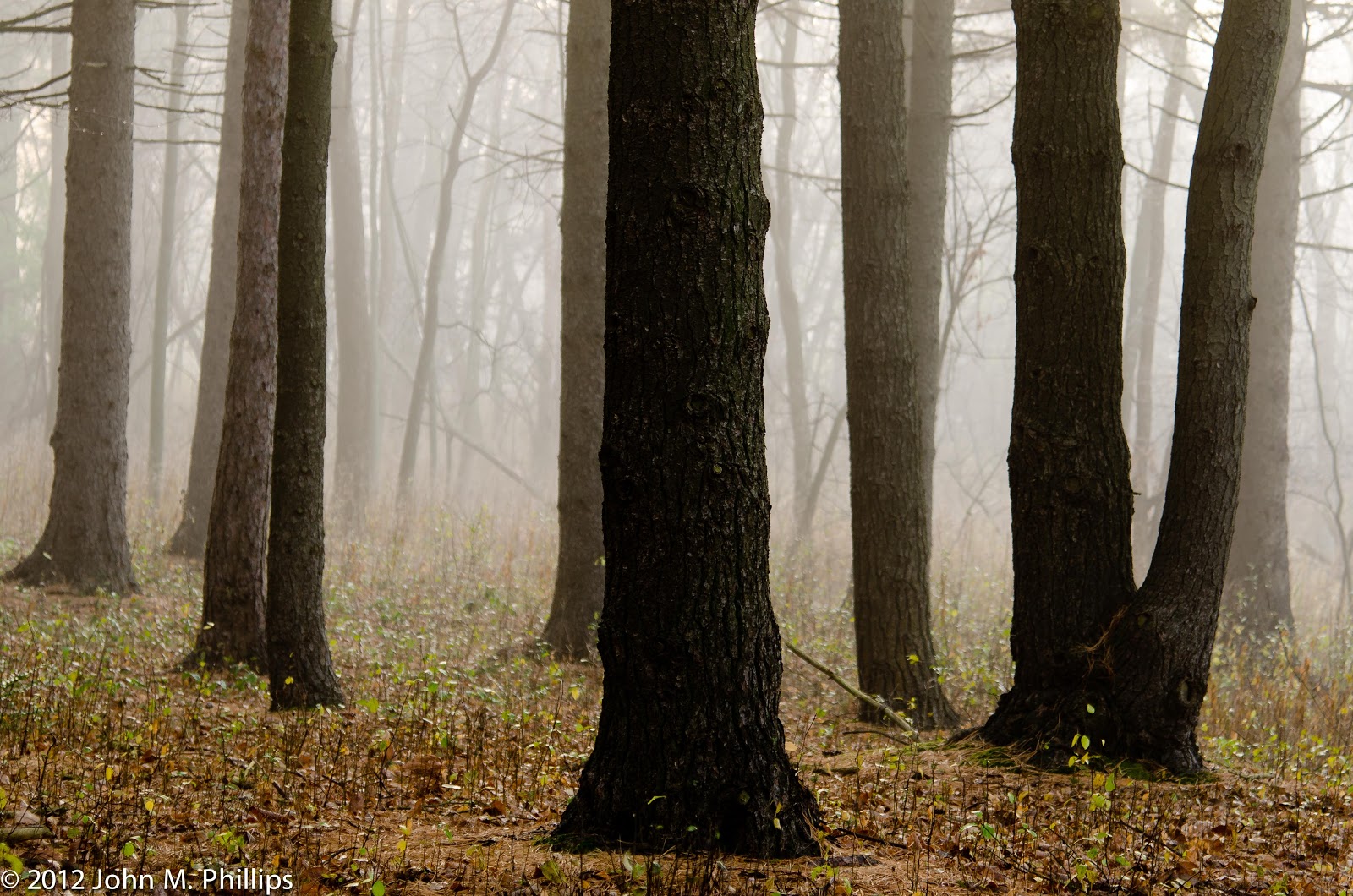
I was looking for shots that would create depth as the trees further from the camera were increasingly "grayed out" by the fog.  I chose this composition because I wanted to focus on the small sapling about one-third of the way from the left edge.  I would have done better had I moved closer to the sapling to feature it more prominently, but I was concerned by a nearby sign that warned that the property was protected by a surveillance agency.  I also liked the tree on the right of the image with the small stubby limbs.  The composition would have been stronger without the prominent dark trunk in the center of the image.

Here's another shot of these woods.


This shot is less cluttered, putting more emphasis on the quality of the fog.  Again, I would have preferred not having the large dark trunk in the middle of image, but I did like the random quality of the arrangement of trunks.  I also liked that I  emphasized just the trunks and not on any major limbs or foliage (assuming any foliage was left this late in the fall).

On to Virmond Park and to the following solitary tree located in an open area.


The sun was already starting to burn off the fog, so I hurried to take shots that would isolate the tree with the fog-shrouded sun as a backdrop.  Here are a couple more shots of this tree.


In these shots I positioned the sun directly behind the tree, which I think worked a bit better.  I struggled with whether to include all of the tree in the shot and whether to position the tree in the center or off to one side.  Here is this last shot as a B&W.


I think this also works pretty well, but the images in color seem to have more power.

In the end I liked having the branches of the tree fill the shot to the edges of the image.

Now the fog was lifting rapidly, and I moved on to a stand of trees where there was still some fog but which the early morning sun was starting to light up.


There is a building now visible in the background, but it is not well defined and doesn't distract from the light on the trunks of the trees.

Here is another similar shot.


I really liked the quality of the light in this shot; it seems almost palpable.  Again, there is a building in the left background in this shot, but it is very faint and doesn't detract significantly from the shot.

Here is one last shot of this type.


There is still some fog visible in the background, but it has little remaining impact on the foreground.  I like the balance in this shot, both horizontally and vertically, but it doesn't have the power that the previous shot has.

Here is a final shot that I took of a solitary evergreen in the park.


Although the fog had largely dissipated, it was still enough of an element to add to the shot's emotional quality.  The sunlight coming from the left and lighting up the trunk also helped the shot.

I've always been enchanted by fog.  I recall a time when as a child I was on my school playground in a dense fog.  It seemed that the fog away from me was denser than where I was standing, so I would run where I thought the fog was denser only to discover that the fog now appeared denser where I had just been.  It took me a while to realize that the fog appeared denser at a distance only because I was looking through more of it.

Ordinarily, on Saturday mornings I look forward to relaxing over a powerful cup of coffee and a muffin at our local coffee shop.  I'm glad that this once I forewent that indulgence to take advantage of the fog.

Taken with my Nikon D7000 with Nikkor 24-120mm f/4 lens.

Saturday, November 17, 2012

SUNSET

I wanted to get a few final shots of the barn and silo associated with the abandoned house, but as I hurried to get those shots in the late afternoon, I realized that the sun was just about to set and that I should instead take advantage of that light.

First is a shot that includes part of the abandoned house.


The sun is just sitting on the horizon.

And here are additional shots of just the sunset.


I wasn't sure how to do this.  These shots were taken at the standard amount of exposure called for by the camera's light meter.  However, in post processing I wound up underexposing the images about two f-stops in order to deepen the colors.  I found myself taking shots about every 10 seconds because the colors change rapidly during  a sunset.

I had my 70-300mm lens on the camera when I started shooting the sunset.  At some point, after the sun had dropped below the horizon, I switched to my 24-120mm lens to capture a wider view.  I also began underexposing the shots.  Here are a couple of those photos, which I have cropped horizontally (in part because there were jet contrails visible in the upper portions of the images).


In all of these shots, I feel that the taller tree in the left portion of the images is critical to the success of the composition.

Taken with my Nikon D7000 with Nikkor 70-300mm f/4.5-5.6 and Nikkor 24-120mm f/4 lenses.

ABANDONED HOUSE REVISITED: BARN

The abandoned house near our home was once an operating dairy farm, and there are a barn, two silos, and various outbuildings on the property.  Here is a photo of the barn taken in late afternoon.


Here are a couple of photos of a window in an outbuilding that caught my eye because, while the window frame had remained rectangular, the window itself has deteriorated into a parallelogram.


The first shot was taken around midday, while the second was taken in the late afternoon--an interesting study in the importance of the quality of the light.

The buildings included a steel silo located on the north side of the barn.  Here is a B&W of the silo and barn.


And here are a couple of shots the silo.


This second shot of the west side of the silo was actually taken shortly after sunset.

There is some "artwork" located on the west side of the barn.


The above shot reflects that the windows of the barn were made of glass block.  And I decided that they might present a photo opportunity.  Initially, I started taking shots from the interior of the barn of the block glass of the windows facing the sun, but the glass was, of course, extremely dirty and the sunlight just accentuated that.  So I began taking shots through the windows facing away from the sun.


Of course, some of the glass blocks had been broken.


Boys will be boys.

Here is a selected portion of one of the windows.


I like that the scene has an impressionistic quality to it and the borders of the glass blocks add interest.

I also took a number of close-up shots . . .


. . . including of broken blocks.


Taken with my Nikon D7000 with Nikkor 24-120mm f/4 lens.

Friday, November 16, 2012

ABANDONED HOUSE REVISITED: INTERIOR

As I stated in my prior post, I have been spending some time taking pictures at the abandoned house that is located a few miles from our home.  In the last post I showed some of the exterior shots of the house.  In this one, I am showing some of the photos I took of the house's interior.

Given the No Trespassing signs on the property, including on the side of the house, if I felt a little uncomfortable walking around outside the house, I felt a lot more uneasy walking around inside.  My guess is that it isn't so much that there are objects of value on the property--there aren't--it is more that the owner wants to protect himself from anyone who might get hurt while wandering around on the property and then brings some sort of lawsuit for tortious injury.  All the time I was in the house there was a concern in the back of my mind that the owner or his agent (or worse yet the police) would spot my car parked out by the road, would come to investigate, and would "trap" me in the house with my camera and without the shred of an excuse for being there.  And I'm not the sort of person who could talk my way out of the situation based on my "charm."  Well, in the four recent visits--nothing.

As indicated before, for the most part the house has been stripped down to the studs.  With few exceptions the plaster walls, insulation, doors, plumbing, electrical, and heating and cooling systems (actually there probably wasn't any cooling system) have all been removed.  Here are a couple of shots of the interior that reflect that fact.  (These are not the award winning shots, by the way, in case you were wondering.)


But there were a few exceptions that caught my eye.  First, although the house had obviously been a relatively small, unpretentious farmhouse in its day, one interesting touch was that the wall next to the stairs leading to the second floor had been curved, a relatively expensive architectural touch for what otherwise must have been a very unexceptional design.  Here are a couple of shots of that wall.


Beautiful, eh?  What fascinated me was apparent history that this wall reflected.  Originally, of course, it had been newly plastered and painted, and then painted and painted and painted again.  I counted at least five successive layers of paint on the wall.  And then, ultimately, the house was abandoned and left to the elements, which had the effect of revealing those different layers.  Here are a couple of closer shots.


There were a few technical issues with taking these shots.  These were interior shots in a relatively dark area in the house, requiring relatively long exposures.  In addition, as mentioned, the wall was curved.  As a result, the surface was not flat.  Consequently, I could not rely on all portions of the image being the same distance from the lens.  To compensate, I used a relatively narrow aperture to increase depth of field, as well as a relatively long exposure.  The above shot was taken at f/11 with a 4-second exposure.

And there was a bit of peeling paint elsewhere in the house, as in the following examples.


Here the late afternoon sun that was coming through a (missing) window provided ample light and shadows to create a three-dinensionality that I found interesting.  Yes, that was the color of the wall.

Although most of the interior doors had been removed, along with the door jambs, baseboards, and moulding (why? could they really have been of any value?), there was a bit left, as in the following shots.  


I especially like this last shot, probably because of the warm late afternoon light available.

Finally, there was one spot that still had a bit of wallpaper.  Here are a few shots of that.


Obviously some major wall deterioration going on there.

Looking back over what could be 20 years or more of exposure to the elements--moisture and great variations in temperature--I am beginning to understand that the house may have been somewhat presentable at the time it was vacated.  I have to believe, though, that it had seen a fair amount of neglect before that abandonment, particularly based on what was evidently a long-term lack of cleanliness.

Taken with my Nikon D7000 and Nikkor 24-120mm f/4 lens.