Thursday, October 27, 2011

FREEDOM TRAIL AND TRAVEL PHOTOGRAPHY

On Sunday Geri and I decided to walk Boston's Freedom Trail, a 2.5 mile walk marked by a continuous line of red paint and/or red bricks passing by many of the historical sites in Boston between Boston Commons and Bunker Hill.


To save our legs, we took the MTA to the starting point in Boston Commons and then back to our hotel from a station not far from Bunker Hill.

Here I have chosen to focus on just a few of the places we visited.  The first was the Granary Burying Ground.


I found it difficult to provide a proper perspective for a graveyard, and I wound up taking a number of shots of headstones.  I liked this one the best, primarily because of the interesting light.  It might have been better had I taken the shot from a slightly lower perspective.

It was interesting to learn that bas relief sculptures of skulls were commonplace on gravestones during that time period.


And, yes, my namesake was the first mayor of the city of Boston.


The key in the shot below was the play of light and shadow, so I turned it into a B&W.


Not a travel photo, but I liked it anyway.  The following shot includes an interesting juxtaposition between an old gravestone and a more modern wrought iron fence and building behind it.


The viewer can't identify exactly where this was taken, but it does give a sense of the old and new that the Boston historical area incorporates.  The ivy also helps to make the shot.

Here is another typical street scene along the trail.  I wish the shot did not include the car, but I would have had to come back at a very different time of day with any hopes of getting that shot.


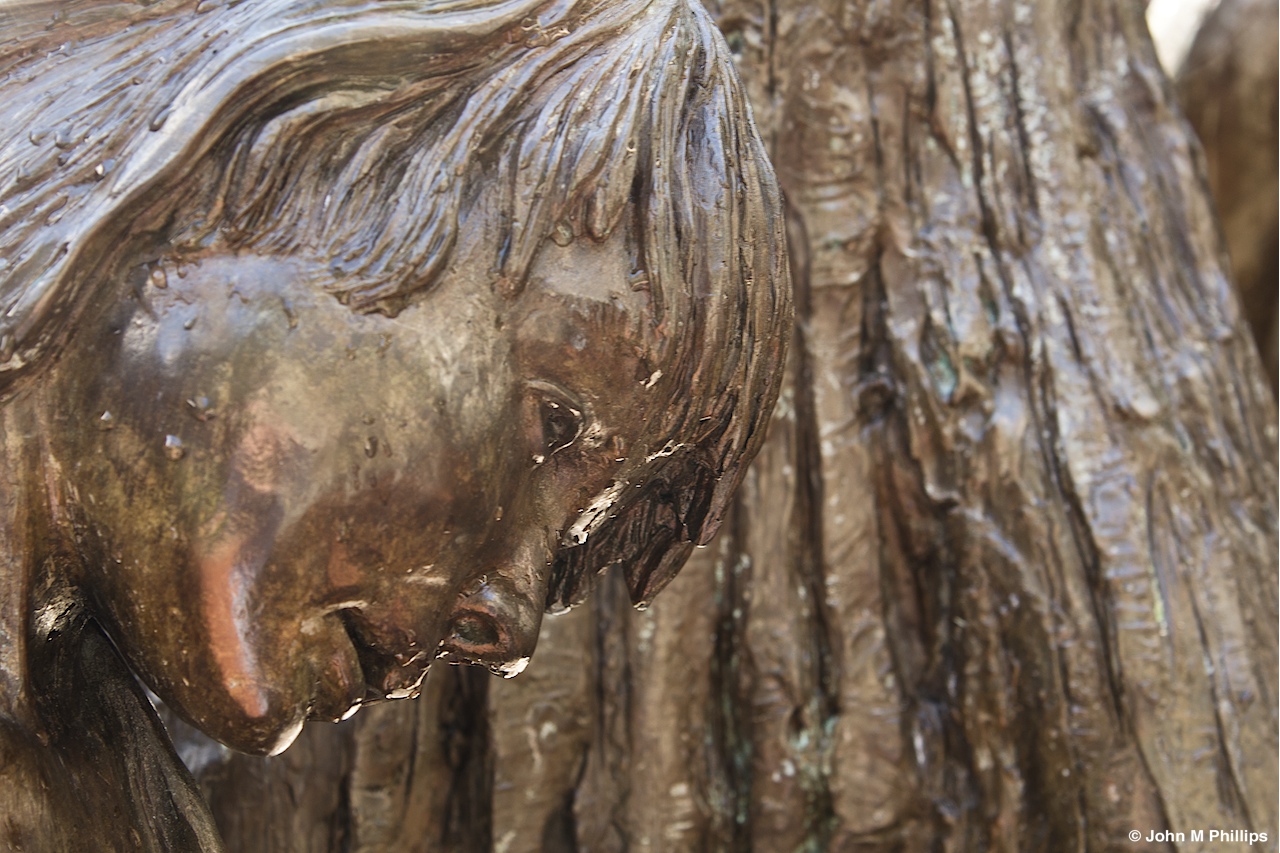
One of the more impressive sites was a group of sculptures depicting the Irish immigrant experience.  There were two sets of sculptures, one featuring a group of self-assured individuals . . .


and a second of a group clearly experiencing anguish and despair.


The young man's face is just too close to the woman's skirt to use depth of field to distinguish the two.


It might have been better to have taken this shot more from the front than from the side.

We did a brief tour of the Paul Revere house, a handsome structure that has been well maintained.


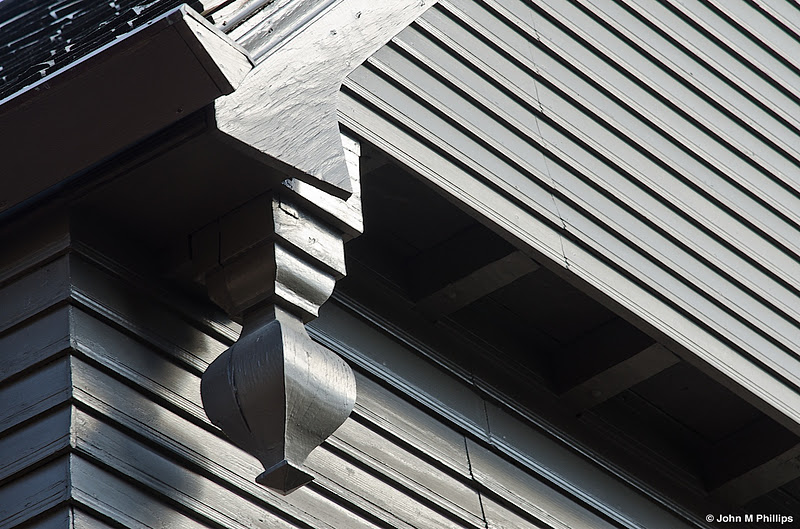
 I liked the architectural detail in the following shot.

Next stop was the iconic Paul Revere statue.  My problem was the play of sunlight and shadow across the statue.  This was not such a big problem for a side shot, but that was not really a very interesting view.


I wanted to capture the statue with the Old North Church in the background, even though as I took the shot I realized that this had to be a very common compostion.


In this first shot, the church steeple is clear, but I wanted it to be larger in the shot, as in the photo below.


Unfortunately, the white steeple is somewhat lost against the white clouds behind it.  And of course there  were those strong shadows running across the Revere statue.

I then turned around and realized that the lighting was much better if the statue was shot from behind, and the handsome St. Stephen's Church with its bell tower provided a very nice backdrop.


I felt the trees on either side helped to focus attention on the statue and church, and it helped that the bell was fully visible.  A minor regret was that it would have been nice if the statue had been a bit larger in the shot.  In addition, resolution of this shot is a bit soft.

The Benjamin Franklin statue is also a Boston icon.  I liked how I captured it in the following two shots.


This second shot, in particular, I felt very good about.  Instead of having the statue fill the image, I included a significant amount of the background building to provide context.  The trees on either side and in front provided depth.  It also helped that the trees were showing their fall colors.  The statue is also in exceptional focus.  Usually, I am trying to learn something from my mistakes.  The above photo was, I felt, a classic travel photo, and hopefully I learned something from its success.

The Freedom Trail ends at the Bunker Hill monument, which is fronted by another interesting statue, this time of Col. William Prescott, who was instrumental in the battle by that name.  By this time the sky had clouded over, and I decided to convert the shots I took of the statue to near-B&Ws.


The first shot, with part of the Bunker Hill obelisk in the background, is probably the best of the three, although I liked the positioning of the Colonel's left arm in the third shot.  The buildings in the background are a bit of a distraction.  Either they should have been excluded by taking the shot from a lower angle or  they should have been given a more prominent role.  I do feel that the conversion to B&W added to these shots.

Wednesday, October 26, 2011

DE CORDOVA SCULPTURE PARK AND MUSEUM

On Saturday afternoon, the 22nd, we drove to the deCordova Sculpture Park and Museum with Michelle and Tobias.  Tobias's dad, Marty, accompanied us on our visit.

This park, which is located southeast of Concord, Massachusetts, was spectacular.  The gardens are located on a beautiful piece of rolling terrain, and it helped that our visit was very close to the time of peak fall colors for the many trees on the grounds.  The gardens contain dozens of sculptures scattered throughout.  There was also a museum that we visited.  However, although some of the exhibits in the indoor museum were interesting, the real attraction was the sculpture gardens.


Following my brief experience of photographing sculptures in Utah, I was looking forward to trying my hand at some of those in the deCordova collection. As with most of my photographic adventures, I had mixed success.  


The sculptures ranged from the relatively realistic . . .


(I worked to get a dark background for the ball player)

to the surreal . . .


to the purely abstract.


One of the more interesting--but difficult to photograph--pieces was what I called the tree person.  Part of the difficulty was that the sculpture, which appeared to be made out of tree branches, was very tall, perhaps 25 feet in height, requiring that it be shot for the most part against the background sky, which was cloudy during our visit.  That had the effect of turning the sculpture more or less into a silhouette.


I took a tighter shot that was largely silhouetted and with very little color and decided I might as well convert it into a B&W.


I am wondering why I took the following shot from the side rather than from the front. 


Perhaps there was something behind the sculpture that I felt would be a distraction in the shot.

I very much liked the following "head" sculpture, which has a significant surreal quality to it.


I also took a tighter shot that, I think, emphasizes the haunting expression on the face.


The shadowless light nicely brought out the surface texture of this sculpture.  I did brighten up these shots a bit in post-processing.

I liked the following abstract bronze piece, and it was in a beautiful setting, but it is somewhat "lost" in the stand of trees behind it, even though it is taken with the lens aperture wide open.


I tried a close-up, but I am afraid it is just  too abstract to capture the overall effect of the piece.


There was some humor in the following sculpture made from pine cones.  Michelle remarked that some of the figures appeared to be male.


I took this shot at an aperture of f/7.1, but I might have done better to have set the aperture wide open to reduce the distraction of the trees in the background.  I also wished that I could have excluded the electrical conduit running down the large tree on the right.

One of the sculptures consisted of a couple of large heart-shaped pieces set among the trees on the grounds.  When we got closer, however, we found that the surfaces of the hearts were covered by various objects acting as bas reliefs . . .


including faces.


Here is a closer shot that includes Michelle and Tobias.  A face is visible in the heart behind them above and to the right.


I felt that the composition in the following shot worked very well.


I liked how I was able to frame the sculpture by the small tree behind it in full color and to have the sculpture appear to "wrap around" the bench.  I only wish the sculpture itself had been more interesting.

I also liked how I handled the following bronze of a female figure.


I chose to set the aperture at wide open (f/4.0) and to focus on the woman's outstretched hand, which is in very sharp focus.  Even though the woman's face is out of focus, I think the shot is more powerful than if I had tried to get the entire sculpture in focus.  I also liked that the hand covers just a little part of the woman's face.

As I stated, the grounds of the park were spectacular and the museum building was gorgeous, particularly as the ivy was also showing off its fall colors.

Tuesday, October 25, 2011

NEW ENGLAND AQUARIUM

On Saturday morning, the 22nd, we took the Boston subway (the MTA) to the New England Aquarium, situated in the wharf area east of the commercial district.  We were pretty impressed with the overall quality of the facility and the exhibits.  The aquarium essentially consists of a four-story tank surrounded by a spiral walkway and numerous smaller exhibits.

There are a number of difficulties in photographing aquatic animals.  First, the interior lighting is always going to be subdued, and the color of the lighting may change from exhibit to exhibit.  Additionally, the animals, particularly the fish, are constantly moving.  This poses problems, not just in terms of "freezing" the action but also in maintaining an interesting composition: the fish can swim out of the shot or turn away or other fish can swim in--all this in a low light situation.  Moreover, the animals are generally behind glass, which can cause reflections, and in water, which can create distortions and other "defects."  Fortunately, with digital I could take as many shots as I wanted in the hopes that a few of them would turn out.

The aquarium did house a large number of penguins.  The following shot (unfortunately) illustrates the problems with color balance.  I wasn't sure where the green shadows were coming from, but I couldn't find a way to get rid of them.


I liked the following shot better.  I was able to position the penguin's topknot(?) against a dark background to show it off better.


This looked like a mean dude (or dudette).

We were there during meal time and the aquarium feeder person seemed to know each of the penguins by name and was making sure that they all got fed properly.


The following shot illustrates some of the problems I had.  This was a stunning "dragon" seahorse that I must have taken 10-12 shots of.  They looked remarkably like leaf-covered branches, but they were constantly on the move and this was the best shot I could get.


Pretty disappointing.

And here is another example of a shot that didn't quite work.  I really liked the stripes on this fish but could not get the timing right to get the whole animal in the shot.


Not terrible, but it would have been nicer to get the complete tail in the image also.  I probably should have backed off and not tried to have the fish fill the frame.

I got luckier the the following shot.


And that raises another tactical error that I made.  Rather than getting shots of single specimens, it might have been better to have included a number of different specimens in the same shot.  However, that carries risks too, as the following shot may illustrate.


Is there some confusion about where one fish leaves off and another starts?  It is true that the center fish is in focus and the others are somewhat blurred out, but it would have been better if the other fish had been different species (and colors).  I do feel the following shot worked better.


This was taken at a shutter speed of 1/125 second, but it is still not quite sharp.  I did like the composition, though.

I really liked the following guy.  I only wish that I had been able to catch it in a bit more of a side view.


One wonders how something like this could evolve.  A real cutie.

One would think that shellfish would be easier, but these never seemed to stay still either.


And, yes, there are bright blue shellfish.


Anemones proved to be easier subjects, since they stay pretty much in one spot.  There was an amazing variety at the aquarium.


Surreal.

And the following starfish was stuck to the side of the tank and wasn't about to move.


I took this at an aperture of f/4 to limit the depth of field to the animal.  Actually, one of the aquarium workers informed me that they were no longer referred to as starfish because they are not actually fish.  Instead, they are called "sea stars."

The following frog had great coloration.  Unfortunately, the background was very distracting, and there was some sort of stick lying on top of part of it.


Keep in mind that these were probably the best of the shots I took.  For each of these, there were probably five or six shots that were unacceptable for one reason or another.