Sunday, June 5, 2022

REFLECTIONS ON THE BEAN

 One of the popular  attractions located in Chicago's Millennium Park is the Bean, formally known as Cloud Gate.  On my recent trip to Chicago to visit the Art Institute I also paid a visit to the Bean, which is just a block or so north of the Art Institute.  

The surface of the Bean is a highly polished stainless steel, which allows it to create a variety of distorted reflections of Chicago's skyline, as well as of the visitors.


The Bean is large enough for visitors to walk underneath and observe the sculpture's concave underside, known as the omphalos (Greek for navel).  I decided to take a photo of the omphalos from the western edge.  This is what I got.  Somehow, it reminds me of Dante's Inferno.


Once I got a chance to review the photo I realized that there were multiple images of me and my camera.  In spotting them I was helped by the fact that I was wearing an orange polo shirt.  By my count I found a total of 25 reflections of my image in the shot.  Perhaps my least distorted reflection is the one in the center close to the bottom of the image.

John

Friday, June 3, 2022

KOHLER ART PRESERVE

 Recently, friends tipped me off to a new art museum, the Art Preserve of the John Michael Kohler Arts Center.  The museum is located just outside of Sheboygan, only about 40 minutes north of my home.  It opened a year ago and is dedicated to the preservation of bodies of work of folk artists.  The museum is housed in a new, architecturally interesting building and is home to the art of about 25 artists.  It is terrific.

It is hard to define what is meant by folk art.  Generally, folk artists do not have formal training and their art is characterized by a certain primitiveness in which perspective or proportions may be distorted.  Of course, many of the Impressionists might be described as folk artists, say, for example, Van Gogh.  But no one would classify his art as "folk."  So perhaps it is that folk artists are not intent on commercial success.  Their art is more a function of a need to create than an interest in making money from the art.  Perhaps the most that can be said is that you know folk art when you see it.

First, the building, which was completed in June 2021. 


A little odd, but overall more attractive than this photo might indicate.  Oh, and the restrooms--after all this is a Kohler facility.


The museum houses the works of about 25 artists and is organized by artist rather than by subject matter, medium, or style.  Here is some of it.


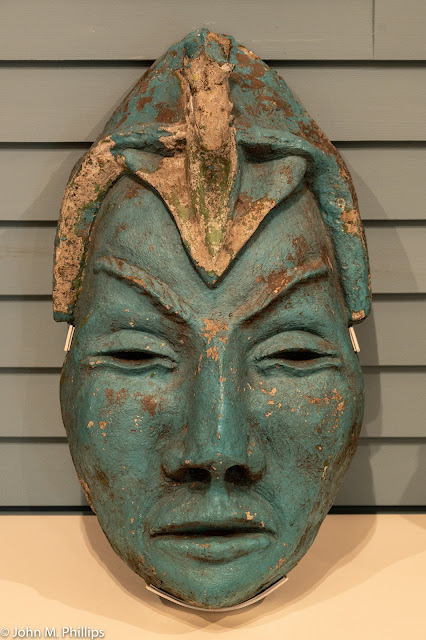
One of the artists featured is Mary Nohl, a Milwaukee artist who died in 2001.  She was eccentric, to say the least, and had placed many of her sculptures in her yard.  But she also produced wall art, which I found interesting.


I highly recommend that you pay this place a visit.  Besides, there is no admission fee, though they are happy to receive your donations.

John

Thursday, June 2, 2022

ART INSTITUTE OF CHICAGO

In May I took Amtrak down to Chicago with my camera to visit the Art Institute, a world-class art museum, especially in the area of Impressionism.  I was not disappointed.

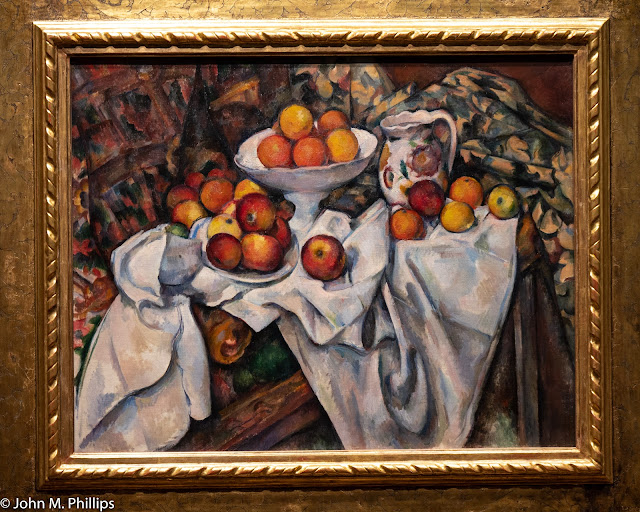
There are of course a number of recognizable masterpieces, including the following:


The museum also includes a fine collection of Van Goghs.


I particularly like photographing three-dimensional art because it offers more options and opportunities in the way of the use of light and context.


This last features a Rodin marble sculpture entitled "Eve After the Fall" that I positioned in front of what I think is a Monet.

The museum also features a goodly number of off-the-wall pieces including the following.


This was part of a much larger work, but what had struck me was the woman's hair, which I decided to feature.

The Art Institute is currently featuring a large (some 120 works) of Cezanne.  His art was much more diverse, both in terms of subject matter and medium, than I had realized.  Here are a couple, including a self-portrait:


Anyone with even a modicum of interest in art should put the Art Institute on their bucket list.

John

Monday, May 30, 2022

CIRCUS WORLD MUSEUM

Baraboo, Wisconsin had been the summer home for the Ringling Brothers Circus in the heyday of the traveling circus.  Generally, circuses, traveling or otherwise, are no longer a thing, but the romance of the circus survives in the form of the Circus World Museum in Baraboo.  The museum is generally open to visitors except in the winter months and features daily performance shows from late May through late August.  In early May I drove up to Baraboo with my camera to capture some of the circus paraphernalia.

The museum features all manner of memorabilia in various states of restoration, especially old posters and circus wagons from a time when the circus would roll into town, including a number of exotic animals and equipment.

One thing I realized, especially as portrayed in the posters, is that the circus took advantage of exaggeration and fantasy.


The museum has a number of buildings devoted to circus wagons and similar equipment.  When I was there individuals, perhaps volunteers, were working on the restoration of some of the wagons.


Many had already been beautifully restored.


Some wagon wheels especially were nicely restored.


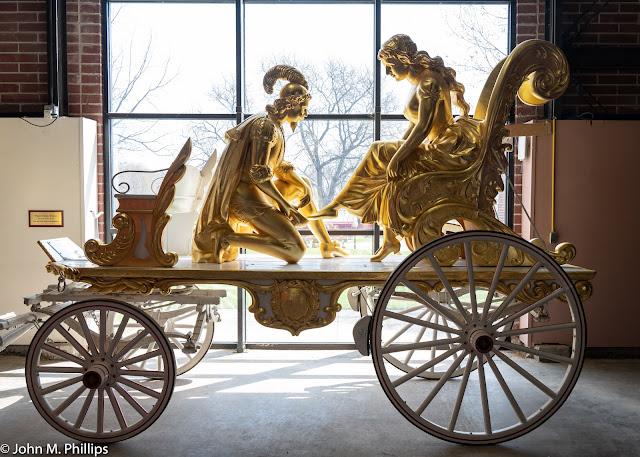
The Cinderella wagon below was especially nice, particularly in how it was placed in front of the light from a window. 


Here is a detail from that wagon.


The following detail shot illustrates the deterioration in some of the wagons before restoration.


Still, I liked it for its decrepitude.

John

WISCONSIN STATE CAPITOL

 After a long hiatus, I have decided to resume posting to my photography blog.  Part of my motivation has been the fact that I recently purchased a new camera.  I stayed with the Nikon family but have moved to mirrorless. I also acquired a new lens compatible with the new camera.  This one is a 24-200 mm zoom.  I plan to do some travel with my camera, and the 24-200 offers great versatility and convenience for that purpose.  But enough of the technical.

One of my first trips with my new equipment was to an old haunt, the Wisconsin State Capitol building in Madison.  This is "old ground" for me, as I have photographed the capitol numerous times in the past.  But that was part of my motivation, as I wanted to get comfortable with the new equipment and see how it handled this sort of subject matter.  In general, I was pleased with how it performed.

Here are some of the photos that I got.


This is the only exterior shot I am posting.  It was a cloudless day and there was plenty of light.  So to emphasize the building's lines, I converted the shot to a black and white and darkened the sky to make it a bit more dramatic.

The rest of the shots are of the beautiful and beautifully restored interior:


The central dome area features amazing mosaic murals.

I was able to use post processing software to rectify the support pillars that otherwise would have appeared to be on an angle.

Nice detail in the ceiling of a side corridor.


My standard procedure for making ceiling shots, where possible, is to place the camera on the floor pointed up. It works well as long as I am able to position the camera properly.  Sometimes this takes several shots.

Generally, I was quite happy with my new equipment.  One thing I noticed was that the technology has improved in terms of image stabilization.  Generally, in the past I have shot such venues using a tripod, where feasible.  Here I was able to dispense with the tripod and didn't think I lost much in the way of sharpness.

John