Monday, May 30, 2022

CIRCUS WORLD MUSEUM

Baraboo, Wisconsin had been the summer home for the Ringling Brothers Circus in the heyday of the traveling circus.  Generally, circuses, traveling or otherwise, are no longer a thing, but the romance of the circus survives in the form of the Circus World Museum in Baraboo.  The museum is generally open to visitors except in the winter months and features daily performance shows from late May through late August.  In early May I drove up to Baraboo with my camera to capture some of the circus paraphernalia.

The museum features all manner of memorabilia in various states of restoration, especially old posters and circus wagons from a time when the circus would roll into town, including a number of exotic animals and equipment.

One thing I realized, especially as portrayed in the posters, is that the circus took advantage of exaggeration and fantasy.


The museum has a number of buildings devoted to circus wagons and similar equipment.  When I was there individuals, perhaps volunteers, were working on the restoration of some of the wagons.


Many had already been beautifully restored.


Some wagon wheels especially were nicely restored.


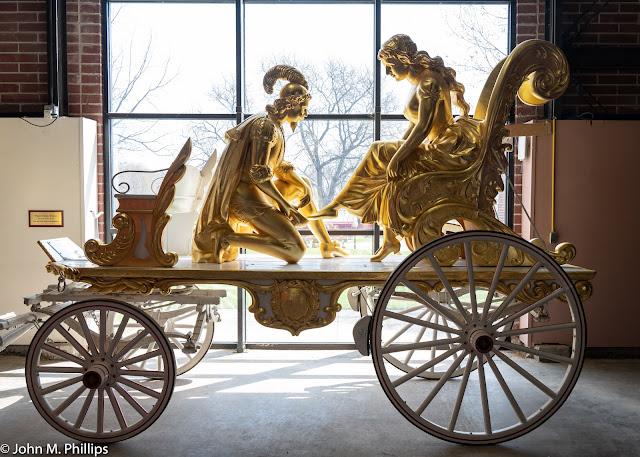
The Cinderella wagon below was especially nice, particularly in how it was placed in front of the light from a window. 


Here is a detail from that wagon.


The following detail shot illustrates the deterioration in some of the wagons before restoration.


Still, I liked it for its decrepitude.

John

WISCONSIN STATE CAPITOL

 After a long hiatus, I have decided to resume posting to my photography blog.  Part of my motivation has been the fact that I recently purchased a new camera.  I stayed with the Nikon family but have moved to mirrorless. I also acquired a new lens compatible with the new camera.  This one is a 24-200 mm zoom.  I plan to do some travel with my camera, and the 24-200 offers great versatility and convenience for that purpose.  But enough of the technical.

One of my first trips with my new equipment was to an old haunt, the Wisconsin State Capitol building in Madison.  This is "old ground" for me, as I have photographed the capitol numerous times in the past.  But that was part of my motivation, as I wanted to get comfortable with the new equipment and see how it handled this sort of subject matter.  In general, I was pleased with how it performed.

Here are some of the photos that I got.


This is the only exterior shot I am posting.  It was a cloudless day and there was plenty of light.  So to emphasize the building's lines, I converted the shot to a black and white and darkened the sky to make it a bit more dramatic.

The rest of the shots are of the beautiful and beautifully restored interior:


The central dome area features amazing mosaic murals.

I was able to use post processing software to rectify the support pillars that otherwise would have appeared to be on an angle.

Nice detail in the ceiling of a side corridor.


My standard procedure for making ceiling shots, where possible, is to place the camera on the floor pointed up. It works well as long as I am able to position the camera properly.  Sometimes this takes several shots.

Generally, I was quite happy with my new equipment.  One thing I noticed was that the technology has improved in terms of image stabilization.  Generally, in the past I have shot such venues using a tripod, where feasible.  Here I was able to dispense with the tripod and didn't think I lost much in the way of sharpness.

John

Saturday, August 8, 2020

CEDARBURG SCENES

 Cedarburg is a city of some 12,000 residents located in Ozaukee County, Wisconsin, about 20 miles north of Milwaukee and about 10 miles from my home.  It was founded in the 1840s as a mill town taking advantage of the water power available from the river that flows through the town.  When the mill industry ended decades ago, the town became a bedroom community located within a reasonable commuting distance from Milwaukee.  More recently, Cedarburg has developed into a tourist destination, attractive for its quaint and well preserved downtown shopping district.  I have not spent as much time as I should have exploring the town for its photo opportunities.  After all, it's only a 15-minute drive from my home.  Yesterday, I had an opportunity to spend a couple of hours in Cedarburg with my camera, and this is what I got.

Some of the "trappings" of the town are predictable.  They include a clock "tower" and posters of civic opportunities.
They also include nicely restored homes, many of a victorian style, that have been converted to various commercial uses. This first has been converted to a museum.  
The masonry of this house has many fine details, including the following.
I believe the following was converted into a B&B. Note the ceramic goose.
Cedarburg also features a number of churches, all of which appear to be well maintained.  Here is an entrance to one and a gorgeous stained glass of another.
The town has more than its share of boutiques and other shops, many featuring whimsy and kitsch.

(No, I do not.)


(Not sure what Uncle Sam [?] is supposed to be holding.
I think this was the entrance to a (newer) drinking establishment.

This being August, the town had a fair amount of flora on display.  This coneflower had a visitor, a Japanese beetle.


A hosta that had an unusual turquoise central element, the color of which I was not quite able to capture with my camera to the same extent that my eye witnessed.
And some coleus leaves that, yes, were as "electric" as what appears in the shot.
Finally, because I can't seem to help myself, here is a shot of a couple of barrels that I rendered in black & white.


My guess is that this is not exactly a "fan favorite," but I liked the image for its simplicity of composition.

John


Wednesday, June 24, 2020

FUCHIA "GILLIAN ALTHEA"

This year we got baskets of something called Fuchia "Gillian Althea" to hang at the entrance to our home. The plants feature abundant showy flowers, each two to three inches across. The blossoms have a complex system of petals, and I decided to use my macro lens to photograph just a portion of one of the blossoms to create a colorful abstract. 


What drew me to this particular flower was the fact that the backlighting of the blossom's interior created a sense of depth that appealed to me.  

My macro lens allows me to get very close (2-3 inches between the front of the lens and the subject).  As a result the image is not greatly cropped.  The drawback is that the optics reduces significantly the images depth of field.  I chose to focus on the leading edge of one of the petals, but even at relatively narrow aperture of f/22, the overall focus is a bit soft.  Because the image is semi-abstract to begin with, in post processing I softened it further by reducing contrast.

The next day I took another shot of the same blossom but in different lighting conditions.  Here is how that turned out.


In this shot I wanted to emphasize more the backlighting of the blossom's interior.  The light was warmer as well.  I also introduced a bit more overall contrast between lighter and darker elements.  All of which served to make for a more dramatic shot. This was taken at an extremely narrow aperture of f/64, my macro lens's limit.  Even so, there are elements of greater and lesser sharpness of focus.

John

© 2020 John M. Phillips

HUMMINGBIRDS

Each year we put up a hummingbird feeder outside our living room windows that overlook our deck.  And each year I am amazed that the neighborhood hummingbirds find the feeder to get sugar fixes.  And almost every year I tried to capture some of those visitors with my camera.  This year has been no exception.  

I am the first to admit that I lack the patience to do wildlife photography, even on those occasions when I don't need to leave my living room.  Not only are hummingbirds notoriously skittish around humans, but they are nearly always in motion.  And, let's face it, they are tiny.  Given those problems, even with a telephoto lens they are difficult to capture in photos.  As a result, I am never going to get award-winning shots of these beautiful birds.  But here are some images that I was able to capture.


These photos warrant a few comments.  First, all were taken from inside our home rather than from the deck.  The birds were simply too wary to stick around when I was outside on the deck.  The glass was relatively clean, but in the middle photo (of the bird sitting vertically) the bird's breast's reflection in the glass is apparent.  Second, the shots are cropped to an extent.  Even from a distance of 5 or 6 feet (when I am lucky) and with a 300mm lens, the birds appear small.  Third, the top of the feeder is a red faded over the years to a magenta.  That color serves to attract the birds, which is good, but, depending on the light, the red reflects off the birds' nearly white breasts, false-coloring them a pink.  I was able to eliminate most of the reflected color in post processing, but not all.

Hummingbirds are amazing and I am generally happy to have captured what I did.

John

© 2020 John M. Phillips


Wednesday, May 20, 2020

CALLA LILIES

In this time of coronavirus, a couple of weeks ago I acquired a new houseplant, this time some healthy looking calla lilies.  The plant included a number of fairly tightly packed blossoms, and I wasn't sure how to capture them in photographs.  I finally decided that my best bet would be to take photos of isolated blossoms against a suitable background.  I was able to isolate individual blossoms, and then it became a matter of depth of field.

The blossoms have a variegated green and yellow exterior and a primary yellow interior. My first effort was to isolate a single flower against a generic red background (a chair in our library).


I decided to crop the shot as a square, and I ramped up the color saturation.  I like the color combination, and I thought the increased saturation matched my aesthetic sensibility.  The issue was the depth of field.  This was shot at f/8 with my 90 mm macro lens, focused on the flower's top front edge.  Because the macro lens allows me to shoot from very close range--a matter of a few inches--the depth of field is quite shadow. Close inspection reveals that the back edge of the flower, just 2 or 3 inches further away, is quite out of focus.  There is something to be said for that, but I decided to shoot at a much smaller aperture to pull more of the flower into reasonable focus.

This next shot, which is of only a portion of the blossom, was shot at f/36.  This was an 8 second exposure.


The back edge of the flower is in better focus, but still not great.  I like the composition of this shot better than the first, even though (or perhaps because) it only includes a portion of the blossom.  Again, I increased the color saturation.

Here, for the record, is the same shot in black and white.


In this case I darkened the red and lightened the yellow.  I didn't think the black and white was quite as effective as the color version.

A few days later I spent some more time with the lilies, in this case against a textured white background (our bedspread).  First a shot of an entire flower.


This was shot at f/16, which produced fairly good depth of field for the flower.  The background was far enough away that its texture is sufficiently out of focus to eliminate it as a distraction.  But there is a different problem with this composition--the camera is positioned too low relative to the flower so that very little of the flower's yellow interior is visible.  So following is a second shot taken from a higher angle that does a better job of revealing the flower's yellow interior.


I then noticed that two of the plant's blossoms were positioned "back to back" and felt that that composition might provide some interesting near-symmetry.  My first shot was at a very narrow aperture of f/36 to bring both flowers into fairly good focus.  The focus was on the front edge of the flower on the right.


It is evident that the texture of the background is a significant element in the shot.  That's not all bad, but I thought I would take one more shot in which I separated the flowers further from the background to eliminate it as an element.


Here there is very little remaining background texture (except a faint line running diagonally in the upper right.  I like this shot, although it almost looks like the background has been removed artificially.  A matter of artistic preference.

John

Wednesday, April 29, 2020

WOODS IN FOG

The other morning we experienced some dense fog in our neighborhood, and I took advantage of it to get a few photos of the woods in a nearby park situated on a bluff overlooking Lake Michigan.

Fog can be a real friend to landscape photographers because it can provide added depth to their photos.  In some cases fog can also be useful in eliminating background distractions.  In this case I did some post processing to emphasize the fog and the depth that it creates.  I did crop down the shots to improve the shots' compositional balance.  I felt too that the photos worked better as black and whites.  I also softened up the shots' apparent focus to emphasize the fog.  This is most apparent in the shot cropped as a landscape.


 John