Monday, September 24, 2018

DOORS OPEN MILWAUKEE 2018: CHURCHES

At this year's Doors Open Milwaukee event, I visited three churches on Milwaukee's lower east side, First Unitarian Society of Milwaukee, Immanuel Presbyterian Church, and St. Paul Episcopal Church.  All three venues were constructed in the last quarter of the 19th century, all are within three blocks of each other, and all are classic architecturally.  But none are, in my view, particularly outstanding.  Here are some of the photos that I got.

First Unitarian Society.

The Unitarian church was the smallest and had the most rustic interior.


Probably the best feature of this church was the large stained glass window above the balcony at the rear of the nave.


Immanuel Presbyterian Church.


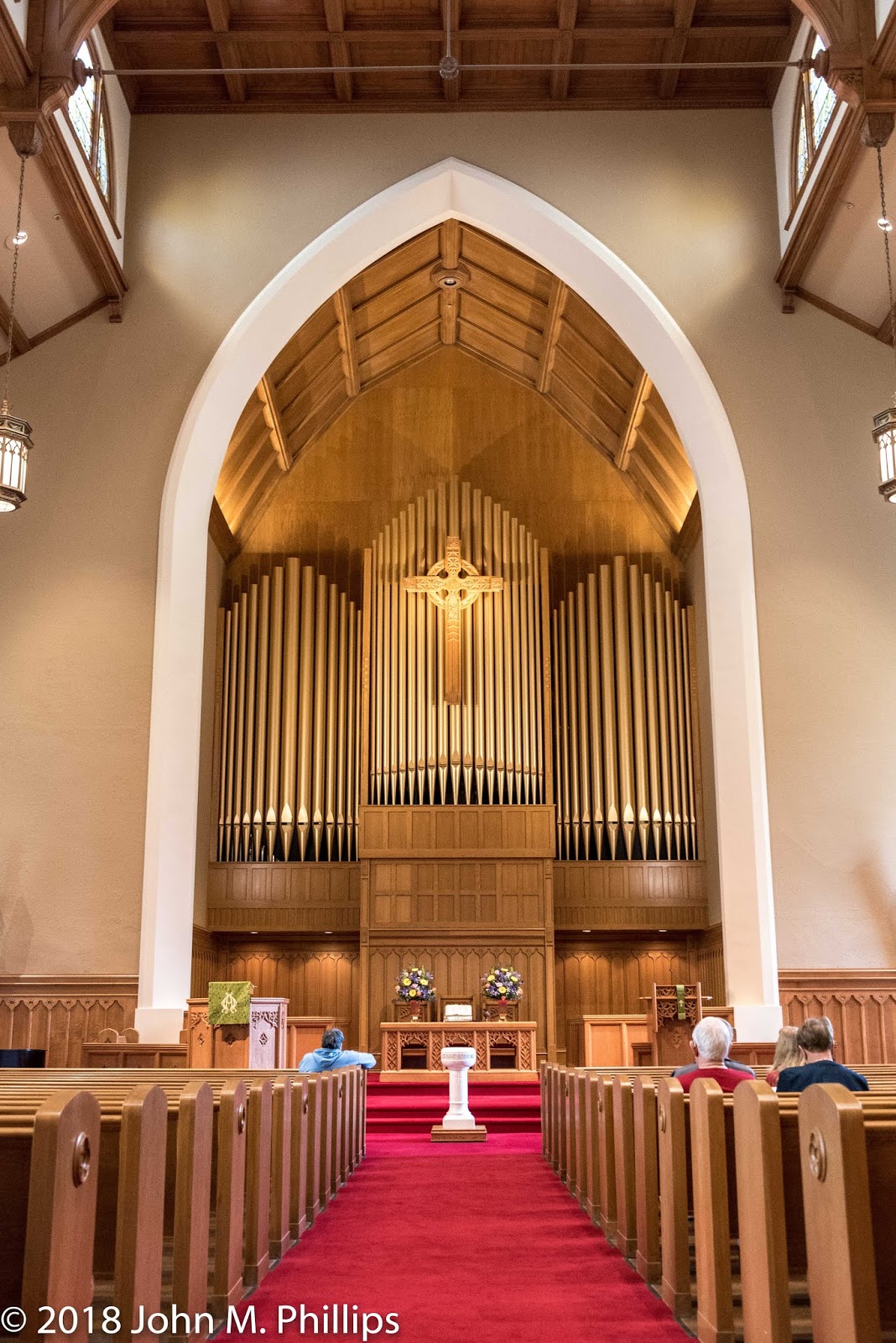
Interestingly, this church's organ was at the front of the church.  While I was taking pictures, I was fortunate to hear a recital by the church's organist, including an emotional rendition of J.S. Bach's Toccata and Fugue in D Minor (emotional for me at least).

The church also featured an excellent collection of stained glass windows.


This last igroup was at the landing of the stairs leading to the balcony.  A fine collection.

St. Paul's Episcopal Church.

I didn't really care for the dark brown stone used to face St. Paul's Episcopal Church.


The interior was more attractive, but, perhaps because I am a bit jaded, I thought it was OK but not great.


The church's best features, and the ones the docents properly touted, were the stained glass windows, including a number created by Tiffany.


Photographing stained glass windows can be tricky because of the vast difference in brightness between the window and the interior walls.  Either you have to overexpose the window or underexpose the walls.  In this last photo of the rose window, I exposed for the glass, and then darkened the "non-window" areas in post processing.  In fact, post processing helps a great deal in this process.

I visited a fourth church during the Doors Open Milwaukee, St. Stanislaus, on the city's south side.  It was by far the most interesting of the religious venues, and I chose to provide it with its own post, which follows this one.

John

NORTH POINT WATER TOWER

The North Point Water Tower is located on the bluff above Lake Michigan on Milwaukee's East Side.  This year it was included in the Doors Open Milwaukee event.  The tower was built in 1871 and remains been a Milwaukee landmark.  It of course no longer serves as a functioning water tower, but it is architecturally distinct and was placed on the National Register of Historic Places in 1973.

Here first is a view of the tower's exterior.


The tower is 175 feet tall.

Here is another shot of the tower looking up from just outside the entrance.


This shot is a bit silly, as it provides little in the way of perspective.

During the Doors Open event, the door to the tower was literally open and visitors could squeeze inside to view the tower's standpipe and spiral staircase.  The light inside the tower was surprisingly good, and I took the following shots primarily in an attempt to capture the staircase (which visitors were not allowed to climb for obvious reasons).


I tried these shots as black & whites but in the end decided that they were more interesting in color.

John

DOORS OPEN MKE: BLACK CAT ALLEY

Another venue in this year's Doors Open Milwaukee event was Black Cat Alley, an alley running between Prospect and Farwell Avenues on Milwaukee's East Side in the block behind the Oriental Theatre.  Two or three years ago the alley was designated as a graffiti zone and various artists have been invited to "decorate" the alley.  I have visited the alley a couple of times previously and paid another visit right after my disappointing visit to the Oriental Theatre as part of the Doors Open event.  Here, without further comment, are the graffitis that caught my eye and that I shot and kept.


I remain impressed by the abilities of graffiti artists, who often express themselves in anonymity and in spaces that very few of the public ever see.  So it is gratifying to see that this particular venue has been created to provide more public exposure for these artists.

John

ORIENTAL THEATRE

Each September Milwaukee holds a weekend event, known as Doors Open Milwaukee, inviting interested persons to visit various venues throughout the metro area, many of which are not generally open to the public or not open just for curious visitors.  For the past several years, whenever I have been in town during the event I have visited a number of the venues with my camera.

This year one of the venues was the Oriental Theatre.  Built in the 1920s, the venue was opened as a "movie palace" with East Indian decor.  Like most older movie houses, it was built to accommodate perhaps 1500 patrons, including both main floor and a balcony.  More recently, in an effort to keep up with modern multiplex cinema venues, the theater was divided into three auditoriums so that multiple movies could be shown at the same time.

A couple of years ago, I had talked with personnel at the theater about photographing the facility's interior and had been told that that was not feasible.  So I was excited to learn that the Oriental was going to be part of this fall's Doors Open event.  The description for the venue included the fact that the theater's lights would be on so that visitors could see what the decor looked like.  That is not what happened.

The lobby area was lit as it normally is during showtimes, which is to say a typical interior space--dim.  I did get a few shots of the East Indian motif, including elephants and lions.


Not terrible; not great.

The main auditorium was another story.  The lighting was, as far as I could tell, at the same level as during a movie, in other words, extremely dark.


I took this shot from the balcony.  I had to shoot it at a high ISO and a long exposure, specifically, three seconds.  Hand held.  To give an idea, I did not know that the color of the area above the stage was in the red end of the spectrum until I reviewed the actual shot.

John

Friday, August 31, 2018

MUSHROOMS

We have had a ton of rain during the second half of August, and it appears that that has inspired a new crop of mushrooms.  Today as I started on my morning walk I noticed a couple of mushrooms growing in a mulched area in our subdivision.  Mushrooms are ephemeral organisms and I decided I had better get a few photos before things changed over the course of the morning.

I took all of the shots with my Tamron 90 mm macro lens, and even though it was sunny and quite bright, I was using my tripod on nearly all of the shots.

There were actually two primary mushrooms.  The first was 4-5 inches across and was accompanied by a "juvenile" companion.


Here is a closeup of just the larger mushroom.


This was at about 6:30 a.m., and the mushrooms must have emerged during the night.  The larger specimen was draped in some sort of orange liquid that I chose not to touch.  This was actually a pretty good shot technically, at an aperture of f/18 with an exposure of 1/25 second.

Then it was on to the larger specimen.  I think these were all the same species, but this one was quite large, at least 8 inches across.  Here, first, was a set shot of the whole mushroom.  Classic.


What caught my eye were the gills on the mushroom's underside, and I spent most of my "session" attempting to capture them.  This was not going to be easy, for a number of reasons.  First, the mushroom's underside was only 4-5 inches off the ground, and it was impossible to capture the gills in full without physically taking the mushroom apart, which I did not want to do.  What that meant was that I basically had to lie on my stomach and in a public place . . . in my own subdivision.  Second, if I wanted to get a closeup, depth of field was going to be an issue.  Optically, the closer my lens was to the object, the shallower the depth of field.  I didn't mind that part of the image would be out of focus, but I would need to play around with apertures and focal points to see if I could get a shot that I liked.

Here was an early effort that I shot at a wide-open aperture of f/4.5.  For this shot the front of my lens was probably only about 3 inches from the leading edge of the mushroom.


This shot did not work.  The gills were in good focus, as was a portion of the top of the mushroom that happened to be at the same distance from the lens as the gills.  I was OK with the fact that the bulk of the top of the mushroom was badly out of focus, but what I did not like was the fact that the very perimeter was out of focus.  I am much more comfortable when a background is out of focus than when the foreground is.

The following shot was much better, with a super-narrow aperture of f/51.  Everything except the mushroom's"peak" and stem are in good focus.  However, the background, though not in good focus, is quite distracting.  Not really what I wanted.


So for the rest of the shots I got close enough with my macro lens to largely eliminate any background.  All of these were shot at a very narrow f/51.  The first was OK, but it didn't tell much of a story.


I thought perhaps the best shots were the following, which gave a hint, at least, of the curvature of the mushroom's underside.


John

Thursday, August 23, 2018

MILWAUKEE HARBOR CRUISE

A couple of local rivers empty into Lake Michigan to form Milwaukee's harbor and a couple of companies offer harbor sightseeing cruises.  When my son and his family were here earlier this month we took one of the cruises.  Here are some of the photos that I got during our 1-1/2 hour voyage.  The cruise began on the Milwaukee River in downtown Milwaukee, passed out into the lake past the breakwater, moved north a couple of miles, and then returned inside the breakwater and back up the the river to the downtown area.

Here first is a photo of our cruise ship, the Vista King.


And, by the way, here is a photo of what turns out to be a "houseboat," a decrepit boat that has been an individual's residence for many years, the Solomon Juneau.  At least one could say it has "character."


The cruise passes a number of buildings in Milwaukee's industrial area.  I like older architecture and enjoyed photographing some of the buildings, but others might find the buildings to be forgettable.


The cruise also passes a number of bridges, including the following, known as a bascule design.


The largest bridge we passed is the Hoan Bridge, which spans the river as it empties into the lake.


Here is a shot of a portion of the downtown that includes the northern approach to the bridge.


At the southern end of the breakwater is a U.S. Coast Guard lighthouse that sits out about 3/4 mile east of the shore.


On the portion of the cruise heading north, I was able to get a shot of Milwaukee's skyline that I thought worked best as a black and white.


At the north end of the harbor is a spit of land extending out into the lake that includes a line of trees that I thought also worked well as a black and white.


On our return inside the breakwater, a thunderstorm was approaching, and I took a few shots of the Milwaukee Art Museum and Discovery World museum with the storm clouds as a backdrop.


Finally, for what it is worth, I also took a couple of photos of a tableau of rope on our cruise ship.


John