Thursday, August 23, 2018

MILWAUKEE COUNTY ZOO

Milwaukee has a highly regarded zoo, and when my son and his family came for a visit earlier this month, we made the zoo one of our stops.

One of the first areas we visited was the primate house.  In the past I have had good luck photographing the mandrills.  This time I caught a few shots of the gorillas and orangutans.

This gorilla shot was not good, but they seemed uninterested in us humans, generally turning their backs.


I had better luck with the orangutans.  First was a juvenile hiding behind the crotch of a tree.


The best shot, though, was of an adult orangutan.  Really quite a nice shot.


I got a number of decent shots of large mammals, including a camel, a giraffe, an African elephant, and something called a red river hog.


My favorite of these was the  elephant leg, but the red river hog was pretty weird.

We also visited the reptile house.  The iguana would have made a nice shot except for the fact that the animal was in the process of molting.


I had better luck with the following green lizard.


Reptiles generally make good photo subjects because they tend to be motionless much of the time.

The Milwaukee zoo really is a fine facility.  It seems pricey, but if you have young children and live in the area, the annual memberships are a fairly good value.

John

Saturday, August 18, 2018

SANDHILL CRANES

Our subdivision includes both woods and ponds.  As a result, we are blessed with a variety of birds.  Of course, the geese are not welcome, and we have found ways to discourage them.  But we also have our share of other birds, including wild turkeys and cranes.  This morning as I was coming home from my daily walk I almost ran into a couple of sandhill cranes that were loitering in the doorway of an office building a couple of blocks from our house.  The cranes didn't seem wary of my presence, which seemed unusual to me.  In any event, as soon as I got home I grabbed my camera and returned to catch some shots of the cranes.

The cranes were still there and seemed to be in no hurry to leave.  I began taking pictures from about 30 feet away and worked my way closer, ending within 8-10 feet of the birds.  I would up taking perhaps 50 shots and kept 5 of them.

The first is of one of the cranes that standing one one leg.


One of the drawbacks to this set of shots is that the background was an office building.  I was using my 70-300 mm lens to get as much reach as possible.  I opened up the aperture as far as I could to isolate the birds from the background.  That works better the closer the camera is to the subjects.  In this first shot the background remains something of a distraction.  As I moved closer, I was able to reduce that problem.

This second shot is not great, as the bird was looking away, but I did like how I caught the curve of the crane's neck.


The next is a classic profile shot from the neck up.


I was pleased with the overall resolution of this shot, which I shot at an ISO of 400 and an aperture of f/5.6.  The shutter speed was a quick 1/1000 second. The lens was all the way to a 300 mm focal length.

As I said, there were actually two cranes, which are sort of included in the following two shots.  I was focused on the nearer crane, so that the other bird was blurred out.  I thought that approach was better than trying to boost the depth of field at the cost of greater background clutter.


The composition in the latter shot is the better of the two.  I was happy to get shots with the birds in the same posture, though contrasting postures would have been nice also.

John

Wednesday, August 15, 2018

WISCONSIN STATE FAIR

It had been literally decades since my wife and I had been to Wisconsin's State Fair, held in one of Milwaukee's suburbs.  But when the visit by my son and family earlier this month coincided with the annual run of the fair, we decided to go.  I brought my camera and got the following:

Our first stop was to get the fair's iconic creampuffs.  Here is a shot of my son, Jeff, and grandson, Max, enjoying one.  For some reason Max was only interested in the powdered sugar atop the confection.


We also visited the giant ferris wheel, touted as the world's largest traveling ferris wheel.   The signs said the wheel stood 150 high.  I'm not sure either of those claims was true, but here are the shots I took.


Along the way we took in a couple of pig races.  Contrary to my assumption, the races were free, which was about what they were worth.


The best part of the races, as one might suspect was the talent of the announcer, whose narrative and jokes were polished and occasionally funny.

The next venue was the giant slide.  Jeff and I took the boys down the first time, and later Jeff and Bei took them down a second time.


I made a technical error in taking the above shot.  I used a narrow lens aperture, which necessitated a slower shutter speed, resulting in a blurring of Jeff, Bei, Stanley, and Max.

Every fair has vendors selling whatever the patrons will buy.  The following wares caught my eye.


Every fair has animals.  Here are a few.


"Ugh.  You're choking me."

Here are Jeff, Max, and Stanley in the scoop of one of the farm tractors on display.


Finally, I enjoyed the following trash receptacle.


John

DISCOVERY WORLD

My son and his family visited earlier this month, and during their stay we visited Discovery World, an interactive museum located in downtown Milwaukee.  The venue, which is housed in its own building on the shores of Lake Michigan, includes a curious mixture of exhibits and is pricy but is generally well done.  Many of its exhibits are a bit mature for my 3- and 5-year-old grandsons, but they took advantage of what they could absorb.

The museum includes a number of sections.  These include a small ship housed inside the building that can be explored, a nice diverse aquarium,  a crafts area, a series of hands-on exhibits that illustrate basic principles of physics and technology, such as momentum, pulleys and levers, and an area devoted to guitars (seemed incongruous, but there it was).  In addition, the museum serves as the home anchor for a reconstructed tall ship, the Denis Sullivan, which unfortunately was cruising out in the lake at the time of our visit.  

Here are some of the photos that I got.

First, a couple of shots of the building's exterior.


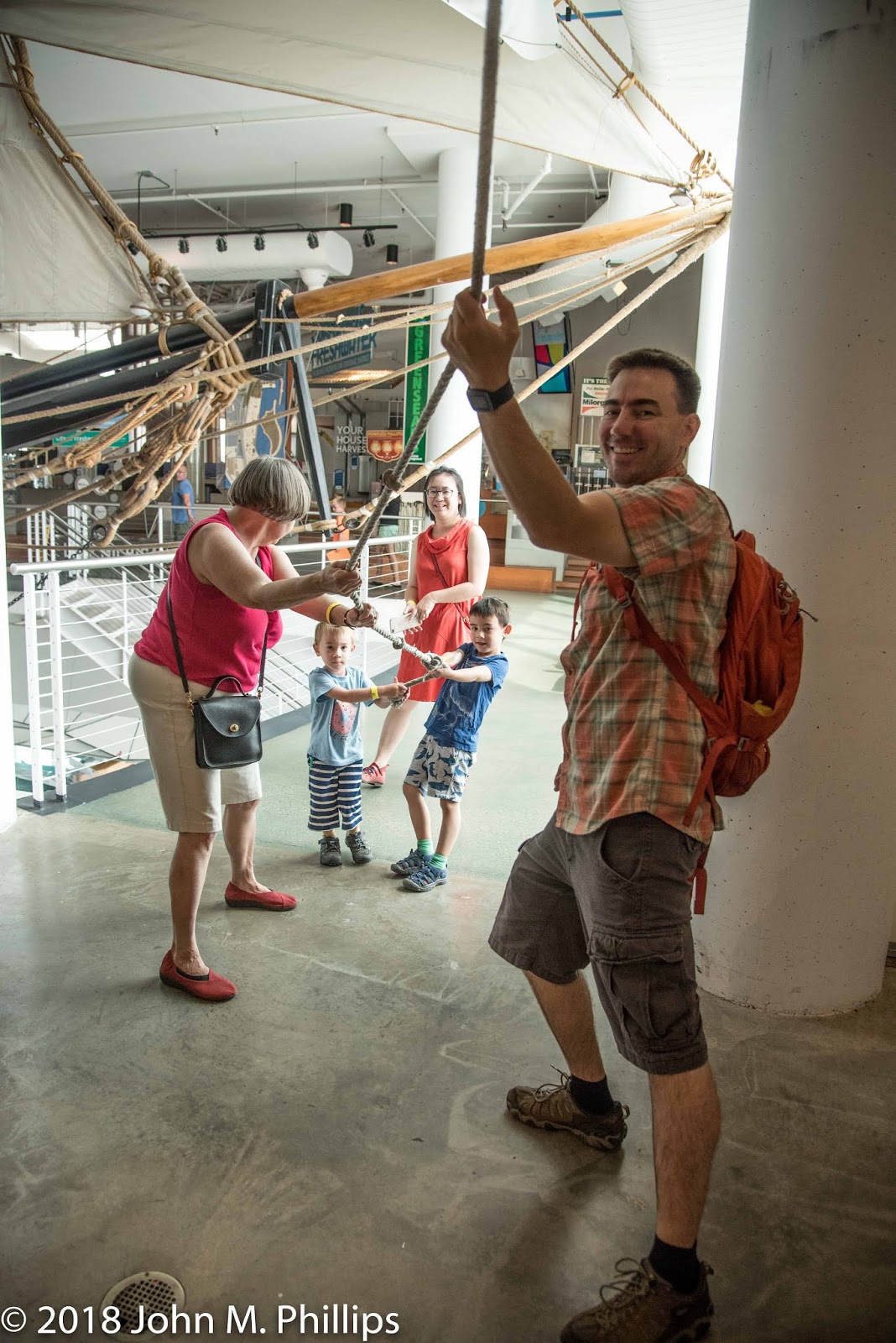
A shot of my family hoisting me by taking advantage of a pulley system.


Jellyfish in the fine aquarium, which included a section that allows the visitor to walk through a glass archway with fish swimming both on the sides and above.


The aquarium area also included a number of reptiles, including the following snake.


I'm not sure of the function of the following stylized sculpture, but it made an interesting subject to photograph.


Finally, a shot in the guitar section.  


In fairness, Les Paul, who was a long-term resident in the Milwaukee area before his death a few years ago, was a major innovator in guitar technology and construction, and the exhibit pays homage to his contributions.

The museum has a pleasant exterior, including an amphitheater that offered some interesting black & white opportunities.


John

Tuesday, July 31, 2018

ROADSIDE WEEDS

Several days ago, on one of my morning walks, I noticed some distinctive weeds along one of the quiet side roads on my route.  The sun was high enough to be backlighting the weeds, revealing their elaborate veining.  By the time I had finished my walk, the sun had gotten higher in the sky and, more importantly, a breeze had sprung up, making it problematic to try to photograph the weeds that morning.  However, a couple of days later, when the wind was again calm, I decided to revisit the weeds, before my morning walk, armed with my camera and macro lens.

This was a residential neighborhood, and while the weeds were quite close to the street, to shoot the them I technically had to stand in someone's yard.  Fortunately, it was early and no one came to ask what I was doing.  Not having the steadiest of hands, I took most, though not all, of the shots with the camera mounted on my tripod.

The morning was clear, but the sun had not yet risen above a nearby line of trees when I first got to the site.   The sun was not yet backlighting the weeds, and, as a consequence, the light for the early shots was what I would characterize as "flat."  Here is one of those early shots.


1/800 sec, f/6.3, ISO 1000

I worked on this shot for quite a while in post processing.  First, of course, I converted it to black & white and cropped the shot quite a lot.  Then I ramped up the contrast, which served to darken the background.  However, I thought this also made the veining look artificial.  The reason I held on to this shot was because of the strand of spiderweb that I discovered in post processing.  This was also early enough that there were still some dewdrops on the perimeters and in the weed's "crotch."

Once the sun made it above the line of trees, the backlighting of the weeds made a big difference in the overall dynamics of the images.  Here's a somewhat similar shot in terms of composition but that conveys a richer depth, both in the weed itself and in the background.


1/800 sec, f/8.0, ISO 800

Here is another shot in color that also illustrates the value of the having the right light.


1/800 sec, f/8.0, ISO 800

All of the shots were made with my 90 mm Tamron macro lens, which allows me to shoot at a very close range of just a few inches.  As a result, in both of the above shots, the backgrounds are pretty much totally blurred out, despite the aperture being in the midrange of f/6.3 or f/8.0.  That can make it easy to eliminate background distractions.  However, it also means that, because depth of field is so narrow, any significant changes in the distance between the object (the weed) and the camera will be reflected in loss of focus in parts of the subject.  That is why I was looking for weeds that presented a flat surface and tried to position my camera so that it was as close as possible to being perpendicular to the plane of the weed's surface.

Finally, following are a couple of shots taken at a somewhat longer range so as to feature more of the weed.


1/640 sec, f/3.2, ISO 100


1/640 sec, f/3.2, ISO 100

Because the distance between the camera and the subject was greater in these shots, I opened up the aperture to f/3.2 to eliminate any background distractions.  Note that portions of the subject are out of focus because they are not all in the same plane.  This is perhaps most noticeable in the black and white shot where parts of the plant on the left side of the image are curved away.  Even so, I thought the black and white in particular shows good three-dimentionality and is my favorite of the bunch.

One more comment: I probably spent nearly an hour taking close to 100 photos of these weeds.  Because of the morning dew, my shoes and my jeans from the knees down were soaked.  I kept fewer than a dozen photos from this shoot.  Still, I thought the session was a success.

Saturday, June 23, 2018

PIONEER VILLAGE SCENES

Pioneer Village is located northwest of Saukville, Wisconsin, about 30 miles north of Milwaukee.  It consists of perhaps 25 buildings from the late 19th century and very early 20th century that were disassembled and then reassembled on the grounds of Pioneer Village.  The grounds are compact, so it is easy to tour the site in a relatively short period of time.  I have visited the venue with my camera a few times in the past.  This was my first visit this year.  Here is some of what I came away with.

The first is a black & white of a wheelchair ramp along the side of one of the buildings.  Not great, but I liked the shot for the composition, including the shadows the railing was casting on the ramp.


Several of the reconstructed buildings were built of dovetailed timbers that had never been painted and show great weathering of the wood, as in the following shots.


I especially liked the composition of this second shot that featured both a window and the dovetailed timbers.

Associated with this same building was a wooden silo, which was interesting on the inside, looking up.


The following black & white of a corn crib was somewhat cliched, but I liked it anyway.


Many of the buildings, while structurally sound, exhibit deferred maintenance, including the following screen door, which I thought presented an interesting composition.


Here is another screen door shot that I have taken on previous visits but I still think is worthy for the unusual design of the corner panel that holds the screen in place.  I intentionally set the lens for a shallow depth of field and focused on the screen, leaving the scene behind out of focus.


All of the buildings at the venue are filled with artifacts from the same time period as the buildings.  Here are a couple of those.


The second shot isn't great, but the light coming through a side window was doing a great job of illuminating the wheel.

One of the featured buildings is a reconstructed train station, including a caboose.  The caboose apparently was part of the Milwaukee Road system, at one time a prominent Midwestern railway line, now defunct.


Speaking of signs, I enjoyed the following, even though in fine print it appears to have been created relatively recently.


The caboose is in fairly good shape, but it does include some paint failure, as in the following shot.


Ugly but interesting.

My favorite of this series, though, is a relatively simple shot of lace curtains in a window of one of the reconstructed homes on site.  There was an ample amount of light coming through the window, which made catching all of the lace in good focus a lot easier.


John