Wednesday, June 25, 2014

CROWN PRINCESS

Our Alaska vacation included seven nights on a cruise ship, the Crown Princess, and I thought I should include one post that features the ship itself, if only for documentary purposes.

Here, first, are a couple of shots of the exterior.


The ship is huge by any standard, with a crew of 1,200 and a guest passenger capacity of over 3,000.  It includes any number of restaurants, bars, entertainment venues, and viewing decks, many of which we didn't visit.  The ship spends much of the year in more tropical climates, including the Carribean, which explains the large pool and sunning sections that were sparingly used in the Alaskan weather that was always cool and often rainy.


A major interior feature of the ship was the Atrium, a three-story section at midship that I think can best be described as opulent.  Here are a few shots of that area.


And, yes, the ship included a white grand piano and central ceiling fixture that I also tried to capture in photos.


This was our first cruise vacation in a traditional sense.  Perhaps if we did another we would more fully embrace the cruise "life."  I'm not sure, though, that that is going to happen.

John

TRAIN TO WHITTIER, ALASKA

On our Alaska tour/cruise we were transported by train from Talkeetna to Whittier, where we were to board our ship.  The seven hour rail trip was scenic but very long and made longer by a very annoying "guide" who told numerous stories in a self-important, cloying manner and who kept pestering us to buy some sort of book concerning the ride.  We turned her down at least three times.

Photography on the trip was challenging for a couple of reasons.  First, much of the time the train was moving pretty fast--60 miles an hour--and that made it difficult to incorporate any foreground elements because of motion blur.  If I had attempted to pan the camera to compensate for the movement, that would have caused the background to show motion blur.  As a result, I had to avoid including anything in the near foreground and just accept the fact that the photos were going to lack crispness.  A second factor that reduced the quality of the images was that I had to shoot everything through the glass of the train windows.  To add to that problem, I noticed that there was some sort of interaction between my camera's polarizing filter and the train's window glass that was creating a rainbow effect in some of the shots.  Even so, I managed to get a few shots that worked OK, despite the overcast and occasional rain.


Some of the shots seemed to work better as black & whites.


This shot below was my favorite, primarily for the meandering stream running through the tidal mudflats in the foreground.


The last shot I got on this leg of our trip was of our cruise ship, the Crown Princess, docked at Whittier.


John

TALKEETNA, ALASKA

Talkeetna, Alaska was a way station on our journey from Denali to Alaska's southern coast, where we were to board our cruise ship.  The community has a population of about 850 permanent residents, and, although the town is technically unincorporated, it does have an honorary mayor, Stubbs, a local cat who as a write-in candidate in a local election is reputed to have beaten out its human competitors.  What Talkeetna lacks in population it makes up for in local color.  Here are a few of the shots that I got during our visit there.


Fairview Inn has something of a history.  It seems that President Warren Harding stayed in the inn on a visit to the area in 1923.  He was accompanied by his wife, who booked a separate room, and his mistress, who did not.  Harding also dined at the inn during his visit.  That's important because he contracted food poisoning from which he died before getting back to Washington, D.C.  It appears that the inn never fully recovered from the blow; it's something of a dilapidated mess.

While in Talkeetna, we took a river float trip.  Lots of fun.


There were only 12 of us on the excursion in two rafts.


Because we were approaching the summer solstice, the area was enjoying nearly 20 hours of daylight, which led to lush summer vegetation.


The float trip did not include a great deal of wildlife, although we saw plenty of evidence of beaver activity.  We did spot one bald eagle situated in a dead tree on the riverbank.


And that posed a bit of a problem.  Eager to give us a good look at the eagle, our guide/oarswoman realized--too late--that we needed to make a sharp turn in the river just there to avoid a large snag in the river, similar to the following.


We hit the snag, which sent Geri out of the raft and into the river, although her feet remained in the raft and we were able, after perhaps 20 seconds, to haul her back in.  Unfortunately, I was busy trying to avoid falling in the river myself and then trying to pull Geri back in and failed to get any shots of the accident for posterity.

But I did get one last shot of the Denali National Park mountains.


John

DENALI NATIONAL PARK

My wife and I recently returned from an Alaska land tour and cruise.  We had a great time.  I, of course, had my camera and took plenty of photos, perhaps 1,200 in all, retaining about 250 of them.  I thought I would show some of those images on this blog over a series of posts.

Our trip began in Fairbanks, and we spent the better part of a day there on a sternwheeler riverboat cruise on the Chena River that runs through the town.  But, frankly, the cruise, while designed to showcase a number of aspects of Alaskan life, including dog sledding, native American culture, and even reindeer, seemed contrived and didn't generate enough photos that I thought deserved sharing.  The next major stop was at Denali National Park, where we participated in a nature hike and a bus tour of the park.

The nature hike started at 5 pm and lasted until 8 pm, not a problem as the mid-June sun was not setting until nearly midnight.  Here are a couple of panoramic shots of the overall scene from the trail.


Among the reasons we chose to do this trip in June rather than later in the summer was the fact that the mountains would still be sporting a portion at least of their winter "coat" of snow, and we were not disappointed in that regard.

The following morning we took a narrated bus tour of Denali National Park, which was nicely done.


Although the scenery was about what I was expecting for such an expansive wilderness . . .


. . . we were primarily looking for two things, wildlife and Mt. McKinley (aka Denali).  Ultimately, we saw a bit of both.  Although some of our companions spotted moose, the only local wildlife close enough for me to get shots of was a small herd of caribou.


This group was perhaps 300 yards from our bus, and even with my 300 mm telephoto I had to crop this image quite a bit to make it presentable.  I thought the stream shown beyond the animals acted as a nice backdrop for the overall scene.  Even so, it would have been nice to have something like an 800 mm lens to do justice to the opportunity.

But my biggest goal for this leg of the journey was to capture a look at Mt. McKinley.  In the end, my patience was rewarded, at least in part with this look.


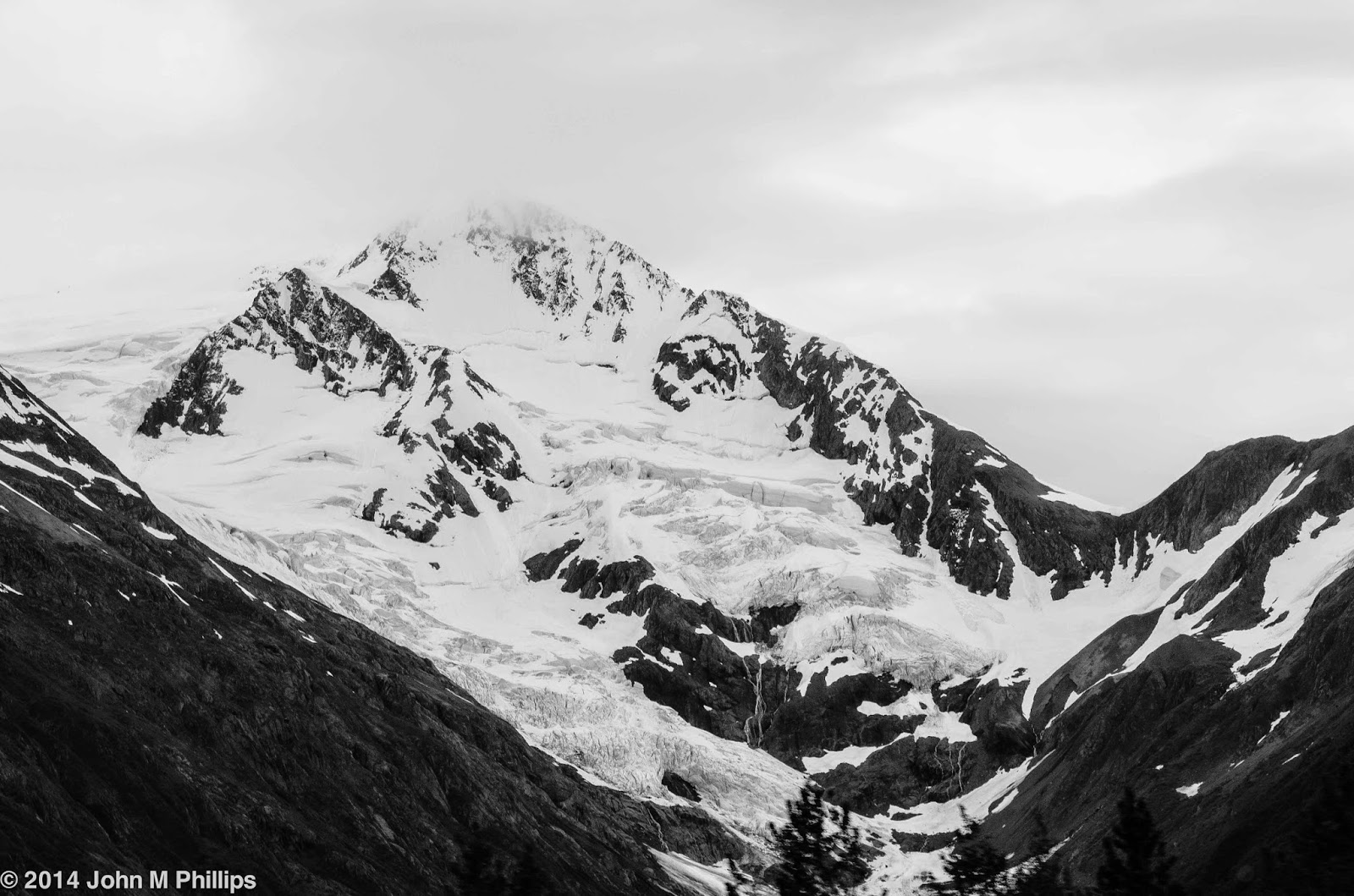
In case it's not obvious, McKinley is the white area between the darker mountains in the lower foreground and the cumulus clouds above.  The very summit is, unfortunately, still just hidden behind the clouds.  I will have to admit that I had to spend a fair amount of time in post processing to tease out some of the mountain's detail.  Even so, I was happy to have caught this view, one of my "bucket list" items for the trip.  To provide some perspective, the purplish foreground mountains running through the middle of the image are 6-8 miles away and are perhaps 5-6,000 feet high.  McKinley, at 20,320 feet in elevation, is some 40 miles distant.

John

Friday, June 6, 2014

ST. JOSEPH CHAPEL

A fellow tutor at the literacy center where I volunteer suggested that I arrange to do some photography at St. Joseph Chapel.  I followed up on that suggestion and, in my view, found the chapel to be an architectural masterpiece.  It was actually built in 1917 as part of the campus of the School Sisters of St. Francis (SSSF), located on Milwaukee's south side.

I had envisioned the chapel (perhaps like it sounds) to be small, but it is huge, really.  The order of SSSF included about 500 nuns at the time the chapel was built, and so it was designed to accommodate a congregation of 500.  The main chapel (there is a smaller chapel behind the main one known as the Chapel of Perpetual Adoration) is some 200 feet long by 90 feet wide and includes original mosaics, wood-carved stations of the cross, copious statuary, and some 115 stained glass windows, including several on the chapel's ceiling.   Moreover, the chapel has been maintained in superb condition.

As with most building interiors, the chapel's lighting presents substantial challenges from the point of view of photography.  I was helped substantially by the willingness of the personnel at SSSF to have the lights turned on.  And we were blessed with a bright and sunny day.  Even so, the interior walls and ornamentation were significantly darker than the stained glass windows.  And, as anyone who has photographed interiors would know, there is simply a great deal less interior light than is available outdoors.  In addition, white balance (light color) is also a challenge, as the sunlight streaming through the windows is generally much cooler than the incandescent light generated by the interior lighting.  I wound up relying on a "tungsten" setting for white balance, which I believe is close to what my eyes registered, but I could be off a bit.

Here is an initial, standard shot from the back of the chapel that gives some feel for the chapel's size and grandeur.


This clearly was an occasion when I lamented not having more of a wide-angle lens.  Moreover, my camera's "crop" sensor eliminates a portion of the perimeter of the scene that the lens was transmitting.  As a result, the effective angle of view with the lens set at its widest angle of 24 mm was only equivalent to what would have been 36 mm in a full-frame sensor camera.  So this was the best I could do.

Here is a vertical shot that manages to include the beautiful circular stained glass ceiling window above the sanctuary (more of that later).


Of course, I was using a tripod, and these, as well as most of the remaining photos were shot at f/8 and an ISO of 200.  Both of these photos had exposures of 1.6 seconds.  I have learned to be very compulsive in lining up symmetrical shots to ensure, where possible, that my camera is situated on the axis of symmetry (I mean within an inch).  If I am off by even an inch or two, it becomes impossible in post processing to fully correct for the lack of symmetry.

Here is another shot looking down from the balcony at the back of the chapel that housed the pipe organ and choir.


As well as another, asymmetrical shot that I took to give a better idea of the chapel's side balconies.


I think this second shot does a little better job of conveying how large the chapel was.  These shots also were taken at f/8 and with an exposure of 1.3 and 1.6 seconds, respectively.  Again, the staff at the SSSF graciously allowed me access to the balcony, something that doesn't always happen.

And while I'm at it, here is another asymmetrical shot taken from the main floor.


A couple of final "grand views," in this case looking toward the rear of the chapel from the sanctuary.


I took this last shot on my hands and knees with the camera about 15 inches off the floor.  I felt that by including both the central aisle flooring and the arched ceiling I was able to create a greater dramatic aspect.

As mentioned, and as is obvious from the above panoramic shots, the chapel includes a great deal of ornamental detail.  Here are a few photos that I got of some of those features.

A stained glass triptych window on one of the side balconies.


A lovely arch, again on a side balcony that framed twin stained glass windows.  Note the curved stained glass window in the arch's ceiling also.


And a portion of a mosaic at the end of one of the side balconies.


The amount of detail is extraordinary, and the cost of construction, even 100 years ago, must have been enormous.  Thankfully, the space has been beautifully maintained and is generally made available to the visitor to appreciate.

One of the nuns invited me to photograph the priests' sacristy, sort of a locker room for the priests that is off the sanctuary.  I felt a little uncomfortable, although there were no priests about, and wound up taking only a few photos of triptych paintings above the priests' lockers on either side of the room.  Here is a photo of one of the paintings.  It was done by an artist nun at the time of chapel's construction, in 1917.  I was told that the artist used actual priests, nuns, and other church personnel as models for the figures portrayed.


For me the real highlights of the chapel were the apse and the ceilings above the sanctuary and apse.

Here, first, is a shot of the gorgeous ceiling area above the sanctuary and apse.


The circular blue window is located above the sanctuary and another "D-shaped" window is just visible in the ceiling of the apse.  Below is another shot of the apse generally showing both the ornamentation of that space's statuary and ceiling.


This last photo, I thought, turned out particularly well, at least in terms of resolution.  It was shot at f/8 with an exposure of 1 second.

One minor distraction in the prior photos was the presence of some sort of rectangular loudspeaker system hanging from the sanctuary ceiling.  Fortunately, I was allowed direct access to both the sanctuary and apse and took advantage of the opportunity to get more closeup shots of their ceilings that eliminated or reduced that distraction.

Here are a couple of shots of the circular stained glass window above the sanctuary . . .


. . . including this closeup.


The only blemishes in the first of these two shots was the presence of a modest amount of flare streaking in the upper portion of the image, leaking in from a neighboring light fixture, as well as a light spot just to the window's right.  (A portion of the loudspeaker is visible in the lower portion of each image also.)

And below are some additional shots of the apse ceiling, including its D-shaped window.


I particularly liked the apse ceiling as an abstract and shot the following two photos with that in mind.


I took this last shot, as well as the two shots of the circular window above, simply by setting the camera on the floor pointing straight up and triggering the shutter using my remote.

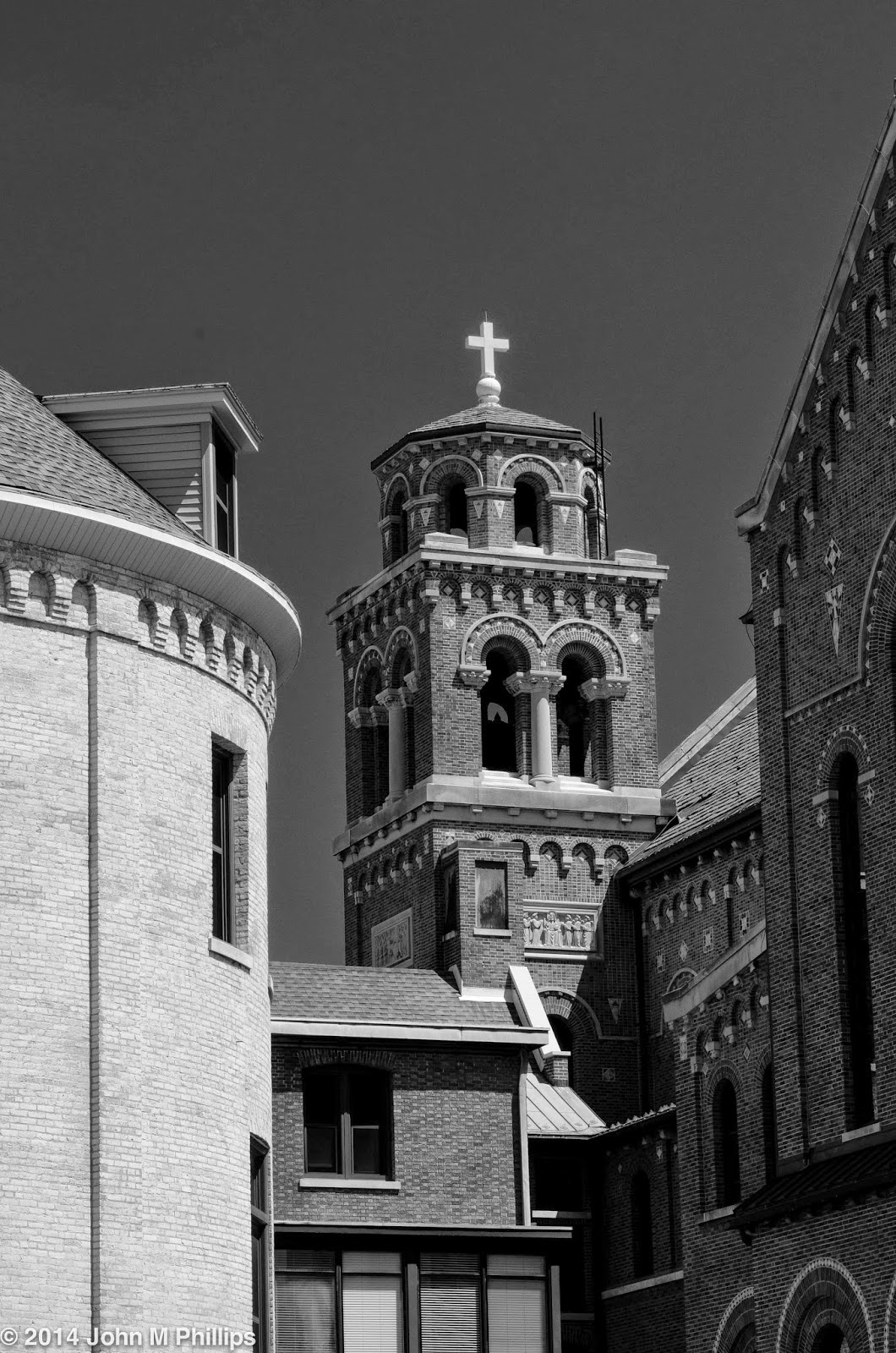
I finished my shoot by taking a number of photos of the exterior.  These were, to be truthful, disappointing.  Because the chapel is part of a large complex of buildings, it is impossible to get a clear shot of just the chapel building.  Here, if only for completeness sake, is one of the shots I did take, which I converted to a black & white.


Again, I am very grateful to the personnel at SSSF for graciously allowing me access to the chapel to feed my photography habit.  I would commend this chapel to anyone who has even a passing interest in traditional architecture and particularly religious architecture.  It is well worth the visit.

John