On the first Thursday of each month admission to the Milwaukee Art Museum is free and, cheap as I am, periodically I take advantage of the offer to make a visit. Last Thursday afternoon I found myself returning for more photo opportunities, even though I didn't think there would be much new to try to catch. All in all, I was happy with what I got.
I found myself following a familiar pattern. Although I favor shooting three-dimensional art objects, I also take some shots of wall art. But usually I find myself focusing on detail rather than trying to capture the entire piece. Here are some examples.
I liked this detail of a man and woman that was part of a much larger triptych.
I particularly like this detail of a second piece that features a woman wearing what looks like a cooking pot.
I was happy with the resolution of the following shot, which clearly shows both canvas texture and crackling of the paint. But what drew me to the painting was the quality--and size--of the subject's eyes. Each of her eyes is as large as her entire mouth.
For many indoor venues lighting can be a major problem. With an art museum the amount and quality of the light is critical, so conditions are usually better than in, say, a natural history museum. This time I used a technique I hadn't employed before, moving my camera to an auto-ISO setting. On aperture-priority mode with this setting the camera automatically adjusts the ISO upward until the shutter speed becomes at least as fast as some pre-set value. If the light is still too low, then the camera begins to slow the shutter speed. I can set the limits on both shutter speed and ISO. On this occasion I set the upper limit of the ISO at 1600 and the minimum shutter speed at 1/40th second. Things worked out pretty well with those parameters. The above shot was taken at f/4 with an ISO of 1600 and a shutter speed of 1/40th second. Right at the limits that I had set.
And here is another piece of wall art that I have shot before but that I like because for some reason it invariably makes me think of Batman and Robin.
And finally as to wall art, the following is a new piece that I liked; at least I don't recall seeing it before.
Again, this is a portion of a much larger painting, all of it very similar to this detail. I chose this portion because of the green horizontal object some of the figures are carrying, positioning it in the lower left corner of the image.
On to a few sculptures. A couple of these are nearly entirely abstract, including the following.
A kneeling figure, maybe? The shot was a little too simple, but I liked the quality of the light.
This bronze of flowers in a vase is at least recognizable.
I turned this into a black & white because I did not like the quality of the color of the bronze. Again, a little simple.
The following is of the statue of a Puritan that I have shot before.
The lighting here is very tricky, as the sculpture is quite dark and is set against a very light background. Moreover, the figure's pilgrim hat casts deep shadows over his face. As a result there is a great deal of contrast and it is difficult to bring out the sculpture's details that are in shadow. Here in post processing I lightened the image somewhat and then lightened the darker elements a bit further.. I also converted the image to a black & white. A little surreal, but I like it. Very intimidating.
One of my favorite sculptures is the following of a nude.
I've shot this piece many times, in part because of its interesting, exaggerated lines and in part because of its setting in one of the beautiful side corridors of the Calatrava addition. My criticism of this particular shot is that I should have aimed the camera to the right rather than to the left, so that the sculpture was positioned to the left of center rather than to the right. That would have brought more of the support structures into the image. Next time, maybe.
And here is one final sculpture of a Roman or Greek bust. What caught my attention were the eyes and the curly locks. Rather than trying to capture the entire bust, I chose an unorthodox shot of just those elements that stood out for me.
But the real star attraction of the Milwaukee Art Museum is its architecture, and I am always trying to capture a different nuance. Here are a couple of shots of the central atrium, ones that I have shot before.
I tried a couple of slightly elevated shots that excluded any patrons, but that converted the photos into pure abstracts. Having people in the shots creates both context and perspective, though I'm not sure I need the figure to the left in the second shot. Converting these to black & whites helped too, I think, as it helps to accentuate the lines. I especially like the difference in lighting between the left and right sides in the upper portions of the atrium's soaring upper surfaces. I also liked the reflection on the floor tiles of the light streaming through the windows, particularly in the first of the two shots.
One thing: it is very important to get the camera centered if I want to preserve symmetry. As I have said before, it is easy in post processing for me to correct a shot that is not horizontal or that is aimed slightly to the left or right. But if the camera is not positioned on the intended center line, there is no way to rectify the lack of balance.
Following are two shots that feature the side corridor on the west side of the Calatrava addition. The first was taken shortly after I arrived.
I had decided to wait for the area temporarily to clear of patrons, and I really liked that I positioned the bench in the lower left to create a point of interest. I also liked the pattern that the light was creating on the floor tiles of the corridor.
Here's another shot of the same corridor and bench that I took later just before leaving the museum.
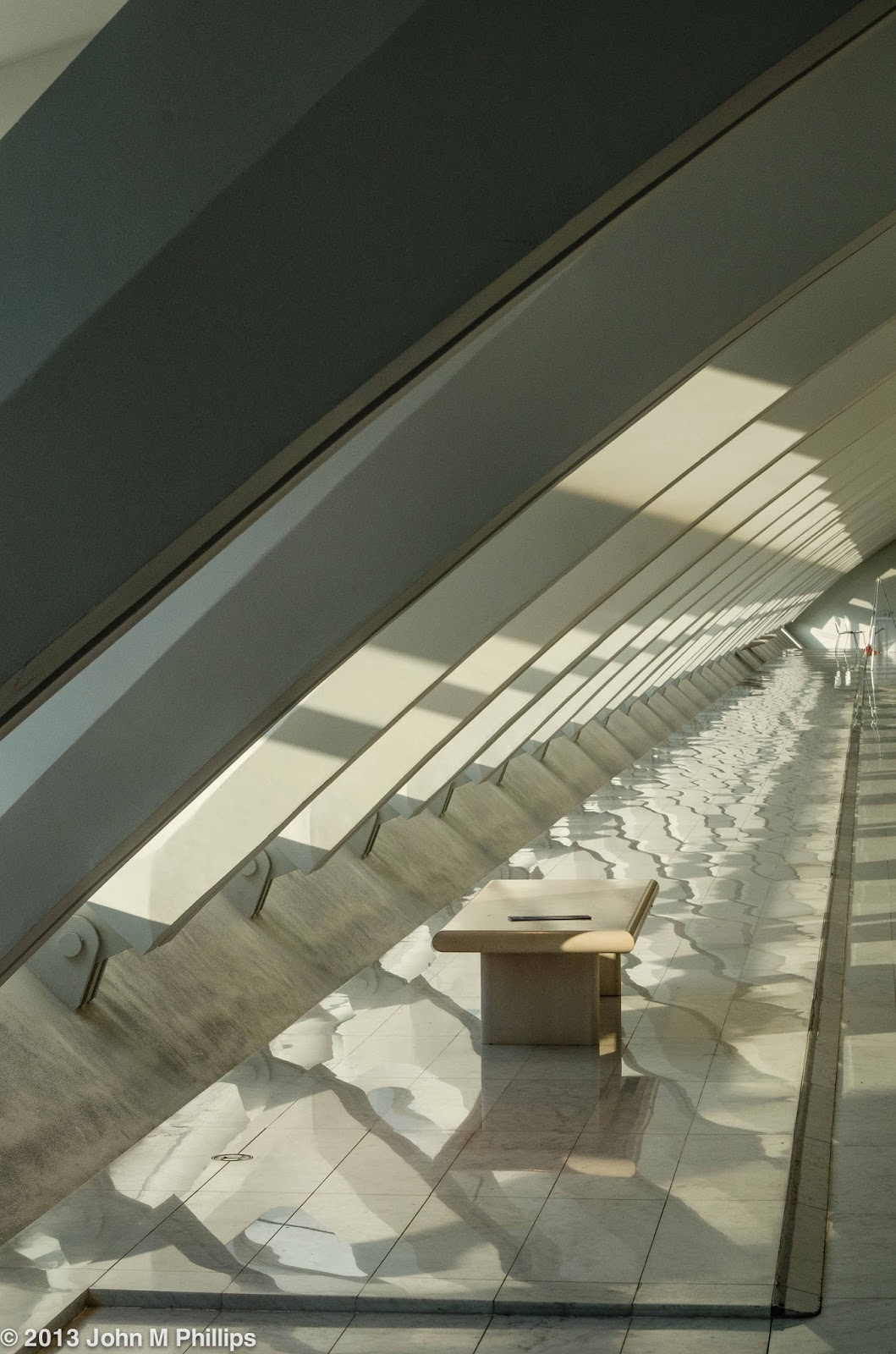
Now there was more afternoon light streaming into the corridor, creating even more complex patterns of light and shadow on the floor. I also liked the dark band in the upper left that provided more depth. These shots involved very little modification in post processing, including no cropping. Of the two, I like this second shot a bit better. (Yes, someone had left an object on the bench.)
Taking a few exterior shots of the brise soleil is virtually irresistible, especially when it is elevated as it was on this visit. Here is a shot on my way back across the bridge above Lincoln Memorial Drive.
I know these shots are legion, but the sky had a particular quality that helped the overall composition. The clouds appeared suspended just above the top of the structure and there was a hint of rose coloring in the lower clouds over the lake being created by the afternoon light. In addition, the soft quality of the clouds contrasted nicely with the hard lines of the architecture. The resolution on this shot was outstanding, particularly for handheld. This image required very little in the way of post processing, just a little tweaking of the contrast and cropping only for leveling and centering.
As I was entering the parking ramp to return to my car, I noticed that the sun had come out and I took one more, off-center shot of the Calatrava.
It's amazing what a difference in light over a three-minute span can create. The white balance settings for these two shots were identical. Again, this shot involved very little in the way of post processing. Both of these photos were shot at f/10, which kept virtually everything in good focus.
Finally, I had earlier taken the following shot of the landfill area to the north through one of the museum windows facing the lake.
The afternoon light was unusual, lending a sort of landscape oil painting quality to the image. The composition does include cars and buildings visible on close inspection, but I really like the overall feel. The clouds help a lot as well, and I'm glad that I placed the horizon relatively low in the image, establishing the sky as an important semi-negative-space component in the overall composition. This was shot with an aperture of f/6.3, but the scene is sufficiently distant that depth of field was not an issue. The overall resolution is excellent, particularly for a shot taken through window glass that was not entirely clean.
John
Sunday, November 10, 2013
Friday, November 8, 2013
A LITTLE MACRO
The Mitchell Park Domes have been undergoing some renovation, and the Tropical Dome has been closed for a couple of months now. I seem to find more opportunities for macro photography in that dome and it is my favorite of the three. So my trips to the Domes during this renovation period have been curtailed. Even so, I found my way there again earlier this week.
This first photo, in the Desert Dome, is sort of a fake shot of a dead juniper branch.
I thought the branch, though obviously dead, was rooted in the ground. But it was actually loose and just propped against the fake stone wall behind it. Even so, I wanted to capture the twisted grain in the wood. I sort of like the composition and the fork in the branch and the graining is OK. But it doesn't have enough going for it.
The next shot was of a relatively large budding desert flower.
The overall bud was perhaps 7-8 inches in length, and that give me a couple of choices. I could back off and include the entire bud, or I could close in and include just a portion of the bud. The former option would present the whole story, so to speak, but at the expense of loss of detail. Much of the detail might still be there, but at normal viewing size it would be partially lost. So I chose to move in and emphasize the detail, at the expense of clipping off the top of the bud. But there is no suspense there anyway, and I did like the renegade bud extending to the right. The big problem is with the background. It is featureless, which might otherwise be OK, but not when it is an ugly tan.
Here I cropped the shot down to eliminate any background beyond the agave. The problem was with the color of that background, again an ugly tan. As a result of the crop, the points are too close to the top of the image.
The day was partly cloudy and from time to time the sun would break through. I had told myself that sunlight wouldn't make any difference, but of course it did. For one thing, it allowed me to shoot plants that were being backlit by the sun. Here is one those that sort of worked.
I liked that I had positioned the convergence of the leaf's veins in the upper right corner of the image. What I didn't like was that the leaf was an unattractive blend of light greens. So I converted it to a black & white and ramped up the contrast a bit. That emphasized the black and white "measles" that the leaf exhibited, which added, I thought, to the image's overall interest.
Here is another tropical flower (but in the Show Dome, not the Tropical Dome) that I have shot many times in the past.
Here again I had to decide between presenting the entire flower and focusing on the key elements, which were the yellow stalk and the bright red leaf behind it. I wanted to keep the stalk in focus because of its interesting texture and allow the leaf to go out of focus but retain enough detail to show off the curved ribbing. The result is OK, I think, but I probably could have included a bit more of the overall scene.
Finally, here is a large leaf from the Show Dome that, again, was being backlit by the sun.
Here the challenge was depth of field. I wanted to feature the cleft in the leaf, but I wanted the background to be fully blurred out. At the same time, I wanted the entire leaf to be in relatively good focus. If the leaf were perfectly flat, focus on the leaf would not have been a problem. But that was not the case. I wound up with an aperture of f/8. Given how close my focus was, that was adequate to blur out the background.
Overall, I would give this session a C+.
John
This first photo, in the Desert Dome, is sort of a fake shot of a dead juniper branch.
I thought the branch, though obviously dead, was rooted in the ground. But it was actually loose and just propped against the fake stone wall behind it. Even so, I wanted to capture the twisted grain in the wood. I sort of like the composition and the fork in the branch and the graining is OK. But it doesn't have enough going for it.
The next shot was of a relatively large budding desert flower.
The overall bud was perhaps 7-8 inches in length, and that give me a couple of choices. I could back off and include the entire bud, or I could close in and include just a portion of the bud. The former option would present the whole story, so to speak, but at the expense of loss of detail. Much of the detail might still be there, but at normal viewing size it would be partially lost. So I chose to move in and emphasize the detail, at the expense of clipping off the top of the bud. But there is no suspense there anyway, and I did like the renegade bud extending to the right. The big problem is with the background. It is featureless, which might otherwise be OK, but not when it is an ugly tan.
This next is one of those agaves that I have shot numerous times before. I am still trying to capture the right combination of sharp lines and interesting patterns.
Here I cropped the shot down to eliminate any background beyond the agave. The problem was with the color of that background, again an ugly tan. As a result of the crop, the points are too close to the top of the image.
The day was partly cloudy and from time to time the sun would break through. I had told myself that sunlight wouldn't make any difference, but of course it did. For one thing, it allowed me to shoot plants that were being backlit by the sun. Here is one those that sort of worked.
I liked that I had positioned the convergence of the leaf's veins in the upper right corner of the image. What I didn't like was that the leaf was an unattractive blend of light greens. So I converted it to a black & white and ramped up the contrast a bit. That emphasized the black and white "measles" that the leaf exhibited, which added, I thought, to the image's overall interest.
Here is another tropical flower (but in the Show Dome, not the Tropical Dome) that I have shot many times in the past.
Here again I had to decide between presenting the entire flower and focusing on the key elements, which were the yellow stalk and the bright red leaf behind it. I wanted to keep the stalk in focus because of its interesting texture and allow the leaf to go out of focus but retain enough detail to show off the curved ribbing. The result is OK, I think, but I probably could have included a bit more of the overall scene.
Finally, here is a large leaf from the Show Dome that, again, was being backlit by the sun.
Here the challenge was depth of field. I wanted to feature the cleft in the leaf, but I wanted the background to be fully blurred out. At the same time, I wanted the entire leaf to be in relatively good focus. If the leaf were perfectly flat, focus on the leaf would not have been a problem. But that was not the case. I wound up with an aperture of f/8. Given how close my focus was, that was adequate to blur out the background.
Overall, I would give this session a C+.
John
Sunday, November 3, 2013
LOYALTY BUILDING REVISITED
I first visited the Loyalty Building as part of the 2013 Doors Open Milwaukee event back in September. The building, located in downtown Milwaukee, has been converted into a boutique hotel. It features a skylight-lit central atrium that is gorgeous. So I went back in late October for another look. It's still gorgeous. I wanted to get some shots different from those I took at the Doors Open event, but most of them look pretty much the same, except there were fewer people to get in the way.
I did like the following, more vertical shot, which does a nice job of featuring reflections of the skylight in the atrium's lower windows.
I've said this before, but it is worth taking the time to get the camera properly centered. A shot that is not completely horizontal can be corrected by cropping, but there is no way to completely correct a shot that is not properly centered, and being off by only an inch or two can make the difference.
I also took a few "level" shots of the atrium, including the following.
Finally, one of the main reasons I went back to the Loyalty Building was to try to capture the lines of the stairway leading to the lower level. At the Doors Open event there were always people milling around. Not the worst to have people in a shot, but not if they are moving all the time. This was probably the best of the stairway shots, which I converted to a black & white.
Not bad but a wider angled lens would have helped here.
John
I've said this before, but it is worth taking the time to get the camera properly centered. A shot that is not completely horizontal can be corrected by cropping, but there is no way to completely correct a shot that is not properly centered, and being off by only an inch or two can make the difference.
I also took a few "level" shots of the atrium, including the following.
Finally, one of the main reasons I went back to the Loyalty Building was to try to capture the lines of the stairway leading to the lower level. At the Doors Open event there were always people milling around. Not the worst to have people in a shot, but not if they are moving all the time. This was probably the best of the stairway shots, which I converted to a black & white.
Not bad but a wider angled lens would have helped here.
John
VILLA TERRACE
On the advice of friends, I recently paid a visit to Villa Terrace, along with my camera. Villa Terrace is located on the bluff above Lake Michigan on Milwaukee's lower east side. It was originally built in 1924 as a private residence. Ultimately, it became a modest sized decorative arts museum. The museum includes both the residence and a nicely maintained garden leading down the bluff to Lincoln Memorial Drive, bordering the lakeshore.
The museum does include articles of decorative art, including some wrought iron pieces . . .
a bit of sculpture . . .
and even some interesting drape tassels.
Admittedly, a little unorthodox, but I did like the natural lighting that the window was offering. (This required my getting down on my hands and knees, by the way.)
But the real interest is in the building and grounds, rather than in its contents.
The gardens behind the residence were very nicely maintained and included a number of nice sculptures.
I also liked the wrought iron gate at the east end of the gardens.
Here is a closeup of the gate that featured a jogger going past on Lincoln Memorial Drive. My timing wasn't the best on this shot.
The residence was built around a central courtyard that featured a 2nd century marble statue of Mercury (Hermes),
And one of the detail in the courtyard's stylized stone walkway.
Finally, I took a shot of one of the windows in the front wall of the courtyard.
I did like the espaliered shrub next to the window. My only quibble is with the sunlight that was catching the top of the shrub.
John
The museum does include articles of decorative art, including some wrought iron pieces . . .
a bit of sculpture . . .
and even some interesting drape tassels.
Admittedly, a little unorthodox, but I did like the natural lighting that the window was offering. (This required my getting down on my hands and knees, by the way.)
But the real interest is in the building and grounds, rather than in its contents.
The gardens behind the residence were very nicely maintained and included a number of nice sculptures.
I also liked the wrought iron gate at the east end of the gardens.
Here is a closeup of the gate that featured a jogger going past on Lincoln Memorial Drive. My timing wasn't the best on this shot.
The residence was built around a central courtyard that featured a 2nd century marble statue of Mercury (Hermes),
although I learned that only the torso was original; the remainder was reconstructed in the 17th century. Still, impressive.
Here is a shot of one of the courtyard corridors.
Finally, I took a shot of one of the windows in the front wall of the courtyard.
I did like the espaliered shrub next to the window. My only quibble is with the sunlight that was catching the top of the shrub.
John
Saturday, November 2, 2013
STANLEY'S BIG ADVENTURE (as told to Grandpa)
This has been a great week. First, I got to go on an airplane ride, along with Mom and Dad. We went from home in Salt Lake City to the Twin Cities. Mom had a conference on computational topology and gave one of the talks at the conference. I have no idea what that is. Do you?
Anyway, Dad just came along to take care of me. Here's a picture of Dad. I think he's pretty proud.
I don't remember much about the airplane ride, just that we sat in a small place with a lot of other people and when we got out we were in the Twin Cities. It was fun, even though I slept some of the time.
But the big thing was that I got to meet Great-Grandpa. Here's his picture.
He's really old. He's more than 101 years older than I am (wow), and I'm getting pretty old myself. I just celebrated being five months old. The other thing was that I got to see Dad's parents for the first time since August, when I was only half as old as I am now. They helped take care of me too.
Grandpa kept taking pictures of me. Here's one of me looking right into his camera.
Grandma was holding me and I was going to have lunch. You can tell because I was wearing my bib.
Here's another picture of Grandma and me. I think you can tell that we like each other a lot.
We were having such a good time that I fell asleep.
The next night we all went to a Polish restaurant. Did you know that I am one-half Chinese, one quarter English, and one quarter Polish? So it was only right that we went to a Polish restaurant. Grandpa took a lot more pictures there. Here's one of Mom, Dad, and me. I think I look pretty handsome, even though I kinda forgot to look at the camera. There was just too much else to see.
Anyway, Dad just came along to take care of me. Here's a picture of Dad. I think he's pretty proud.
I don't remember much about the airplane ride, just that we sat in a small place with a lot of other people and when we got out we were in the Twin Cities. It was fun, even though I slept some of the time.
But the big thing was that I got to meet Great-Grandpa. Here's his picture.
He's really old. He's more than 101 years older than I am (wow), and I'm getting pretty old myself. I just celebrated being five months old. The other thing was that I got to see Dad's parents for the first time since August, when I was only half as old as I am now. They helped take care of me too.
Grandpa kept taking pictures of me. Here's one of me looking right into his camera.
Grandma was holding me and I was going to have lunch. You can tell because I was wearing my bib.
Here's another picture of Grandma and me. I think you can tell that we like each other a lot.
We were having such a good time that I fell asleep.
The next night we all went to a Polish restaurant. Did you know that I am one-half Chinese, one quarter English, and one quarter Polish? So it was only right that we went to a Polish restaurant. Grandpa took a lot more pictures there. Here's one of Mom, Dad, and me. I think I look pretty handsome, even though I kinda forgot to look at the camera. There was just too much else to see.
And here's a picture of just the guys--me, Dad, Grandpa, and Great-Grandpa.
And here's a shot of Mom, Dad, Grandma, Great-Grandpa . . . and me, of course. That's me, right in the middle.
Grandpa then asked a stranger to take a picture so all of us could be in the shot.
But here's the most special shot of all. A picture of the four generations: Great-Grandpa, Grandma, Dad, and me.
We all had a good time, but I think Grandma was having the best time.
The next day Grandma and Grandpa babysat me while Dad went to watch Mom give her talk on topology. It was fun just hanging out.
Except when Grandma wanted to scare me just a little.
After all, it was Halloween.
Subscribe to:
Posts (Atom)


