Wednesday, December 19, 2012

FIRST SNOW

On Tuesday, December 18th, Milwaukee had its first measurable snowfall of 2012.  It had been over nine months since the last snow, setting all sorts of records (the kind that TV weathermen conjure up to try to create viewer interest).  The snow, about 3 inches in our area, was beautiful and heavy for the period that it fell.  I was so excited that I went out twice during the afternoon to do some photography, heading over to Virmond Park, which is only a couple of miles from our home.  I first went out early in the afternoon at the height of the storm and then again "late" in the afternoon, when the snow had nearly stopped.

I actually took this first shot in our subdivision, which features a stand of woods on the far side of a small pond.


My intention here was to place the evergreen to one side and to make sure the ground at the base of the image was more or less a featureless white.  That's a bird or squirrel nest above the lone evergreen.  Might have better if it had not been there, but there it was.

Here is a stand of trees in Virmond Park that I have shot before and that I shot both times on Tuesday.  This first was taken at the height of the snow.


And, for comparison, here is another shot taken later in the afternoon.


There appears to be a greater buildup of snow on the tree limbs and low-lying vegetation in the second shot.  Perhaps, too, there is more clarity in the background tree on the left in the second shot, as there was less snow in the air by that time.  In addition, there is more color in the tree trunks in this second shot.  I liked the first one better.

This was a wet, heavy snow that clung to the branches.  Here is a shot that illustrates that.


Not a great composition, but I did like the overall effect.  The shot also had nice resolution.  It was shot at an aperture of f/22 for 1/3 second.

One of the features in the park is a pavilion tucked back among a stand of trees, which showed nicely in the snow.  Here is a shot from the early afternoon visit.


The snow was particularly heavy at this point, which gave nice depth to the shot.  This shot was taken at an aperture of f/22 for 0.8 second.  As a result, the snow appears as streaks in the darker areas of the image.  In addition, as I noticed when I looked at the shot on my computer, the image was not as sharp as I would have liked.  Even though I was using a tripod, there must have been some movement, perhaps from wind, during the 0.8 second exposure.

I liked the composition of this shot and was disappointed in the lack of sharpness, one of the reasons that I went back out to take some more shots later in the afternoon.  Here is another shot of the pavilion from that second visit.


Now the shot is sharper, but the snow had diminished, making the scene "busier."  In the first shot, for example, the snow has pretty much blocked out the tree behind the pavilion, while in the second, that tree detracts from the pavilion's lines.  As a result, the shot has lost its depth--and a lot of its interest.

Here is another shot I took in the later afternoon.


This shot was taken with the same lens as the first two.  However, the first two shots were taken at a focal length of 85mm (modestly telephoto), while this third shot was taken at a focal length of 28mm--much more of a wide angle shot.  (The camera was actually closer to the pavilion in this last shot, even though the pavilion looks smaller and therefore farther away.)  I liked this shot because it incorporated the linear stand of trees on the left as well as the stand on the right, which appears to be wrapping around the top of the pavilion.  Still, I wish I had spotted this shot during the height of the snowfall--and gotten it right.

By this point, the light was starting to fail.  At this time of year in Milwaukee, sunset occurs around 4:15 pm, and it was now about 4:20.  Even so, I wandered into a stand of woods on the bluff above the lake.  I was hoping to take advantage of the remaining snowfall to create some "woods" shots that showed depth.  Here are a couple of those efforts.


Just OK, I thought.  Hopefully, I'll have a lot more opportunities this winter to improve my skills.

Taken with my Nikon D7000 with Nikkor 24-120mm f/4 lens.

Thursday, December 6, 2012

NATIONAL MALL, MOSTLY


I thought I would wind up the posts on our brief trip to Washington, DC with some general shots around the District.

First is a shot from a conference room at our daughter's law firm's offices.


That's right.  The White House is only a couple of blocks south of her offices, making for a great backdrop to conferences.

Following a brief tour of her offices, we did pay a visit to the area at the back of the White House . . .


where we got interviewed by Swedish Public Television, who wanted to know our opinion of the Nobel prize award process--as if we knew anything intelligent.  It is amazing how glib you can be when you think your comments will never be seen or heard by anyone you know (at least, that's my hope).

Earlier I took a shot of a flag reflected in a nearby building.


This was a spur-of-the-moment shot.  I liked the simplicity of the composition and the fact that the flag reflections are slightly different in the different glass panes.  I do wish I had taken a wider shot that would have included the building's stone panels above the windows shown, rather than having the upper windows cut off.  Still, not bad.

On Sunday afternoon we found ourselves walking west along the reflecting pool leading toward the Lincoln Memorial and I took a few shots of the trees reflected in the water.  Here is one of the shots.


I chose to put the edge of the pool in the center of the image.  In reviewing the photo, I decided I liked best the portions nearer the edge of the pool showing the remnants of fall color and decided to crop the shot to exclude the top of the trees but to emphasize the center portion.  Here is the result.


And here is a shot closer to the Lincoln Memorial.


I think I was being lazy at this point, as I could have positioned the camera closer to the edge of the pool to eliminate the low wall in the lower left corner of the image and included more of the Lincoln Memorial  along with its reflection.

Earlier in the day I took a few shots of the mall area before the earlier morning fog had dissipated and the crowds had arrived.


I liked this shot even though the objects in the lower center of the image appear to be trash containers.  

And then I noticed a small tree positioned in front of the Washington Monument and took a few shots.  Here is one of those.


This shot cut off the upper portion of the monument, but I didn't really mind that--everyone knows what it looks like.  I also thought the fog helped the shot.  I decided to take a second, wider angled shot that included the entire monument.


I decided to place the monument on the left to include the stand of trees on the right.  Those trees, I thought, added a lot to the composition, as did the small tree on the left.  In addition, even though there were not a lot of individuals in these shots, they helped a lot in providing perspective.  Of the 300 photos I took during this brief trip to Washington, this last was the shot I liked the best.

Taken with my Nikon D7000 with Nikkor 24-120mm f/4 lens.

MASS TRANSPORTATION VENUES

On our brief trip to Washington , D.C. I noted the architectural details of the mass transportation venues we used.  Since I was armed with my camera, I took a few shots while we were waiting.

First are a couple of shots of the ceiling in the waiting area at General Mitchell International Airport.


White balance was something of an issue, as there was a combination of light sources, including fluorescent, incandescent, and natural sun light.  These are actually close to how the colors appeared, at least to my eye.

And here are ceiling areas at the Reagan National Airport, an interesting contrast to Mitchell's.


Finally, there is the Washington DC Metro Subway system.


Taken with my Nikon D7000 with Nikkor 24-120mm f/4 lens.

Wednesday, December 5, 2012

HIRSHHORN SCULPTURE GARDEN

I realized when we were in the Hirshhorn Sculpture Garden how much I like photographing sculptures, particularly in an outdoor setting.  The three-dimensionality of the sculptures present options and challenges in terms of depth of field.  In addition, in most cases there are also choices of perspective to consider.  Finally, background can come into play, either in the form either as a distraction or as a possible compositional element.

The sculpture garden is located on the National Mall on north side of the Hirshhorn Museum.  Most of the pieces might be classified as modern to contemporary and are generally representational.  Following are some of my favorites.

Despite what I just said, these first two are pretty entirely abstract.


I liked the above because of the high contrast created by the strong sunlight.  In the following, on the other hand, I was more concerned with depth of field and chose to crop the image to just a part of the sculpture to emphasize the blend of curves that it presented, making the abstract more abstract.  Doesn't quite work.


And here are some more representational pieces.


I loved this guy's huge arms and hands.  It also worked that he was posed in front of concrete wall that created a nice contrast in textures.

The following was an intriguing three-figure sculpture.


One of the men appeared to be whispering in the ear of a second, and all seems to be fairly placid until one moves around the sculpture and notices that the third figure is tugging on the second figure's shirt.  A lot is going on in this dynamic work.


Unfortunately, that made next to impossible capturing in a single shot the full essence of the piece.  I took these shots at an aperture of f/4.5 to make the figures pop out of their unhelpful background.  Note the unusual way in which the artist handled the figures' eyes.  There is a bit of zombification going on here.

The next photo is part of the sculpture of a very stylized regal couple.  I took a few shots of their upper bodies, but their heads were a little too bizarre for me, so I decided instead to focus on the female figure's hands, which I shot with a wide-open f/4 aperture to generate depth in the image.


I posed the following figure against a background tree and opened up the aperture.


Doesn't quite work; should have had even shallower depth of field (beyond the capabilities of my lens).  But I like the idea, at least.


And here is a highly textured sculpture against a very busy background, but I didn't have a lot of choices here.  I shot this at a nearly wide open f/5.

Background was a lot easier in the following shot, where I could position the sculpture against a neutral grass background.


For me, the key to this piece was the figure's posture, with her elbow braced against her knee in repose.  So I chose to include only a portion of the sculpture in the photo to emphasize that aspect.

Background served as an added element in the following shot--one of the last of the fall maples--which I blurred out with a wide open aperture of f/4.


In retrospect, I would have done better to have included more of the tree and moved the figure off center, as I did in the following piece.


The epitome of the empty suit.  The ivy on the wall made a natural complement to the sculpture.

Finally is this chrome sculpture that was positioned on a relatively high pedestal.


I tried various perspectives and finally decided on this shot that features some background architecture.

Taken with my Nikon D7000 with Nikkor 24-120mm f/4 lens.

AI WEIWEI

Ai Weiwei is a Chinese artist who was primarily involved in the design of the bird's nest stadium at the 2008 summer Olympics in Beijing.  Ai, known for his politically controversial artwork, currently has two exhibits at the Hirshhorn Museum that we visited last weekend.  One of the exhibits is the Circle of Animals/Zodiac Heads, which consists of bronze heads of the 12 animals of the Chinese zodiac.  These are situated in the circular courtyard that the doughnut-shaped museum building surrounds.  The sculptures, mounted on 10-foot poles, are modeled on similar sculptures created in the 18th century for the Old Summer Palace in Beijing.  I thought the sculptures were so-so.  Here are, respectively, the Ram, Snake, Dragon, and Pig.


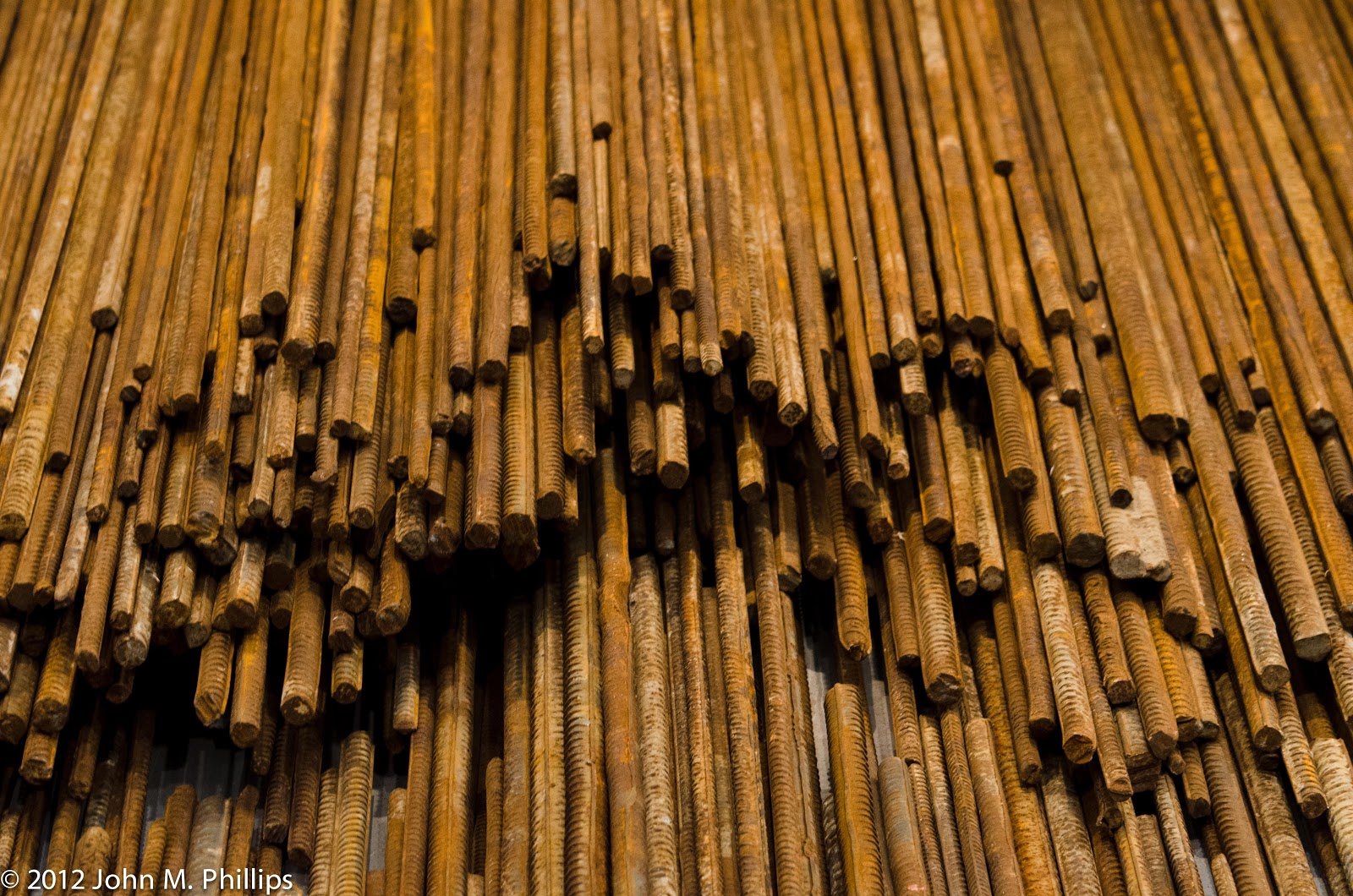
Ai's more significant exhibit at the Hirshhorn is entitled, "According to What?"  It occupies virtually all of the museum's second floor.  The pieces of this exhibit are more socio-politically controversial.  Here is a wider view that shows both a crab and a steel re-bar exhibit.


It should be noted that, while Ai is responsible for the ideas behind his artwork, he employs others to do their actual "fabrication."  Here are close-ups of the crab exhibit (the crabs are actually porcelain) . . .


and steel re-bar exhibit (which I understand was built from steel salvaged from buildings, including schools, that were destroyed in China's 2008 earthquake).


I liked the patterns created by the uneven ends of the pieces of steel.

And then there were antique pots that had been painted . . .


and antique stools that had been stitched together to create an interesting sculpture.


According to the plaque for this piece, the 40 stools had been created originally during the Qing Dynasty between the 1644 and 1911.

Ai had also created a relatively large wooden sculpture in the shape of the country of China.


This piece stood almost six feet high, so I had to hold the camera over my head and hope my aim was good enough to capture the work's "geography."  Note that the separate "stalk" on the right is the island country of Taiwan, which China still claims possession of.

Finally, here is another sculpture whose significance I failed to note but which consisted of mostly wooden pieces packed closely together.  I did like the appearance of the ends of the piece, particularly the metal elements that were interspersed with the wood.


For Ai this had political significance.  For me it was just a matter of pleasing abstract design.

Taken with my Nikon D7000 with Nikkor 24-120mm f/4 lens.

Tuesday, December 4, 2012

HIRSHHORN MUSEUM

We just returned from a trip to see our daughter Michelle and her friend Tobias in Washington, D.C.  One of the places we visited while there was the Hirshhorn Museum.  The museum is on the south side of the National Mall just to the west of the National Air and Space Museum.  Both museums are part of the Smithsonian group and are entirely free to the public.  The Hirshhorn includes a sculpture garden that I will include in a subsequent post.  The artwork at the museum is essentially limited to modern and contemporary artists.  The building is in the form of a ring with an open central courtyard.  Here is a not very good photo of the front of the museum showing the courtyard.


Although it is barely visible in the above photo, the center of the courtyard is occupied by what looks like a fountain that is currently not in use.  An interesting aspect of it is that, while the fountain's overall structure is round, the central portion featured in the shot below is located off-center, more or less as shown in the photo.


And as long as I am describing its overall appearance, here is a shot of a portion of  the museum's ceiling.  I like the simplicity of this shot.


The interior of the museum is on three levels.  One of  the major exhibits in the lower level is by Barbara Kruger with the title "Belief and Doubt," for evident reasons.  Here are a few shots of that exhibit.

This entire saying (which I did not have a lens wide-angled enough to capture was "Belief + Doubt + Sanity."


Another impressive piece of art in the lower level was one by Ron Mueck formally untitled but informally titled "Big Man," again for evident reasons.  This was a full-sized, extremely lifelike representation of very heavy-set nude man.


Fortunately for any viewer, I did not include any full-frontal shots.  Here is a close-up of his face.  The detail is stunning.


The second level of the museum is currently dedicated to a special exhibit by Ai Weiwei, which I am including in a separate post.  The third level primarily houses the museum's permanent collection, which is very good.  Here is one of the sculptures from the collection.


Unfortunately, by the time we got to the third level our art museum tolerance was reaching its 24-hour limit, so we didn't spend as much time there as we could have.  We will just have to return another time and focus on that portion of the museum.

Taken with my Nikon D7000 with Nikkor 24-120mm f/4 lens.