Monday, July 1, 2019

PIONEER VILLAGE: SELECTED IMAGES

Pioneer Village consists largely of a group of 19th and early 20th century buildings originally scattered around various locations in southeastern Wisconsin that were deconstructed and then reconstructed on what is perhaps a 10-20 acre site in northern Ozaukee County.  The buildings have been furnished with paraphernalia appropriate to the their original purposes.  I have visited the site numerous times to take photos. Perhaps not surprisingly, I keep coming away with photos that are for the most part very similar to the ones I had taken on prior visits.  My visit this June was no different, though I did take a few fresh photos.

One of the first structures is a reconstructed schoolhouse.  Here is a shot of the desks populating the building.


One of the buildings is a barn that includes a window that I have shot before.  I think what keeps me coming back to this shot is the existence of a window on the opposite side that is offset just enough to create some interest in the overall composition.


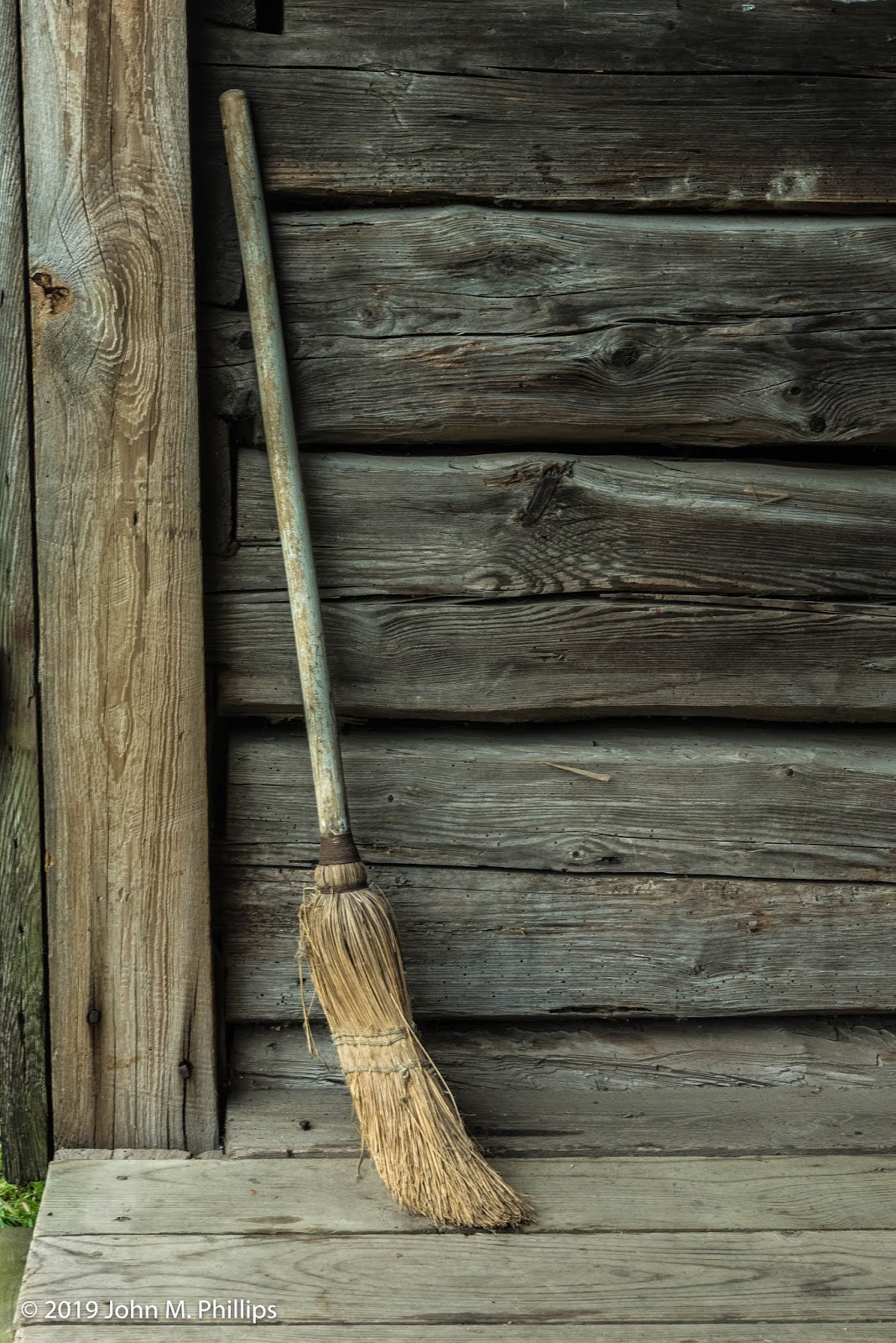
I spotted the following broom at the entrance to the barn, which made this perhaps the best composition of this series.  In this case, I think the fact that the scene was in the shade helped the overall quality of the shot, as it allowed me to bring out the texture in the broom as well as in the weathered wood of the wall behind.


Following is what I consider an ornament atop what I assume was a wood-burning space heater.


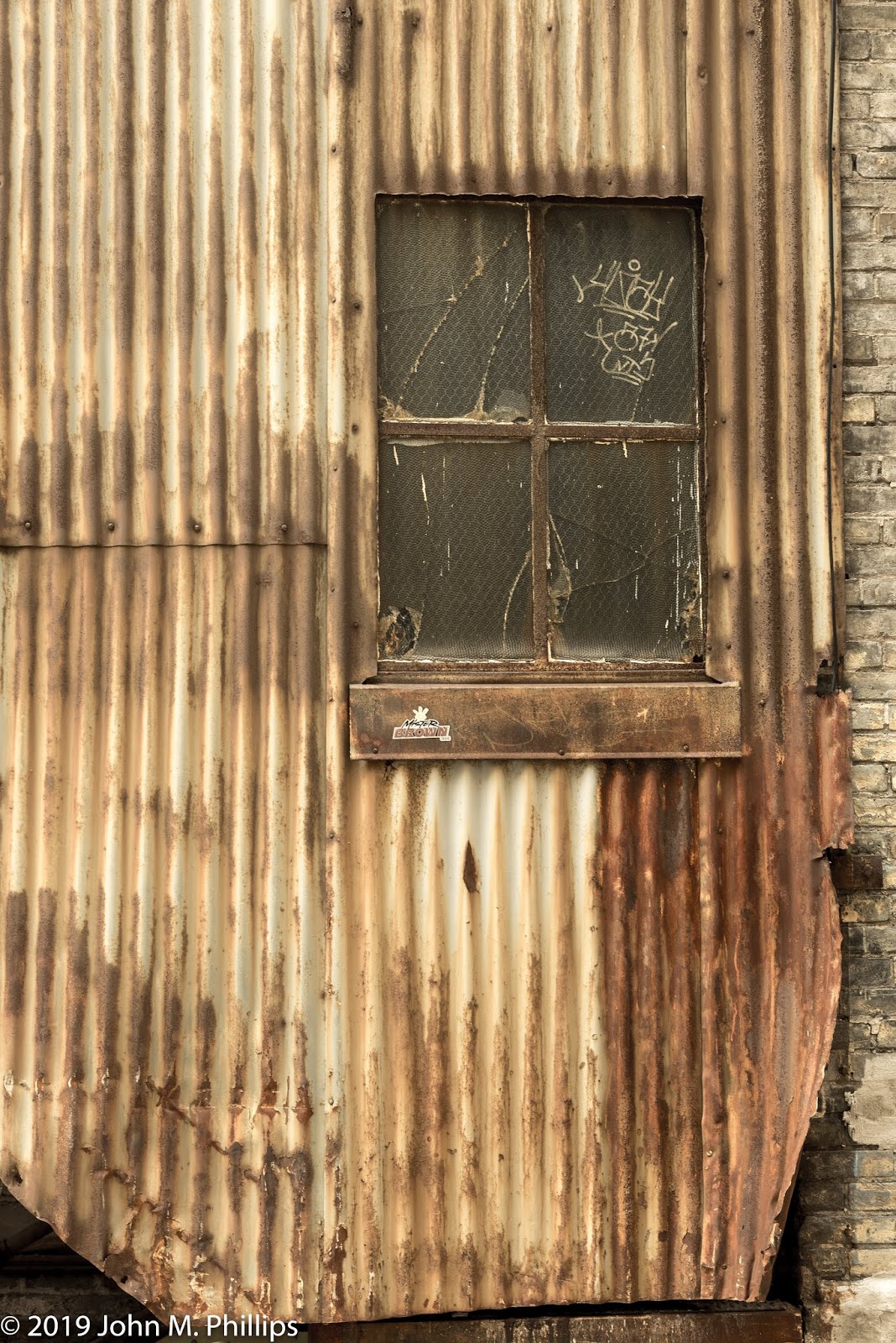
Finally, in one corner of the village there is a collection of farm implements that have been rusting away for a very long time.  The following shot was of some rusted sheet metal on one of the larger implements, a tractor of some sort, I think.  Not to everyone's taste, but I liked it as an abstract.  Or maybe I just can't help myself.


Every time I have gone to Pioneer Village, attendance has been sparse, regardless of the weather.  Add to that the fact that the price of admission is nominal, making this a hidden gem, in my view.

John

Sunday, June 30, 2019

MILWAUKEE RIVERWALK IMAGES

This weekend, with the weather finally becoming summery, I spent an hour or so downtown with my camera, mostly on the Riverwalk that borders the Milwaukee River.  

The river was relatively calm and one of the things I noticed early on was the unusual appearance that reflections were making on the surface of the water.  


I found the patterns to be interesting, but I should have provided some context for the shot, such as the actual object being reflected.  I do not have an explanation for the complexity of the patterns.

Before retiring eight years ago, I worked downtown in what is now known as Chase Tower.  The building is situated right along the river, more or less in the center of downtown.  It features an entrance atrium on the north side, with the office tower extending to the south along the river.  As part of Milwaukee's annual public art show, the atrium has been decorated with floral designs.  I took the following shot from the top of the escalators (which were not operating on this Saturday morning but which were not blocked off) to show the art from the interior.


Chase Tower has a parking ramp connected to the south of the office tower.  The ramp is well over 50 years old and has had chronic structural problems--ugly but still functional.  I was interested in the wire fencing on the river side of the parking structure that separates it from the Riverwalk.  Here I focused on the wire and let the yellow internal structure of the ramp proper go out of focus.


In the summer it is common to see kayakers making their way up and down the river.  It appears that many of the kayaks are rentals, as the following shots reflect.


I liked the second shot, despite the fact that it lacks some compositional balance.

Following is a circular grate on the Riverwalk.  There is certainly nothing remarkable about the grate, but I liked the pattern it presented anyway.


There are numerous restaurants that border the Riverwalk, some of which dress up their river patios with plantings.  I liked the composition and texture of the plant in the following shot, even though I didn't care for its colors.


I noticed the following fern in a waste area underneath the east-west freeway.  In this case I wanted to highlight the fern but use the surrounding vegetation as context, leaving it out of focus.


There are all sorts of private water craft moored on the docks that border the river.  My favorite photo of this group is the following image of docking and a mooring rope tethering one of the boats.


The owner, who apparently has a bit of OCD, took the time to coil the excess rope.  I converted the shot to a black and white and underexposed it to darken the water and to bring out the grain on the wood decking.

On the lighter side, here is a neon sign in the window of a downtown Jimmy John's.  Is this a standard sign for that franchise?


Finally is a mural along the river that I thought initially was simply a sample of public art but that I eventually realized served to notify dog owners of a "comfort station" for their pets, complete with artificial turf.


John

Monday, June 24, 2019

SUNFLOWERS 2019

Recently, my wife and I acquired a small bunch of cut sunflowers.  We're hoping they last for some time before fading.  Meanwhile, I decided to try my hand again at capturing their essence in photos.

These were not the monster-sized specimens one might find in a field of sunflowers.  They were all in the range of 4-6 inches across.  Here is the "cast" in a group shot I took in full sunlight against a black background.


I liked the way the sun was backlighting the petals, but I thought the bright sunlight may have created too much of a contrast to my taste.

Although the flowers on a collective basis create a better appearance from the front than from the rear, on a single flower basis I thought frontal shots lacked a little interest.


Still, not bad.  I particularly liked how the petals appeared a little softer in this shot, which was taken in sunlight that was filtered and indirect.

As in the past, I found the backsides of the flowers more interesting on an individual basis, I think because of the complexity presented by the whiskery sepals.  This first shot was taken with the petals being  backlit by strong sunlight.


Again, I thought the use of filtered light, along with including more of the array of sepals, created a more pleasing look in the petals and more interest with respect to the sepals.  In post processing I also lightened up the sepals a bit, which showed off better their three-dimensionality.


Perhaps this is a question of individual taste.

Armed with my macro lens, I took a few closeups from the sides of individual flowers, which I particularly liked.


One technical point that I might point out:  To increase depth of field, so as to keep as much of the image in acceptably sharp focus, I used a very narrow aperture, ranging from f/36 to f/51.  I also found myself underexposing the images one to two f-stops to bring out the texture of the petals.

John

Friday, June 21, 2019

MKE ARCHITECTURAL DETAIL: GOOD, BAD, AND UGLY

Like many older Midwestern cities, Milwaukee has a mix of architectural styles, much of it extending back to the late 19th and early 20th centuries.  The older architecture, in particular, exhibits a craftsmanship that simply cannot be duplicated in contemporary construction because such craftsmanship no longer exists and even if it did the labor costs would be prohibitive.  Some of that architecture has been preserved, but some has been allowed to deteriorate.  I enjoy trying to capture both in photography.  Here are some recent efforts.

First, the "Good," starting with a couple of shots of the Mackie Building in downtown Milwaukee.  This building was constructed in 1879 and is best known for housing the Grain Exchange Room, which extends back to a time when Milwaukee was a center for the wholesale purchase and sale of wheat, corn, barley, and other grains.  On a recent visit to downtown, I took a couple of shots of the building's front entrance facade.  


The detail on this facade is quite remarkable.  Here is a closeup of the upper left corner of the facade.


In addition to the various figures, note the locomotive tucked in the triangular space between the column and the entrance archway.  The corresponding area on the other side of the archway features a ship.

Another building that has been nicely restored--twice--is the Iron Block building, so named because the facade is comprised not of brick or stone work but of prefabricated iron blocks.  Here is a small but nicely fashioned detail, that includes some of the iron blocks, in the area between windows on the building.


And here is a detail from the entrance to St. Stephen Lutheran church in the Walker's Point area south of downtown.  This church, which sits in a prominent location just east of the city's north-south freeway, was built in 1902 and has suffered a good deal of deterioration over the years, I'm sure for lack of funds, although more recently it has received some much needed restoration.  This detail--one of many--illustrates the craftsmanship that went into its construction originally.


And now some "Bad."  Other buildings, though originally exhibiting interesting detail, have suffered a good deal of neglect, as in this archwork, which I rendered in black and white for the full shot but kept in color for the detail on one of the arches.


And here are a couple of shots of a nondescript building that has suffered some massive paint failure.


And then there's the "Ugly."  The first couple of shots were, admittedly, taken in alleys, not meant for public exposure.  Still. . . .


Somehow I liked the shots for their ugliness--and for the graffitied sleeping figure in the first image.

Finally, are a couple of figures fashioned for a building erected in 1907, based on the numbers the figures are holding.  What puzzles me is why the architect would choose such grotesque visages, positioned in a semi-claustrophobic posture.


© 2019 John M. Phillips

Wednesday, May 29, 2019

BROMELIAD IN THE ABSTRACT

Recently we acquired a bromeliad houseplant.  These tropical plants are relatives of the pineapple, which makes sense, given how stiff and waxen their top, colorful leaves are.  The plant we have stands about 18 inches high.


I thought the plant might make a nice photographic subject.  Given my penchant for abstracts, I decided to capture just parts of the colorful leaves, taking advantage of the varied colors and curves of the leaves.  Here is what I got.


These were extreme closeups taken with my macro lens only 2-3 inches from the leaves.  As a result, depth of field was extremely shallow, even when the camera was set at a very narrow aperture in order to maximize depth of field.  I decided that it was hopeless to keep everything in relatively good focus.  Instead, I focused on a leading edge of one of the leaves and let the remainder of the image fall out of focus.  By having a leaf edge in good focus served, I think, to preserve the idea that these were not just blurry images.  

Normally, when creating abstracts my goal is to retain enough so the subject matter is recognizable.  Here, I think the amount of abstraction makes the subject almost but not quite unrecognizable.  I particularly like these images, especially for their colors.

John M. Phillips

Monday, May 27, 2019

LEAVES IN THE WATER

One of the locations through which I take my daily walks is a natural area that has been preserved from development because it is a wetlands that, frankly, would be unbuildable anyway.  The area includes a small rill.  We have had an abundance of rain this spring, and on this morning I noted some water plants growing in a relatively still area adjacent to the rill.  Although the roots of the plants were under the water, the leaves were resting on top.  I liked the fact that the leaves were creating a pattern that was made more complex by the reflection of trees in the relatively still water.  After I finished my walk I returned with my camera to attempt to capture both the leaves and the reflections.

First, here is a shot of the rill, looking east toward the morning light.


Attempting to capture both the leaves and the reflections in the water was quite difficult from the point of view of depth of field.  Although the leaves and the reflections of trees would appear to be at the same distance from the camera, from the point of view of optics, the reflections are effectively as far away as the actual trees, that is to say, at a much greater distance.  So even taking shots with very narrow apertures (running from f/16 to f/40), left the reflections well out of focus.  And if I focused, instead, on the reflections, the leaves were badly out of focus, which was much worse from an esthetic point of view.

This first shot shows the general pattern of leaves that I had spotted.  The reflections of trees were largely lost among the leaves.  I underexposed this as well as the other leaf shots to darken the water, and that brought out a different pattern that I had not noted before.  Some sort of surface tension process was occurring, creating a series of concentric lines around the edges of the leaves.  These I enhanced a bit in post processing.


In the following shots I focused on smaller groupings of leaves which showed a bit better the surface tension effect.


Finally I got a shot that included both the surface tension effect and some recognizable (sort of) reflections from the trees.  This was taken at an extremely narrow aperture of f/40.  Even so, the tree reflections are very much out of focus.


John

Monday, March 18, 2019

TURKEYS

This winter has been more severe than average, including some bitterly cold days (with air temperatures exceeding minus 20F) and substantial snow that at times reached depths of 15-18 inches.  Our subdivision includes a 10-acre woods which has been home for some time to a flock of wld turkeys.  As often as not, I hear their gobbling as I start my early morning walks, and they frequently wander through our subdivision streets foraging for food or whatever.  I have wondered how well they have fared during this difficult winter.  Not to worry.  This morning on their daily walkabout, I counted 18 of them strolling through the yard of the neighbors across the street from us.  They didn't seem to be in a hurry, so I grabbed my camera and ran out in the sunny, 30-degree weather to catch a few shots.  Here is what I got.

First a couple of group shots, mostly of toms in full display.


It wasn't realistic to try to get all of the flock in one shot, as the 18 birds were strung out across perhaps 50-60 feet, with some obscured by remaining piles of snow.  In addition, several were bunched so close together that it was difficult to distinguish individual birds.  So I focused on smaller sub-flocks, particularly of toms, which were in full display.

Here are a couple more shots of five of the toms when they mostly had their backs turned to me.


The toms were clearly "on the prowl."  Here is a tom attempting, I presume, to "court" one of the hens, who didn't seem particularly interested.


None of the toms appeared to get "lucky" at least while I was watching.

Finally, here are a couple of close-ups of toms that I cropped from wider shots.


The closest I got to the birds was about 20 yards.  Any closer and I would have felt that I was intruding on their territory and they may have moved off.  So I took these with my 70-300 mm telephoto cranked up to a full 300 mm.  Even so, I needed to do some cropping on all of the shots.

John M. Phillips