Friday, May 19, 2017

LA FONDA

This post should probably be categorized as documentary rather than aesthetic.  In any case, during our recent visit to Santa Fe, we stayed at La Fonda.  When we visited Santa Fe in 2004, we stayed at the same hotel, on the recommendation of a colleague.  It was a great choice for our prior visit and wee felt the same about this visit as well.

La Fonda is a 150-room hotel that has been ranked as the best historical inn of its size in the U.S.  I wouldn't know about that, but it was filled with charm and was in the best possible location in Santa Fe, being situated in the historical district right between the main plaza and the cathedral.  The hotel was built in 1922 as a replacement for an inn that had burned down a few years previously.  La Fonda is located on the Camino Real running north from Mexico City and is at the western terminus of the Old Santa Fe Trail.

I regret that I did not take any photos of the exterior of the hotel.  But I did take some interior shots that I am posting here.  Each morning we took breakfast in the hotel's main captive restaurant, which was filled with charm.


One note about the dining room: On our previous stay we also had a breakfast here and sat next to a party that included the actor Jack Palance.

The hotel features a significant amount of local art or at least decor.  Here are a few examples.


Of course, I couldn't resist taking an abstract shot of some railings, along with a whimsical directional sign.


Finally, is a shot I took from our hotel window that features Santa Fe's iconic adobe, as well as an approaching rainstorm, one of the meteorological challenges with which we dealt during our visit.


John

Thursday, May 18, 2017

CATHEDRAL BASILICA OF ST. FRANCIS OF ASSISI


The Cathedral Basilica of St. Francis of Assisi (aka St. Francis Cathedral) is located in Santa Fe's historical district.  Its Romanesque revivalist architecture differs significantly from the adobe style that otherwise dominates Santa Fe.  In that it is in some senses refreshing.  Here is a shot of the building's west facade.


Following is another shot I took at night showing the same facade being bathed in artificial light.


There are a few statues that grace the front of the church.  The statue that caught my attention was the bronze of St. Francis . . . and his dog (wolf?).


Later I realized that I could pose the statue directly in line with the cathedral's rose window.


The exterior was nicely detailed, as in the following.


The interior was, I thought, equally interesting.  Here, first, is a standard shot from the rear of the nave.


And another closer to the sanctuary.


Here is a shot from the front of the nave looking back toward the the rose window.


And finally a side shot midway up the nave showing some of the stained glass windows.


The cathedral is an absolute must-see for anyone visiting Santa Fe.

John

BANDELIER NATIONAL MONUMENT

Bandelier National Monument is 50 miles northwest of Santa Fe, New Mexico.  It is largely a wilderness area that includes a significant number of archeological sites created by cliff-dwelling Native Americans generally during the period from 1100 to 1400 CE.  We visited the area on our recent trip to New Mexico.  There are a number of fairly long hiking trails in the monument, but we confined our visit to the Main Loop, a trail that runs past a number of the ruins but is only about 1-1/4 miles in length.

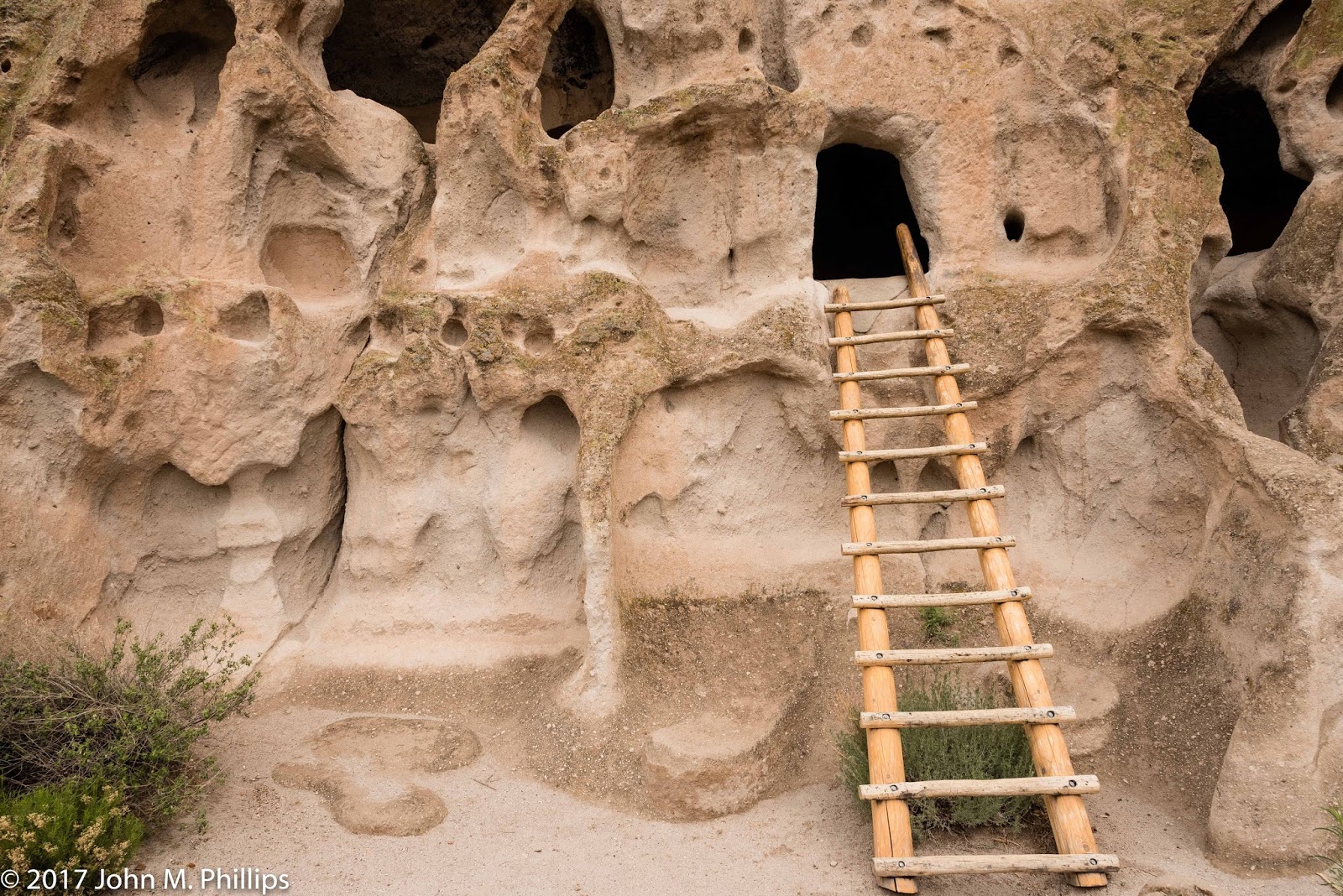
The cliffs that were used for dwellings appear to be sedimentary rock but actually consist of tuff, a compared volcanic ash.  It is porous and much softer than sandstone and therefore very workable for creating cavities for shelters and other purposes.  Here are some examples of that.


The tuff was also cut into blocks that were then used to build other structures, as in the following.


Many of the cliff shelters were accessible by ladders extending up from the trail.  They, of course, are of recent vintage.


It did not rain during our hike, though the skies were threatening the entire time.


And, in fact, it began raining just as we were finishing our hike.

John

Wednesday, May 17, 2017

LORETTO CHAPEL

The Loretto Chapel is a former Catholic church located a block or two south of the main community square in Santa Fe, New Mexico.  It is now a private museum that charges a modest $3 entrance fee to view the chapel's interior.  In my view it is well worth the fee and should be a must visit for anyone visiting Santa Fe.

The chapel was built in 1872 as an adjunct to a convent.  The small chapel's most notable feature is its helical stairway.  Once the chapel was built, it became obvious that there was no access from the main floor to the choir loft.  The story is that an anonymous carpenter came to the rescue to build the stairway, using only very basic tools.

The exterior of the chapel is difficult to photograph because of the proximity of nearby buildings.  Here is what I got of the exterior.


It didn't help that the light was not particularly good for this shot--it was the wrong time of day.  Here are a couple of exterior detail shots.


This last is looking up at the chapel's rose window.

The interior is beautiful and appears to be in excellent shape.


I was especially attracted to chapel's complex ceiling, particularly in the apse.


Here is a wider shot looking toward the rear of the chapel, which features the helical staircase.


Shooting the staircase itself is a challenge because it is roped off.  Here is what I managed to get.


I would have loved to climb the stairs and take a couple of shots looking down, but that was not possible.  I did take a couple of detail shots, one of a lovely stained glass window and one of a Christ statue.


John

NEW MEXICO CAPITOL

In keeping with my interest in architectural photography, I have photographed a number of state capitol buildings, including those in Wisconsin, Minnesota, Texas, and Utah.  So when we visited Santa Fe earlier this month, I took the opportunity to get a few photos of New Mexico's capitol building.  It is a relatively modern building without some of the charms and detail of older architecture.  Still, it has some interesting features.

New Mexico's state symbol is the Zia sun symbol, which consists of a circle with lines radiating from it in the four compass directions.  And that is the shape of the state capitol, as seen from above.  Here are a few of the photos that I got.

First is an exterior shot that I converted to a black and white that shows the circular curve of the central portion of the building.  Attempts to capture the design of the entire building would generally be limited to those taken from the sky.


Considering the building's circular shape, it is no surprise that there is a central rotunda beneath a modest dome.


And here are a few shots of the galleries that surround the rotunda.


I did peek into the senate chamber--functional.


The circular hallways also featured murals of local art.


John

Tuesday, May 16, 2017

SANTA FE ART MUSEUMS

Santa Fe has one of the largest fine art markets in the United States.  By some measures it houses the third largest art market, after New York and Los Angeles.  Pretty remarkable for a city of only 70,000.  In our wanderings around the city we browsed a number of art galleries, none seriously, given the prices.  But, though I always had my camera along, I generally don't photograph art that is for sale.  However, on one of the rainy days we did visit two of the city's art museums, the New Mexico Museum of Art and the Georgia O'Keefe Museum.

The collection at the New Mexico Museum of Art focuses on art by New Mexican artists or that has a New Mexican theme.  Thus the collection is fairly modern and is not as extensive as I had assumed.  But it was nice.  Here is a smattering of pieces in the collection.


This last was a brass sculpture of a pair of native American dancers adorned in antlers.  They were bent over and braced up by short walking sticks.  Odd, to say the least.

One of the things that was distracting about the museum was its walls' color schemes.  I thought the bright primary colors were distracting.


But I did like the stairwell that I captured in the following shot.


The Georgia O'Keefe Museum was a different experience, largely because the collection is essentially devoted to one artist, Georgia O'Keefe.  Most of the artwork is hers, though there was an extensive collection of photos of her, as well as some informal portraits of her that were done by family members.  Here are a few of her pieces.


The collection pointed up the fact that O'Keefe was a prolific artist with a long career that showed a progression toward abstraction.

In contrast with the New Mexico Museum of Art, the decor of the O'Keefe Museum was very neutral, allowing the art to speak without distraction.  Here are a couple of shots that feature that decor.


I realize this last shot has little to do with art, but I liked it as a semiabstract.

John