Sunday, January 22, 2017

SATURDAY MORNING FOG

As an amateur, I always look forward to foggy days for landscape photography.  There are a couple of reasons for this.  First, fog provides depth by fading more distant objects.  Second, fog can essentially eliminate background distractions.  This Saturday dawned in dense fog, so I grabbed my camera and headed for Virmond Park, a municipal park located on a bluff overlooking Lake Michigan.

For the record, I took around 90 shots in 1-1/2 hours, retaining about 15 of them.  I probably spent more time in post processing than in shooting--all pretty standard for my work style.  Following is what I got.

First, is a black & white shot of one of my favorite trees in the park, a small evergreen that stands isolated in an open field.


Here are two more shots of the same tree that arguably offer a bit more compositional interest.  The first places the tree further off to the side and incorporates the park road.


The second is something of a novelty shot.


To incorporate the foreground tree, I needed to position the camera just a couple of feet off the ground.  My one regret with this shot is the metal stake just to the left of the trunk of the foreground tree.  I'm sure there would be a way to eliminate this in Photoshop, but it's too much work for me.

Note that these two shots incorporate different white balances.  Partly that is due to changes in the ambient light during the time I was shooting; partly it is due to post processing choices.

The following shots of a stand of woods in the park illustrate the compositional depth that fog can create.


These shots are all cropped.  When I took them I felt that I needed to "ground" the images by including the floor of the woods in the shots.  There were two problems with this that led me to crop out the floor.  First, the floor, consisting of dead leaves, grass, and weeds, was a much different color than the tree trunks, which have a monochromatic feel without resorting to black & white.  I felt that that this difference in color distracted from the mood I was trying to convey.  Second, my focus was on the trunks, particularly the "stubs" of branches on some of the trees.  I thought that the ground clutter would take away from that focus.

Here is another broader shot of a different stand of trees.


Here I wanted to focus on the tree in the center left background.  In this case, I did not crop out as much of the grass, as the difference in color did not seem as distracting.

I also spent some time shooting a curving rail fence bordering a side road in the park.  I have shot this fence a number of times in the past, but I thought the dense fog in this shoot helped to create more of an uncluttered focus.


These I converted to black & whites to emphasize the grain of the rails and to eliminate the distraction that the greenish grass was creating.  In the first two shots I chose to shoot through the foreground rails in an attempt to create some novelty.  In the third shot I focused on the knot in the top of the rail just to the right of the post.

Finally, I am including a couple of photos of fallen leaves in the grass bordering the fence that, while not involving the fog, did, I feel, offer interesting compositions.


We seldom experience fog this dense in this part of southeastern Wisconsin, perhaps a couple of times a year.  So I was happy that I was able to take advantage of this opportunity.

John

Saturday, December 31, 2016

FAVORITE PHOTOS 2016

As I have done the last few years, for my final post of the year I am reprising some of my favorite photos for the year.  We did not take any major trips this year, and there were plenty of other distractions to keep me away from photography, but I did manage to take some photos to include in this yearend post.

Architecture.

We spent a few days in Tucson early in the year, and here is a shot of the city's old city hall, which is in the process of conversion to a museum.


I also made another pilgrimage to Wisconsin's State Capitol.  I took the usual shots of the dome's interior, but this shot of a side corridor was my favorite.


I also spent some time shooting the federal courthouse in Milwaukee.


I thought this worked best as a black and white.  A few days later I returned to the courthouse hoping to better the first set of shots.  As often happens, the second set was not as good as the first, I think because of a difference in the light.

I also revisited Milwaukee's Cathedral of St. John the Evangelist and got this great shot of the venue's altar, bathed in morning light.


I thought the chiaroscuro effect of this shot worked particularly well.

In June we spent a few days in Washington, D.C.  The two best venues for photography on this visit included the Library of Congress and Union Station.  Here is a shot of the ceiling of a side hall at the Library of Congress.


And a couple of shots I took at Union Station.


Finally, is a shot of Milwaukee's Art Museum.  It's a great subject for architectural photography, but I may be running out of fresh ideas.


Nature.

In past years I have paid multiple visits to the botanical gardens at Milwaukee's Mitchell Park Domes.  However, the domes were closed for most of 2016 for structural repairs, so I only visited the facility a couple of times.  Only one of the shots I took made the cut for this post, a cabbage-like plant that showed nice detail.


The other two shots were more serendipitous.  The first was of some leaves in a large street planter in Milwaukee that I spied while photographing some public art in the neighborhood.


I intentionally underexposed this shot a bit and wound up liking the metallic sheen that the leaves displayed.

The other photo was of some heavily frosted weeds that I spotted while out on a late fall morning walk.  After my walk I returned with my camera to get this shot before the sun burned off the frost.


Family.

I am not good at taking photos of people.  However, I have included a few family photos, not because of their technical qualities but for their natural spontaneity and overall composition.


Potpourri.

Finally are some shots that don't fit into any of the other categories.

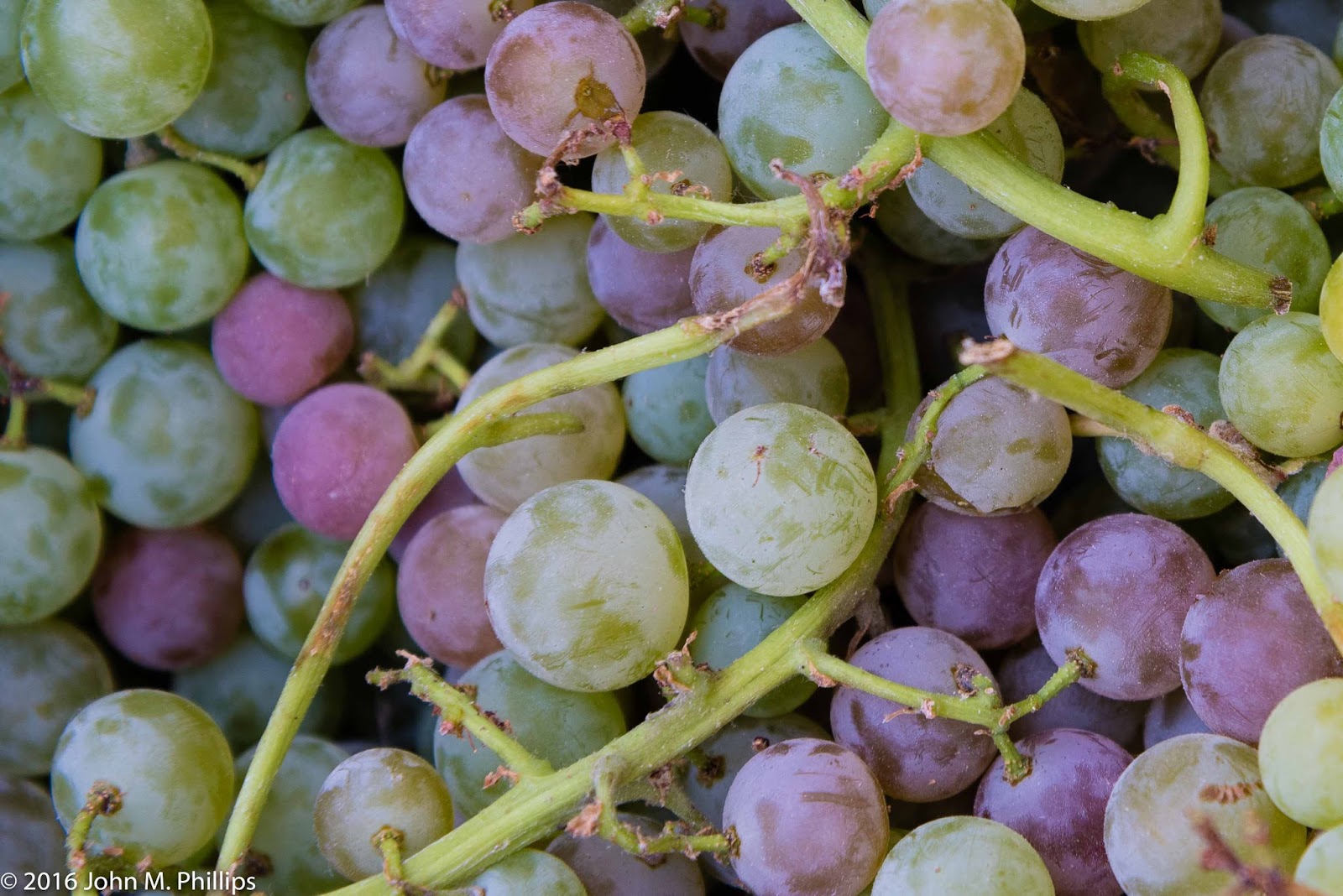
Some grapes at a farmers market that I liked for their variety of colors.


A black and white of alfresco chairs and shadows at a local restaurant.


Part of a mysterious piece of antique farm machinery that I liked for its steampunk qualities.


A solitary broom in a restored residence at the Pioneer Village in northern Ozaukee County, north of the Milwaukee metro area.


The foot of a bear at the Hogle Zoo in Salt Lake City.


And a splitrail fence in a snowstorm at Virmond Park in my hometown of Mequon.


John 

Thursday, December 29, 2016

WINTER AT 35,000 FEET

On our trip to Utah over Christmas I had a window seat on the leg from Minneapolis to Salt Lake City and grabbed a few photos out the window.  For nearly the entire way the landscape below us was snow-covered, and it was interesting to see how the landscape changed over the course of the trip.  There was little in the way of color, at least from the height of the flight, so converted the photos to black and whites.

The first was of farmlands--and a little hamlet--in eastern Nebraska, I think.  I find it interesting to consider the lives that are being played out in the scenes below me.


I felt fortunate that these shots worked out as well as they did, as my view was to the south, which required shooting into the mid-day sun.  I was also contending with the usual scratches and the other defects in the window.  I tried to minimize those defects by putting the camera right up against the window.

The remaining shots were of more rugged country.


What was striking to me in the above shots was that this land is so empty of any evidence of human activity.

Human activity is evident in the final shot, below.  This is my favorite of the group because I was able to capture the sunlight glinting off the river meandering through the scene on the right of the composition.


John

Tuesday, November 29, 2016

ANOTHER FROSTY MORNING

Even though our fall in southern Wisconsin has been incredibly mild, winter is inevitable, including another frosty, but snow-free, morning.  Here are a few more photos that I got of the frost.

In the first shot, I chose to include a young sprig as a point of interest.


In the second, I was more concerned with the overall compositional balance.


I wound up liking the second shot more, despite the fact that it had no specific focal point of interest.

The elements of the third shot below were more diverse, including both new and old and a variety of colors.


All of these were shot with the aid of a tripod.  I thought it was important to keep as much of the image in good focus, so I chose narrow apertures, running from f/16 to f/22.  As a result, exposure times were from 0.3 to 0.6 seconds, much too long for me to take on a hand-held basis.

Finally, while I was at it, I grabbed a photo of my favorite park bench in Mequon, this on the bluff overlooking Lake Michigan in Mequon's Virmond Park.  Colorwise, there wasn't much going on, so I converted the shot to a black & white.


John

Sunday, November 27, 2016

BACK TO MITCHELL PARK DOMES

The Mitchell Park Domes, Milwaukee's indoor botanical gardens, have been a mainstay of mine for getting macro shots of flora.  Unfortunately, last winter it became apparent that the facility was going to need major repair.  The Domes were closed for several months to install netting as a stop-gap measure to prevent chunks of the glass-paneled domes from falling on visitors.  Recently, all three domes were re-opened, and this weekend I paid my first visit since last winter.  Here is what I got.

This first was a more or less traditional shot of a chrysanthemum (or similar) flower from the Show Dome.


The next was of a trio of pincushion cacti in the Desert Dome that I converted to a black and white.


I intended this to be a symmetrical shot that would include the "centers" of all three cacti, but it didn't work out that way, and I decided I was happy with the asymmetrical composition.

This following was of a simple leaf in the Tropical Dome that I also converted to a black and white.


Because the leaf was relatively flat, I could go with a relatively wide open aperture of f/3.5 to eliminate any background distractions.  The conversion to black and white seemed to bring out more of the subtle texture in the leaf's surface.

My preference in these shots has been to crop the composition.  This serves the function of allowing more emphasis on detail and leaves to the viewer the task of completing the overall composition.  That could be said as well for the next shot, also of a leaf in the Tropical Dome.


My goal in the following shot of a detail of a large banana leaf was to bring out the fine pattern in the structure of the leaf, which was being backlit by the late morning sun streaming through the glass dome.


My favorite of the shots from this visit to the Domes was of what appeared to be a chard-like plant in the Show Dome.


In this photo, because it was shot at close range (less than a foot) and because the plant's leaves had quite a bit of depth, I used a very narrow aperture of f/40 to preserve as much depth of field as possible.

John M. Phillips

Saturday, November 12, 2016

FIRST FROST

This fall weather in Wisconsin has been very kind, and it was only this morning that we had our first real frost in the Milwaukee area.  On my early morning walk in the crisp, calm air, I noticed the heavy frost in the fallen leaves along the quiet streets, so as soon as I got home I grabbed my camera to capture some of the heavy frost before the sun burned it off.

The morning was sunny, but I realized that the colors would be richer in the shade than in the sun.  Moreover, including both sun and shadow in a shot would create distracting contrast.  So I focused on shaded areas.  I wound up taking about 35 shots, but as often happens, I kept only a few.


Generally, I try to stick to "unstaged" scenes, which is what I did here.  I did think to bring my tripod, which was important because I wanted to keep as much of the scene in reasonably good focus.  That meant that I needed to employ narrow apertures for the shots, requiring relatively long exposures.

John