Thursday, December 6, 2012

MASS TRANSPORTATION VENUES

On our brief trip to Washington , D.C. I noted the architectural details of the mass transportation venues we used.  Since I was armed with my camera, I took a few shots while we were waiting.

First are a couple of shots of the ceiling in the waiting area at General Mitchell International Airport.


White balance was something of an issue, as there was a combination of light sources, including fluorescent, incandescent, and natural sun light.  These are actually close to how the colors appeared, at least to my eye.

And here are ceiling areas at the Reagan National Airport, an interesting contrast to Mitchell's.


Finally, there is the Washington DC Metro Subway system.


Taken with my Nikon D7000 with Nikkor 24-120mm f/4 lens.

Wednesday, December 5, 2012

HIRSHHORN SCULPTURE GARDEN

I realized when we were in the Hirshhorn Sculpture Garden how much I like photographing sculptures, particularly in an outdoor setting.  The three-dimensionality of the sculptures present options and challenges in terms of depth of field.  In addition, in most cases there are also choices of perspective to consider.  Finally, background can come into play, either in the form either as a distraction or as a possible compositional element.

The sculpture garden is located on the National Mall on north side of the Hirshhorn Museum.  Most of the pieces might be classified as modern to contemporary and are generally representational.  Following are some of my favorites.

Despite what I just said, these first two are pretty entirely abstract.


I liked the above because of the high contrast created by the strong sunlight.  In the following, on the other hand, I was more concerned with depth of field and chose to crop the image to just a part of the sculpture to emphasize the blend of curves that it presented, making the abstract more abstract.  Doesn't quite work.


And here are some more representational pieces.


I loved this guy's huge arms and hands.  It also worked that he was posed in front of concrete wall that created a nice contrast in textures.

The following was an intriguing three-figure sculpture.


One of the men appeared to be whispering in the ear of a second, and all seems to be fairly placid until one moves around the sculpture and notices that the third figure is tugging on the second figure's shirt.  A lot is going on in this dynamic work.


Unfortunately, that made next to impossible capturing in a single shot the full essence of the piece.  I took these shots at an aperture of f/4.5 to make the figures pop out of their unhelpful background.  Note the unusual way in which the artist handled the figures' eyes.  There is a bit of zombification going on here.

The next photo is part of the sculpture of a very stylized regal couple.  I took a few shots of their upper bodies, but their heads were a little too bizarre for me, so I decided instead to focus on the female figure's hands, which I shot with a wide-open f/4 aperture to generate depth in the image.


I posed the following figure against a background tree and opened up the aperture.


Doesn't quite work; should have had even shallower depth of field (beyond the capabilities of my lens).  But I like the idea, at least.


And here is a highly textured sculpture against a very busy background, but I didn't have a lot of choices here.  I shot this at a nearly wide open f/5.

Background was a lot easier in the following shot, where I could position the sculpture against a neutral grass background.


For me, the key to this piece was the figure's posture, with her elbow braced against her knee in repose.  So I chose to include only a portion of the sculpture in the photo to emphasize that aspect.

Background served as an added element in the following shot--one of the last of the fall maples--which I blurred out with a wide open aperture of f/4.


In retrospect, I would have done better to have included more of the tree and moved the figure off center, as I did in the following piece.


The epitome of the empty suit.  The ivy on the wall made a natural complement to the sculpture.

Finally is this chrome sculpture that was positioned on a relatively high pedestal.


I tried various perspectives and finally decided on this shot that features some background architecture.

Taken with my Nikon D7000 with Nikkor 24-120mm f/4 lens.

AI WEIWEI

Ai Weiwei is a Chinese artist who was primarily involved in the design of the bird's nest stadium at the 2008 summer Olympics in Beijing.  Ai, known for his politically controversial artwork, currently has two exhibits at the Hirshhorn Museum that we visited last weekend.  One of the exhibits is the Circle of Animals/Zodiac Heads, which consists of bronze heads of the 12 animals of the Chinese zodiac.  These are situated in the circular courtyard that the doughnut-shaped museum building surrounds.  The sculptures, mounted on 10-foot poles, are modeled on similar sculptures created in the 18th century for the Old Summer Palace in Beijing.  I thought the sculptures were so-so.  Here are, respectively, the Ram, Snake, Dragon, and Pig.


Ai's more significant exhibit at the Hirshhorn is entitled, "According to What?"  It occupies virtually all of the museum's second floor.  The pieces of this exhibit are more socio-politically controversial.  Here is a wider view that shows both a crab and a steel re-bar exhibit.


It should be noted that, while Ai is responsible for the ideas behind his artwork, he employs others to do their actual "fabrication."  Here are close-ups of the crab exhibit (the crabs are actually porcelain) . . .


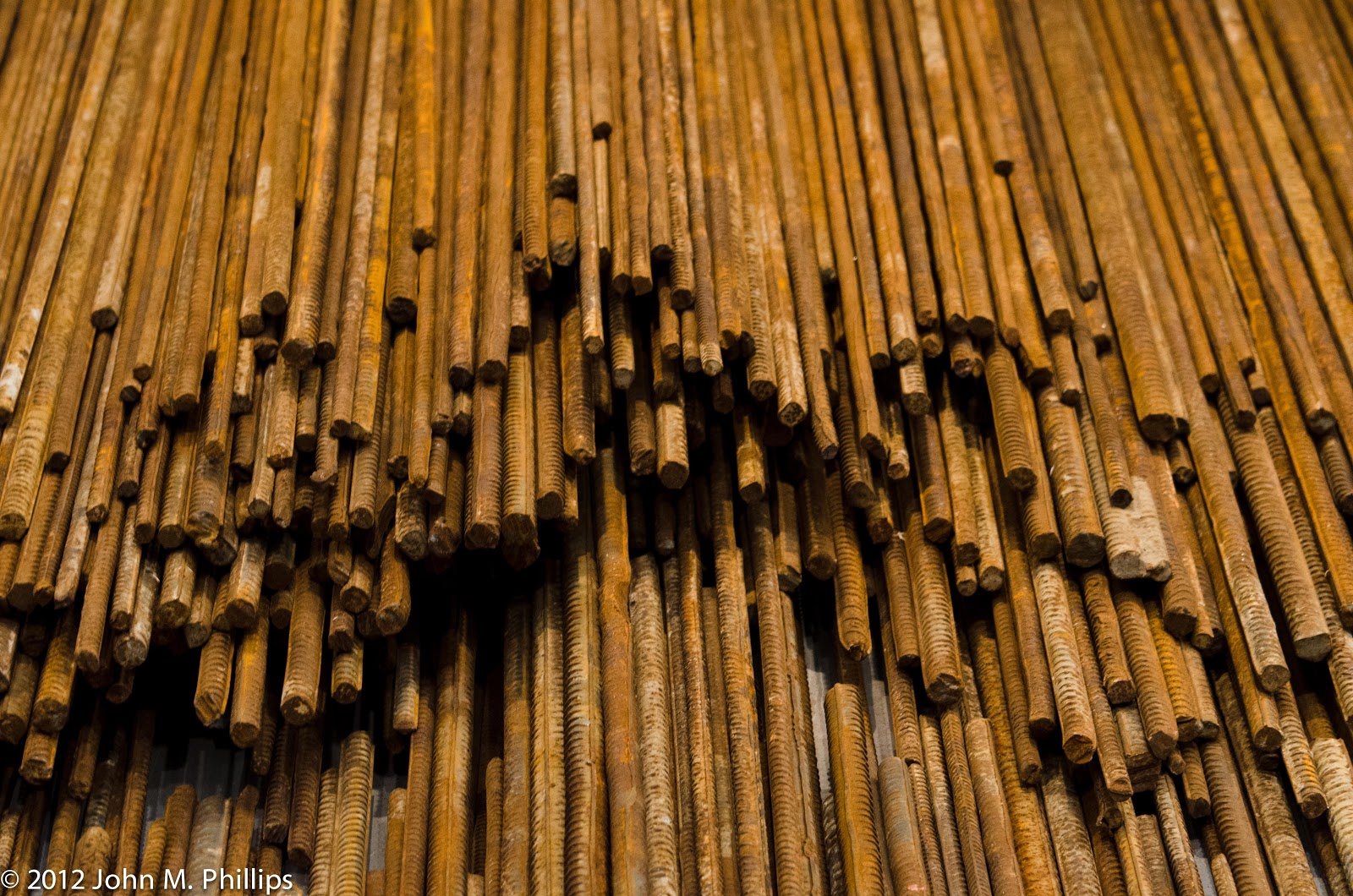
and steel re-bar exhibit (which I understand was built from steel salvaged from buildings, including schools, that were destroyed in China's 2008 earthquake).


I liked the patterns created by the uneven ends of the pieces of steel.

And then there were antique pots that had been painted . . .


and antique stools that had been stitched together to create an interesting sculpture.


According to the plaque for this piece, the 40 stools had been created originally during the Qing Dynasty between the 1644 and 1911.

Ai had also created a relatively large wooden sculpture in the shape of the country of China.


This piece stood almost six feet high, so I had to hold the camera over my head and hope my aim was good enough to capture the work's "geography."  Note that the separate "stalk" on the right is the island country of Taiwan, which China still claims possession of.

Finally, here is another sculpture whose significance I failed to note but which consisted of mostly wooden pieces packed closely together.  I did like the appearance of the ends of the piece, particularly the metal elements that were interspersed with the wood.


For Ai this had political significance.  For me it was just a matter of pleasing abstract design.

Taken with my Nikon D7000 with Nikkor 24-120mm f/4 lens.

Tuesday, December 4, 2012

HIRSHHORN MUSEUM

We just returned from a trip to see our daughter Michelle and her friend Tobias in Washington, D.C.  One of the places we visited while there was the Hirshhorn Museum.  The museum is on the south side of the National Mall just to the west of the National Air and Space Museum.  Both museums are part of the Smithsonian group and are entirely free to the public.  The Hirshhorn includes a sculpture garden that I will include in a subsequent post.  The artwork at the museum is essentially limited to modern and contemporary artists.  The building is in the form of a ring with an open central courtyard.  Here is a not very good photo of the front of the museum showing the courtyard.


Although it is barely visible in the above photo, the center of the courtyard is occupied by what looks like a fountain that is currently not in use.  An interesting aspect of it is that, while the fountain's overall structure is round, the central portion featured in the shot below is located off-center, more or less as shown in the photo.


And as long as I am describing its overall appearance, here is a shot of a portion of  the museum's ceiling.  I like the simplicity of this shot.


The interior of the museum is on three levels.  One of  the major exhibits in the lower level is by Barbara Kruger with the title "Belief and Doubt," for evident reasons.  Here are a few shots of that exhibit.


This entire saying (which I did not have a lens wide-angled enough to capture was "Belief + Doubt + Sanity."


Another impressive piece of art in the lower level was one by Ron Mueck formally untitled but informally titled "Big Man," again for evident reasons.  This was a full-sized, extremely lifelike representation of very heavy-set nude man.


Fortunately for any viewer, I did not include any full-frontal shots.  Here is a close-up of his face.  The detail is stunning.


The second level of the museum is currently dedicated to a special exhibit by Ai Weiwei, which I am including in a separate post.  The third level primarily houses the museum's permanent collection, which is very good.  Here is one of the sculptures from the collection.


Unfortunately, by the time we got to the third level our art museum tolerance was reaching its 24-hour limit, so we didn't spend as much time there as we could have.  We will just have to return another time and focus on that portion of the museum.

Taken with my Nikon D7000 with Nikkor 24-120mm f/4 lens.

Thursday, November 29, 2012

WHITEFISH BAY WATER TOWER

For the past couple of months Whitefish Bay's water tower has been under wraps, covered by a full-length curtain.  I finally learned that the tower was being repainted and that the shroud was intended to prevent any debris from the sandblasting or spray paint to drift on to neighboring homes.  Once the paint job was completed, I decided to see what photos I could get.

First is a shot of the tower from longer range.


The tower is fully accessible--no chain link fences--so I was free to walk directly under it.


Although this shot is asymmetrical, for most of the shots I took I found myself attempting to create a symmetry.  Here are a few of those, which I converted to B&Ws.


Here is a wider view that includes part of the cloudless sky.


I converted this to a B&W also.


I liked that I was able to darken the blue in the sky for this shot.

And here is a "detail" shot of some sort of bolted hatch at the base of the tower's central support.


Generally, I was disappointed with how these came out.  Although there is some interesting geometry in these shots, they don't do a very good job of capturing the tower.  I think I am going to have to go back and give it another try.

Taken with my Nikon D7000 with Nikkor 24-120mm f/4 lens and Nikkor 70-300mm f/4.5-6.3 lens.

BACK TO THE DOMES

I had a free afternoon on a sunny day earlier this week and headed back to the Mitchell Domes for a little macro "fix."  As usual, I found myself reshooting some of the same subjects as in the past--still hoping for that great shot.  But I also spotted a few new opportunities.

Here is one of my old favorites, a variegated coleus leaf.  (At least I got the name of the plant this time.)


I loved the wine-stain color in this leaf.  What I didn't notice until post processing was that there was a piece of thread almost in the center of the image.  Fortunately, I was pretty much able to excise it with my spot removal tool.

Another old favorite is a large plant (notice my failure here to get the plant's name) in the desert dome.


In the past I have taken closer shots that had a simpler composition, but this time I moved back a ways to get this shot.  I realize that there is no flower in this shot and it isn't really a macro shot, but I'm really happy with it.  This was taken at an aperture of f/36 with an exposure of 1.6 seconds.

Here are a couple of shots of blossoms in the tropical dome.  The business end of these flowers is, frankly, a bit messy, so I decided to take my shots from the rear.  The first is a blossom that was still opening.


Sunlight was nicely backlighting the petals and as a result the camera underexposed anything otherwise visible in the background, turning it black.  Here is a blossom that was open fully.


I like the first shot better perhaps because of its richer color or because it is a little more intimate.

In the desert dome I also spotted a leaf that was perhaps 8 inches long and 1-2 inches wide.  I was attracted to this subject because of the combination of orange and green colors that the leaf displayed.  The leaf was "cupped" from side to side, and I was interested in creating a sense of depth by allowing the back edge of the leaf to go out of focus.  I set the camera up perpendicular to the leaf with the focus on the front edge of the side closest to the camera.  In this first shot the lens was about as close as possible to the leaf and still maintain good focus, perhaps 3 inches.  Even though the aperture was a narrow f/16, the back edge of the leaf--at the very top of the image--was very much out of focus.


Here is another shot taken a little farther back from the leaf at an aperture of f/20.


As an abstract, I think I like the first shot better than the second.

And here is another study in depth of field from the show dome, which is now presenting its holiday display.

Here is a shot of a cyclamen blossom that I liked because of the way the petals were nestled together.


(This is actually a color shot, not a black & white.)  Again, the camera was positioned only a few inches directly above the blossom.  Because the camera was so close, depth of field was a real issue.  This was taken at an extremely narrow aperture of f/57.

Here is another shot of the same blossom taken at f/8.


I focused the lens on the left edge of the outside blossom, which also caught a bit of the lower edge of the inside petal.  Otherwise, just about everything else is out of focus.  Even so, I like this shot better than the first image, I think because of its abstract quality.

Taken with my Nikon D7000 with Tamron 90mm macro lens.