Thursday, October 18, 2012

RETURN TO ST. JOSEPHAT'S BASILICA

I last visited St. Josephat's Basilica about a year and a half ago.  (See my post of May 10, 2011.)  I thought I would return and see if I could improve on what I did the first time.  I would say the results were somewhat mixed.  This time I did a few things I failed to do in 2011.  First, I took more shots of the exterior of the church.  Second, I took my tripod and hoped that no one would object.  Third, the greatest architectural attractions are the interior dome and walls, and I determined to get more shots of those features.  On the other hand, last time I had shot more details features in the church, including the stained glass windows, and I probably should have done more of that this time also.

First, the exterior.  Except for the large, impressive dome, this church does not project an exceptional exterior.  Here is a shot from the rear of the church, offering a clear view of the south side of the building.


Clear, except for a chain link fence extending from the left.  So in a second shot I elevated the camera's view and zoomed in to eliminate the fence.


Better, but it does not give as much of a sense of the overall size of the church.

Here are a couple of shots from the side, which show the building's exterior symmetry.


Nice clocks.

Now on to the interior--and to the challenges I needed to deal with:

First, as usual, there was a general lack of lighting in the interior.  This time I prepared for this by bringing my tripod.  (More on this later.)

Second, although there was a light overcast, the day was generally quite bright.  This should have been a good thing, but, in fact, it created a great contrast between the amount of light coming from the interior surfaces and the amount of light coming through the windows.  My camera did not have the dynamic range to cope with this.  As a result, as will be apparent in the following shots, I had to choose between underexposing the interior surfaces or allowing the light coming through the windows to be "blown out."  Generally, I chose the latter.

Third, the color of the light was difficult to gauge, and I found myself moving from one white balance setting to another.  Since I shoot in raw format, I knew I could always modify the color balance in post processing.  Eventually, in post processing I chose a custom color balance that I thought was as close as I could get to the color I had seen and converted all of the interior shots to that setting.  I thought that worked quite well.

Finally, my most wide-angle lens is my trusty Nikkor 24-120mm f/4 zoom.  In a sense, 24mm should be considered wide-angle.  However, my camera has a "crop sensor."  It is smaller than a full-frame sensor and as a result captures only the center portion of what the lens transmits.  It does not capture the peripheral portions, which, of course, is the essence of wide angle.  So because of the crop sensor the effective angle width of the shot was equivalent to a 36mm lens.  The solution, naturally, would be to get (a) a true wide-angle lens and (b) a camera with a full frame sensor.  Someday.

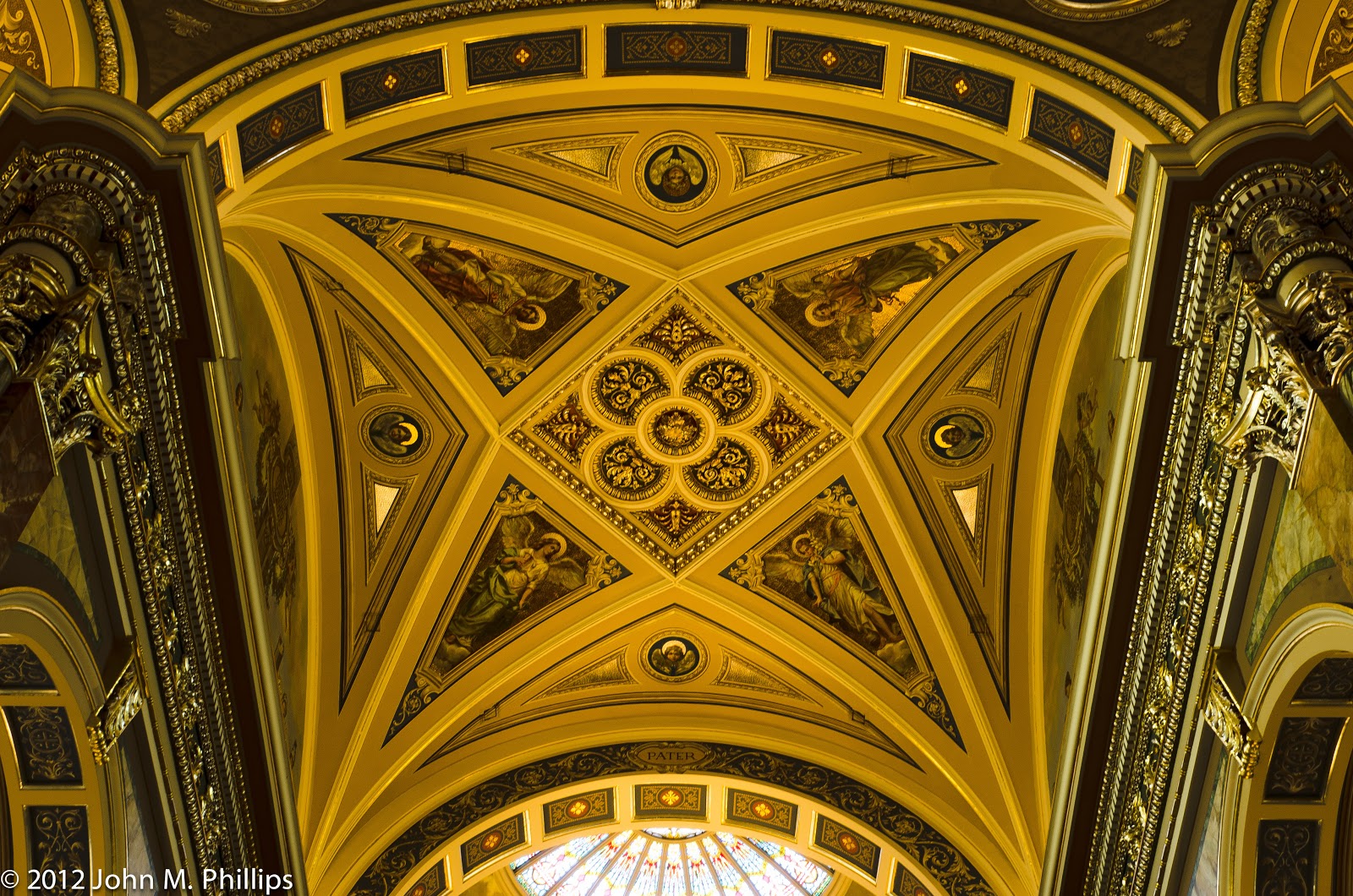
OK, so the biggest attraction is the massive dome.  As I have done in other settings, I took images of the dome simply by placing the camera on the floor directly pointing up and took the shot by remote release.  This is where my lack of a true wide-angle becomes apparent.  Here is the best  I could do.


Here is another shot that I cropped as a square.


I admit that I had to play a little with the placement of the camera to get it centered under the dome.

This time, too, I determined that I would take some dome shots taken at an oblique angle.  Here are a couple of those.


And here are a couple more that, while they are not centered on the dome, are, nevertheless, symmetrical.


I like these shots quite a lot, because of their abstract qualities, particularly the latter of the two.

These shots nicely illustrate the extreme amount of detail incorporated into the interior of this basilica, a truly amazing amount of work and workmanship that went into the creation of this architectural marvel.

The sanctuary/apse is also noteworthy.  Here is a wide-angle shot from the back of the nave.


This also reflects the majestic height of the ceiling.  Here is another shot at a closer range.


And some closeups of aspects of the apse.


One of the things I wanted to accomplish was to give a sense of the size of the interior of the basilica.  I thought one way to do this was to take some shots from the "corners" of the interior, as in the following shots.


Perhaps these give a sense of the size, at least the height, of the interior.  But they also illustrate the problems I was having with dynamic range, as the windows (and in a couple of cases parts of the walls) were generally "blown out."  Even so, the shots are pretty dramatic.

And here are a couple more wide-angle shots of the front of the church that I think do a good job of giving a sense of the size and majesty of the interior.


Finally, here are a few shots of interior "details."  When I took this first shot, I didn't realize what I was photographing.


When I got home I realized that these were the tops of the confessional booths that ranged on both sides of the nave.  I should have included the lower portions of the booths also.

And here are a couple of statues at the back of the nave.  This first I had shot before from directly in front.  This time I chose to do it as a profile shot.


And the following bas-relief at the back of the church was interesting, not especially for its artistic qualities but for the fact that the lighting was from below, creating an eerie, somewhat ominous effect.


A few additional notes:

As I had indicated, I brought my tripod this time and hoped that no one would be offended or tell me that it was not allowed.  Not to worry.  The only people I saw were a couple of parishioners and a couple of workmen doing some sort of construction in the church.  I was as unobtrusive and respectful as I could be.  Late in my visit I did notice a sign that advised professional photographers to check with church officials and obtain permission to take photos in the church.  However, I felt that since my interests (and abilities) were strictly amateur, I did not need to get special permission.  

Even though I was using a tripod, I noticed that a number of my shots lacked the sharpness I was striving for.  I'm not sure what the issue was.  My guess is that because the exposures were quite long--anywhere from 2 to 15 seconds, any sort of disturbance--such as the camera strap lazily swinging back and forth--was enough to affect the sharpness of the shot.  I got enough sharp shots, though, that I was happy with the overall shoot.

Finally, I will admit to modifying (ramping up somewhat) the contrast in the shots, particularly of the interior surfaces.  I did this in large part because I felt that the dim interior light was muting the ornate detail.  In short, I felt that I was bringing the contrast back to what it would have been had the interior been well lit.  Either that or I just liked the effect.

Taken with my Nikon D7000 with Nikkor 24-120mm f/4 lens.

Monday, October 15, 2012

WALKER ART CENTER

Two weekends ago, when Geri and I were in the Twin Cities to see her dad, we took time to visit the Walker Art Center, which is located on the west side of Minneapolis.  It was a bit of a disappointment.  Even so, I decided to post some of the photos that I took during our visit.

I guess we were disappointed for two reasons.  First, the collection was not particularly large.  After we had wandered through what we thought was most of the museum, we asked an employee what we had left out.  (Part of our confusion resulted from the "map" of the museum, which, frankly, was quite confusing.)  The employee confirmed that we had pretty much covered the collection.  Because of the inclement weather, we did not include the sculpture garden, which may have been interesting, but otherwise there wasn't much that we missed.  Second, the collection is nearly all contemporary art.  It's not that we are big fans of more traditional art, but it would have been nice to see more diversity.  Besides, a lot of the art escaped my understanding, I'm afraid.

The building itself was not particularly interesting.  From the outside it appeared to be a nondescript largely windowless not quite rectangular building that appeared taller than it was wide.  Here are a couple of shots from the interior.


This first shot illustrates that the lines of the building were not quite rectilinear.


It did have interesting wallpaper in places, as indicated in the following photos.


Some of the pieces at least approached mainstream art, at least from a contemporary point of view.


This last shot is not just a portion of the artwork like I often shoot; it is the whole thing.

I liked the following piece, not because of the "art" itself, but because of the colors generated by the lighting.


There was one exhibit that featured what I would describe as shadow puppets portraying very disturbing scenes involving what appeared to be a young slave girl and a slave owner in the antebellum South.  I think the following shot gives a good idea of the ominous quality.  We were not comfortable viewing this exhibit for very long.


One piece that I did like consisted of a rectangular box, perhaps five feet high, that had circular holes cut into the sides at seemingly random places.  It became apparent that the interior walls of the box consisted of mirrors.  Here is a shot I took through one of the holes.


The dark circle near the center was actually the lens of my camera which nearly filled the hole.

One of the museum attendants cautioned me not to put my camera close to the hole (which I could understand).  Here is a shot with my camera held back further from the side of the exhibit.


The one good thing about our visit was that it was the first Saturday of the month and admission was free.

Taken with my Nikon D7000 with Nikkor 24-120mm f/4 lens.

Friday, October 12, 2012

UTAH: HOGLE ZOO

Salt Lake City has a zoo that is located only a mile or so from Jeff and Bei's place.  Geri and I had a free afternoon and paid a visit.  This is not a large zoo, but it does include most of the standard animals. In fairness, the zoo is undergoing major renovations and a significant portion of the grounds were inaccessible, though I think all of the animals were still viewable.

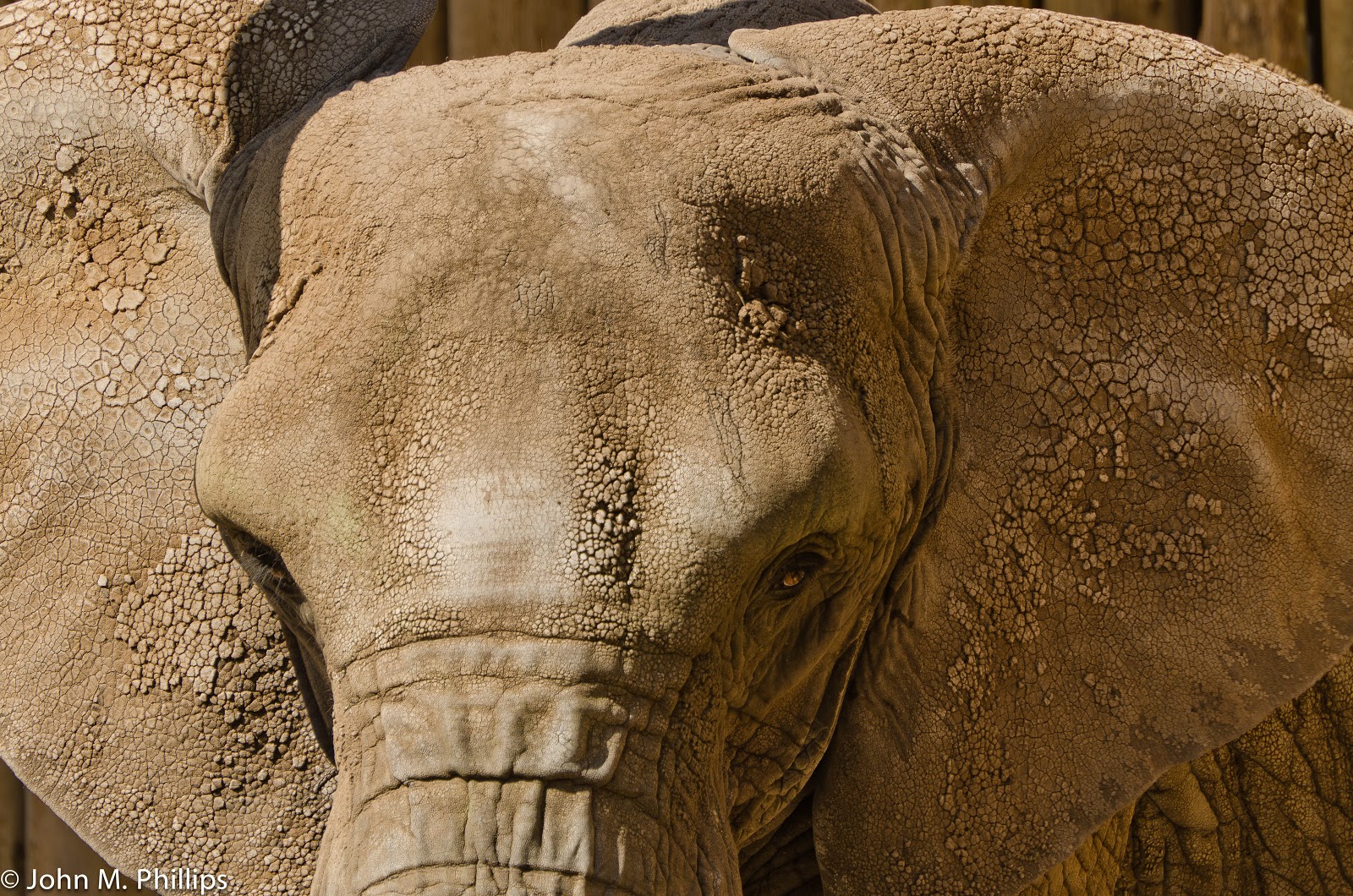
The zoo actually had a nice display of African elephants, and I took a relatively large number of shots of them.  Here are a few.  The first is rather unusual, as the elephant looks to be doing some sort of pole dance.


One of the elephants was facing us and was periodically displaying his/her ears, and I wanted to capture that.  This is the best I got.


Not great.

I also wanted to get as best I could a closeup of an elephant's eye.  Also not too great.


I would have liked to get a closer shot, but this shot is already pretty heavily cropped.  Got some eye lashes, though.

There were also primates, of course.


I liked that I isolated this second monkey from its background.  I didn't mind that it was facing away from me.

There were some new world monkeys inside a small mammal building that had very low lighting.  This shot was taken with the lens wide open and at an ISO of 2000.


Every zoo needs giraffes, and this one had a couple.  Although I took some full length shots, the best ones I got were closeups, as in the following.


The were also some big cats, including this snow leopard that appeared to be looking directly at the camera.


Here was the local tiger.


So why did I take just a closeup of his whiskers?  The truth was that the tiger was lying behind a barrier and this was the only portion that I had a clear shot of.  At least it was different.  Nice pink nose, too.

There was also a grizzly taking his siesta.  Again, I really couldn't get a clear shot, so I decided to concentrate on his paw.


Finally, there were a couple of bald eagles.  One was sleeping, but I  got a couple of nice shots of the other.


Taken with my Nikon D7000 with Nikkor 70-300mm f/4.5-6.3 lens.

UTAH: CITY CREEK MALL

One of the places that we visited on our trip to Utah was City Creek Mall, a new, upscale mall in downtown Salt Lake City owned and managed by the Mormon church.  I didn't spend a lot of time in the mall but did take a few photos.  Nothing great, but I thought I would throw them in.

The mall has a very open, urban feel, which worked well in the 75 degree weather.  However, come winter, it features a system of curved panels that can be drawn across the top of the central space to create a covered structure.  I thought the arced supports for the panels made an interesting composition.  Here are a couple of shots.


Here is a series of support pillars that I thought made a nice composition.


The mall also featured a number of fountains.  In this following shot I wanted to focus on the nearest stream of water and let the more distant streams fall progressively out of focus.


The fact that the lens was wide open allowed a faster shutter speed (1/640th second) to freeze the action of the water.

I also wanted to limit the depth of field in the following shot, to focus on the jets of water.  Again, I also wanted to maximize the shutter speed, which was 1/250th second.


I liked that there were people in the background to provide scale, but I was also pleased that they were out of focus.

Finally, here are a couple of detail shots.  First is simply a cluster of baubles hung in front of some sort of art work.


And here is the door handle for the Tiffany's store.


Even though this was taken at a relatively slow 1/35th second, there is no motion blur in the shot.

Taken with my Nikon D7000 with Nikkor 24-120mm f/4 lens.