Saturday, February 18, 2012

MILWAUKEE CITY HALL


Milwaukee, which happens to share a birthday with me (although it is 99 years older), has a city hall for which it can be justifiably proud. The building, which was completed in 1895 at a cost of $1 million, has in recent years undergone extensive exterior restoration, some of which has experienced problems (cracks, falling masonry) and parts of the exterior of the building are again shrouded in scaffolding.  I had not been in the building in many years but had remembered it as very interesting architecturally, so on a recent trip downtown I decided to pay a visit along with my camera.


I had just taken the above shot (simply by setting the camera on the floor pointing straight up) when I was approached by a police officer questioning why I was taking photos of the interior of the building. I asked if photography was permitted in the building and he admitted that it was but that the police needed to know for security reasons the purpose of the photography.  He asked for ID and called over another officer, I guess for support.  After we got all of that straightened out, I realized that my parking meter had probably run out, so I left but decided to make another visit when I would have more time.  The following week I did return and spent about an hour taking photos of the interior and a portion of the exterior entrance to the building.  This time I brought my tripod so that I could take shots with longer exposures and at a lower ISO to reduce "noise."

The main part of the building has a long and relatively narrow atrium that is eight floors high and is surrounded on each floor by walkways that are open to the atrium.  The shot above looks up at the undersides of each of those walkways, with a skylight at the top.  When I had last visited the building many years ago, there was unattractive wire screening that extended between each of the floors.  One of the officers had told me that the screens dated back to the Depression when they were installed to prevent suicides.  They were removed about 20 years ago.  What a terrific improvement.  

Here are a few other shots taken from the ground floor.


For these first two shots I did my best to make them symmetrical, but for the photo below (actually taken on my first visit), I decided on an asymmetric shot.


I find these shots to be extremely interesting architecturally but perhaps a little busy.  Following is one of my favorite photos from this shoot, which seems to have less "clutter."


I also took some photos from the upper floors.


These were taken from the seventh floor, and again I worked assiduously in post-processing to make sure they were symmetrical.  With this kind of architecture, it is hard to go wrong.

I knew my parking meter was running out, but I wanted to get some images of the exterior of the main entrance, which has its own architectural interest.  Here are a few photos of the roman arches that support the entrance.  By the way, the entrance is situated directly under the bell tower, so the arches obviously were designed to bear a lot of weight, and they show it.
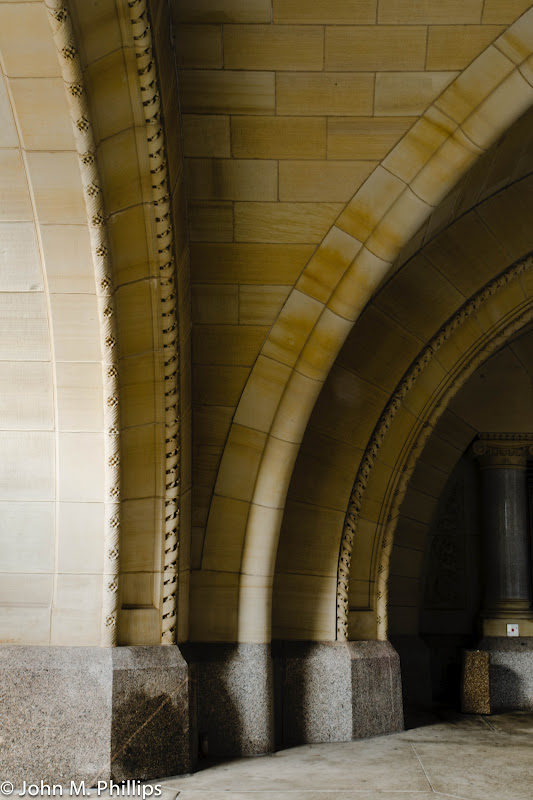


On this last shot I wish that I had taken a bit more care to ensure that the light fixture was precisely in line with the center of the supporting arch.  

I realized when reviewing these images later that I also had something of a light problem.  Although it was fairly dark in the actual entryway, it was a bright day and the sunlight reflecting off the south-facing portions of the arches was creating a contrast problem for my camera.  I did the best I could in post-processing to illuminate properly the stonework without blowing out the portion experiencing direct sunlight.  As is apparent, I was not completely successful.  I will plan to return on an overcast day, or at least at a different time of day, when that should not be a problem.

As with a lot of architectural photography, the story here was as much with the lines as with the color, so B&W shots can work quite well.  Here are a few of the images that I converted to B&Ws.


I particularly liked the elegant simplicity of this last shot.

A couple additional facts about Milwaukee's City Hall:  (a) When completed in 1895, it was the tallest habitable building in the world, exceeded in height in the US only by the Washington Monument.  (b) The footprint of the building is a trapezium, which in the US means a four-sided figure none of the sides of which is parallel to any other side (as contrasted to a trapezoid, which has two sides that are parallel).

After this last shot I realized that my parking meter was again about to run out of time, if it hadn't already, so I hurried over to my car only to discover that the city had just given me a citation for an expired meter.  $22.  Ouch.

Finally, I also happened on the website of a professional photographer who, though he is based in England, has done photographic studies in Milwaukee, including the Calatrava addition to the Milwaukee Art Museum as well as city hall.  I found that, not surprisingly, we had taken a number of shots of city hall with very similar perspectives. The major difference that I noticed was that the professional was using more of a wide-angle lens, allowing him to capture more of a complete view of the atrium.  My most wide-angle lens is my 24-120 mm zoom, and for many of the shots I had it at its widest.  However, my camera has a "crop" sensor, which means that a 24 mm lens covers only the equivalent of what a 36 mm lens would cover on a full-frame sensor camera.  My guess is that he was using something like a 14 mm lens on a full-frame sensor camera.  Anyway, that is my excuse.

Thursday, February 16, 2012

HARLEY DAVIDSON MUSEUM REVISITED


On February 14th, I returned to the Harley Davidson Museum.  As with most museums, the amount of light on the interior is somewhat limited, and I decided this time to bring my tripod with the hopes of taking photos at a longer exposure time but with a lower ISO to reduce camera "noise"and improve the overall quality of the shots.  To some extent that proved to be true, but it also created other problems that I will refer to later.

Although you enter the museum on the ground level, you are directed to start touring the museum on the second floor, where they have positioned many of the oldest motorcycles, dating as far back as 1906.  (The company was founded in 1903.) As with the prior visit, I found myself taking shots of the hubs and spokes of the very early motorcycles, which were little more than motorized heavy-duty bicycles.  Here is one of the better examples.


Here is another that seemed to work better as a B&W.


One thing I discovered about the tripod: it prevented me from getting as close to the subject as I would have liked.

One of the very best exhibits in the museum is the collection of decorative gas tanks that are displayed along one wall.  The layout and lighting for this exhibit are terrific.


Here is one of the tanks that I especially liked because of its white color.


An exhibit that I had not paid much attention to on my earlier visit was a display that showed the evolution of the motorcycle engine. Here is an example of one of those engines.


One of the excellent aspects of the museum is that the motorcycles, and there are literally scores of them on display, are very accessible and generally in great condition.  Here is an interesting detail from one of the machines.


Even though the main function of the museum is to present the history of the Harley Davidson motorcycle and brand, the museum building itself is also interesting.  I was informed that the building was build specifically as a museum and was designed to reflect the industrial character of the city, the brand, and to some extent its customers.  I found myself looking for shots that would reflect that architecture.  Some of the shots were a little weird.


I also found myself attracted to the red corrugated metal walls, particularly on the stairwells.


I also felt this shot worked well as a B&W.


One problem I ran into a number of times on this visit was the fact that, even though I was using a tripod, some of the photos, upon later inspection, showed movement during the period that the shutter was open.  This was disappointing, and at first I thought I had just been sloppy.  However, in the following shot, the composition of which I particularly liked, the camera "shake" appeared to be strictly up and down.


I had taken the shot on a landing on the stairs, and, given the low-light setting, the exposure was for a very long 4 seconds.  I have two theories about this.  One is that I had inadvertently set the landing in motion by moving around while the shutter was open.  The second theory is that there was a lot of noise on the museum, primarily recordings of Harley engine sounds, and that the noise had caused the stair landing to vibrate up and down.

Here is another shot of the interesting light fixtures which fortunately didn't show any vibration.


Following are a couple of shots of a stairway that liked for the various diagonal lines reflected in the shots.  These were probably my favorite shots on this visit.


As I was leaving, I spoke with one of the museum employees who suggested that I try to get a shot of the "hill rider" statue situated outside the museum.  He showed me a photo he had taken one evening which presented the statue in silhouette with the building behind it lighted by interior and exterior lights.  His photo was nice and I was not able to replicate it in the middle of the day.  Here is the shot that I did take.


Finally, here, for what they are worth, are a couple of other exterior shots that I turned into B&Ws.


Friday, February 3, 2012

TIMES SQUARE


Our hotel in New York was located only 1/2 block east of Times Square, and we had ample opportunity to walk around the area, which extends several blocks on a north-south basis.  Again, coming from Milwaukee, I was struck by the amount of light in Times Square, even (or perhaps especially) later at night and thought it would be pretty simple to get some good shots of the scene.  Not the case.

Although the signage was highly illuminated, that did not mean that the overall scene was well-lit (at least from a camera's sensor's point of view).  In other words, there was a great variation between the lighted signs, etc. and the street scene, which was still quite dark.  I started taking photos at an ISO of 400 but soon decided that I could move to 200 and still have an adequate shutter speed.  Here are some early shots.


 I finally realized that these shots were not providing much of a human perspective, so in subsequent shots I tried to incorporate the people scene as well, including cars.


I pretty much had my 24-120 lens set as wide-angle as possible, but it would have been nice to have had more of a true wide angle lens to capture these scenes.

Tuesday, January 31, 2012

NYC: MOMA


On Friday, the 27th, we visited the Museum of Modern Art (MOMA), a world-class museum for 19th and 20th century art. Although when I visit art museums I generally wind up focusing on individual pieces (and in many cases parts of individual pieces), I did manage to take some shots of broader views in the museum, and here are a few of those.


Following, without comment, are some of the works of "wall art" that I found interesting.


Wow! Even though I know very little about art, I was impressed with collection in this museum.

Here are some three-dimensional pieces, i.e., sculptures, that I enjoyed.


Not that I could see having this last piece in our home.

One thing about photographing sculptures: It helps, I think, to position them so that the background provides some added interest and context.  That was not always possible, as some of the above shots illustrate.  Another thing: Photographing bronze statues creates added challenges in that the metal is generally dark against a much lighter background, so the metal's texture can get lost in the relative darkness.  Here I did my best to brighten up the bronze to allow that texture to come through.