Saturday, November 5, 2011

BACKGROUND ELEMENTS AS CONTEXT--OR NOT

Sometimes the area behind the primary subject of a photo is important to the composition and sometimes it is unwanted clutter.  It depends on the subject and the "story" that is being told by the photo.  It also depends to an extent on the "size" of the subject of the photo.

Consider the following photo of Geri, Jeff, and Bei that I took during our recent trip to Utah.  They are the primary subject matter of the photo, but the shot wouldn't make a lot of sense if I didn't show what they were looking at.


This was taken at an aperture of f/8.0.  I might have opened up the aperture to focus on the individuals.  The background scene would still have been present but less in focus.  The effect would have been to emphasize the human side of the story.  As this was more or less a spontaneous shot, I wasn't thinking too much about those options.

In landscape photography, the background is virtually always going to be an important element in the shot and its inclusion is usually unavoidable in any case.

With intermediate-sized subjects, such as sculptures, one sometimes has a choice whether to include any background as context.  For example, in the following shot the background serves to provide a sense of place.


And in the following shot it also provides a comparison of artistic sensibilities and styles.


I'm sure the museum knew what they were doing when they juxtaposed these two pieces of art.

On the other hand, in the following shot I isolated the sculpture from any background context.  There is something to be said for this if the goal is to focus totally on the subject without any distraction.


I particularly liked the following sculpture shot because it provides some context--exterior in the fall--and color, but by controlling the depth of field I was able to prevent the background from becoming a distraction from the subject of the shot.


The following shot was less successful, as I was unable to sufficiently isolate the subject from the background, despite taking the shot with the aperture wide open.


When it comes to macro photography, backgrounds are usually a distraction from the subject matter.  Recently, I went back to Doctors Park to look for some late fall opportunities.  As I said to another photographer also interested in macro, as winter approaches, it's amazing how one starts to look at dead vegetation in a whole new light.  In any event, here is one of the shots that I took.


This was shot with the lens nearly wide open, at an aperture of f/4.0.  I chose this shot in part because most of the elements were close to being in one plane.  However, although the dead leaf, or at least a part of it, is in good focus, the plant stems slightly behind it are not sharp.  I took another shot at f/16.


Now all of the elements are in good focus.  However, the background has become a distraction.  This is especially the case because the background is in the same general earth-tone color family as the subject.

Here is a third shot I took with the lens at f/8.0.


Although the stem slanting up to the right corner is still pretty much out of focus, the remainder is not too bad.  This is probably the best compromise under the conditions.

Here is another shot where I wanted to eliminate the background because of the distraction.


In this case I liked the way in which the stem had curved over.  Moreover, the stem and leaves were more or less all in a single vertical plane and I could position the camera at a point perpendicular to that plane so that the field did not need to be very deep to maintain all of the elements in acceptable focus.  This first shot was taken at f/11.  Unfortunately, the subject was positioned against a chain-linked fence and even though the fence is largely out of focus, I felt that it represented a significant distraction from the subject of the shot.

Here is a second shot at f/6.3.  The subject plant is still in pretty good focus, but the fence has become less of a distraction.


I would have preferred not to have had the curving band n the background (presumably another plant stem), but that was not an option.

Eliminating all background elements is not always a goal in macro photography.  Sometimes the background is so different in color that it is not a distraction and, in fact, may provide some context, as in the following photo.


And in the following shot, the reflections in the water provide some context for this pond scene.


In this example of the use of negative space, I wish I had managed to incorporate more of the reflected trees in the shot.

Finally, in the following shot the other flowers in the frame serve to show that the blossoms most in focus were not isolated but instead were part of a larger group.  The fact that the other blossoms were progressively further out of focus serves to provide added depth to the scene.  As I have mentioned before, I generally find it best to put into sharpest focus those elements closest to the camera, and that is what I did here.


This shot, taken a couple of summers ago, strikes me has having a lot of feminine elements, by reason of its pastel colors and preponderance of soft focus components.

Saturday, October 29, 2011

OLD IRONSIDES

When Geri and I walked the Boston Freedom Trail on Sunday, October 23rd, we took a tour of the USS Constitution, nicknamed "Old Ironsides."  The ship is basically a component of the Freedom Trail.  It was in active service from 1797 to 1855 and is the oldest warship in the world that is still afloat.  It saw most action in the War of 1812 and has a record of never having lost a battle at sea.  But enough of history.

Tours of the ship are free and very well done, though you may have a wait and should be advised that touring the ship requires going through a security check.

The photos I took of the ship reflect some of the mistakes I seem to keep making.  I should have gotten at least one good shot of the whole ship.  Didn't do it.  Instead, I found myself taking photos of pieces of the ship.  Here is a shot of one of the life boats.


At least in the following shot I included the name of the ship.


The rigging on this sailing ship was truly impressive.  We were informed that it could take as many as 250 men to raise the sail on the main mast.


Here is a closer shot that I liked.


As we began our tour, I found myself taking photos of rope.  I must have thought there was something artistic in these shots, but they seem pretty mundane in retrospect.  The technical quality was pretty good, though.


The ship was in terrific shape, and the tour below decks was quite well done.  When fully manned, the ship had a crew of 450 to 500, which seems incredible considering its modest size, relatively speaking.

I did get a couple of good shots of the cannon.


And here are a couple shots of the sleeping quarters for the crew.


I'm guessing these hammocks are not original equipment.

Here is a shot of stairs between decks.  (They probably have some sort of nautical name.)


These photos were basically interior shots with not a lot of light.  They were taken at ISO levels of 800 to 1600.  I was happy with the overall quality.

Thursday, October 27, 2011

FREEDOM TRAIL AND TRAVEL PHOTOGRAPHY

On Sunday Geri and I decided to walk Boston's Freedom Trail, a 2.5 mile walk marked by a continuous line of red paint and/or red bricks passing by many of the historical sites in Boston between Boston Commons and Bunker Hill.


To save our legs, we took the MTA to the starting point in Boston Commons and then back to our hotel from a station not far from Bunker Hill.

Here I have chosen to focus on just a few of the places we visited.  The first was the Granary Burying Ground.


I found it difficult to provide a proper perspective for a graveyard, and I wound up taking a number of shots of headstones.  I liked this one the best, primarily because of the interesting light.  It might have been better had I taken the shot from a slightly lower perspective.

It was interesting to learn that bas relief sculptures of skulls were commonplace on gravestones during that time period.


And, yes, my namesake was the first mayor of the city of Boston.


The key in the shot below was the play of light and shadow, so I turned it into a B&W.


Not a travel photo, but I liked it anyway.  The following shot includes an interesting juxtaposition between an old gravestone and a more modern wrought iron fence and building behind it.


The viewer can't identify exactly where this was taken, but it does give a sense of the old and new that the Boston historical area incorporates.  The ivy also helps to make the shot.

Here is another typical street scene along the trail.  I wish the shot did not include the car, but I would have had to come back at a very different time of day with any hopes of getting that shot.


One of the more impressive sites was a group of sculptures depicting the Irish immigrant experience.  There were two sets of sculptures, one featuring a group of self-assured individuals . . .


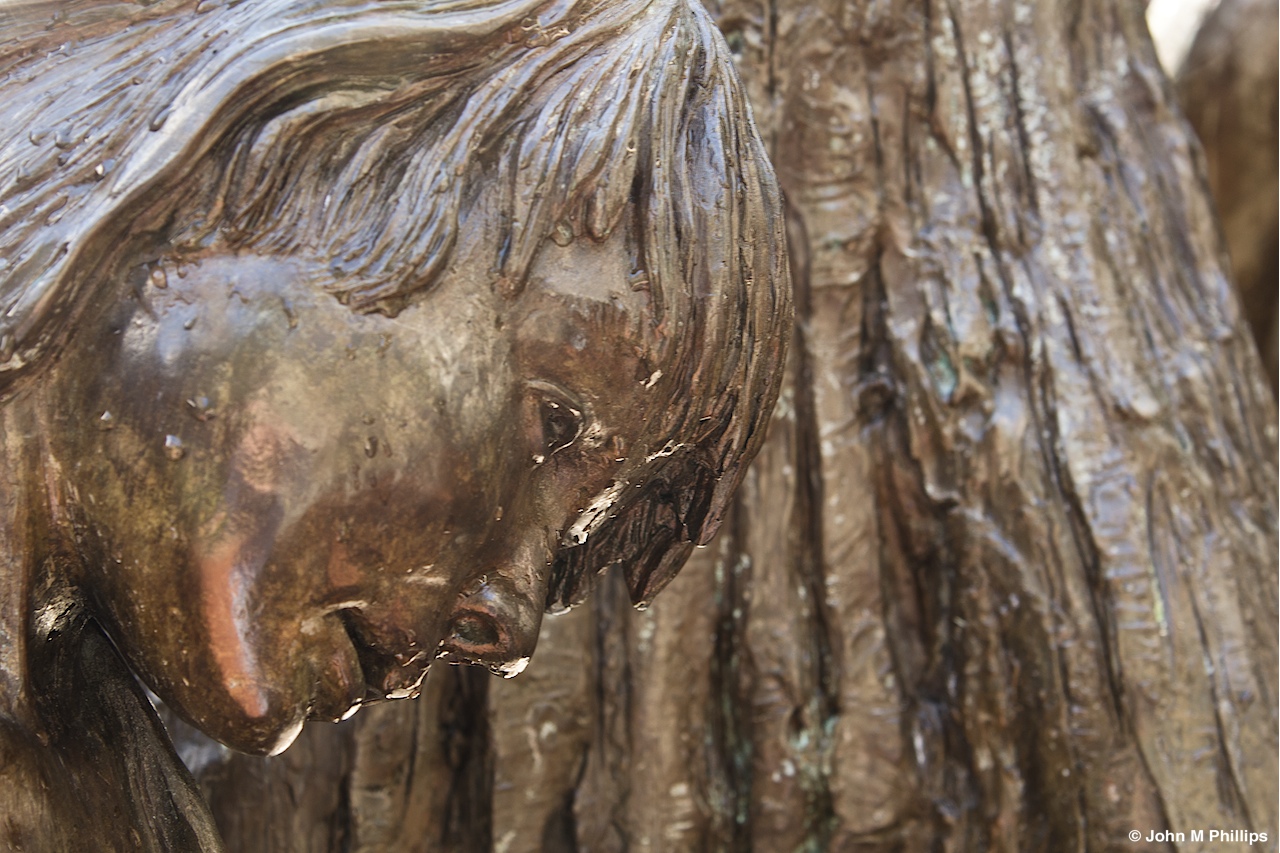
and a second of a group clearly experiencing anguish and despair.


The young man's face is just too close to the woman's skirt to use depth of field to distinguish the two.


It might have been better to have taken this shot more from the front than from the side.

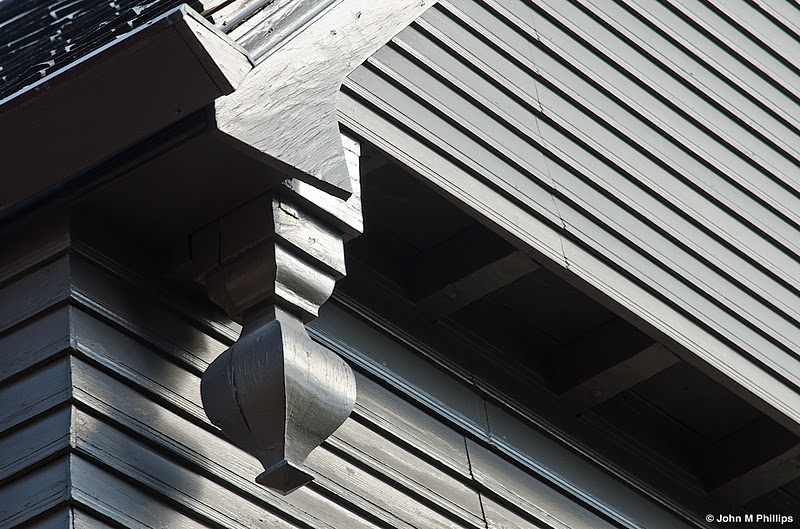
We did a brief tour of the Paul Revere house, a handsome structure that has been well maintained.


 I liked the architectural detail in the following shot.


Next stop was the iconic Paul Revere statue.  My problem was the play of sunlight and shadow across the statue.  This was not such a big problem for a side shot, but that was not really a very interesting view.


I wanted to capture the statue with the Old North Church in the background, even though as I took the shot I realized that this had to be a very common compostion.


In this first shot, the church steeple is clear, but I wanted it to be larger in the shot, as in the photo below.


Unfortunately, the white steeple is somewhat lost against the white clouds behind it.  And of course there  were those strong shadows running across the Revere statue.

I then turned around and realized that the lighting was much better if the statue was shot from behind, and the handsome St. Stephen's Church with its bell tower provided a very nice backdrop.


I felt the trees on either side helped to focus attention on the statue and church, and it helped that the bell was fully visible.  A minor regret was that it would have been nice if the statue had been a bit larger in the shot.  In addition, resolution of this shot is a bit soft.

The Benjamin Franklin statue is also a Boston icon.  I liked how I captured it in the following two shots.


This second shot, in particular, I felt very good about.  Instead of having the statue fill the image, I included a significant amount of the background building to provide context.  The trees on either side and in front provided depth.  It also helped that the trees were showing their fall colors.  The statue is also in exceptional focus.  Usually, I am trying to learn something from my mistakes.  The above photo was, I felt, a classic travel photo, and hopefully I learned something from its success.

The Freedom Trail ends at the Bunker Hill monument, which is fronted by another interesting statue, this time of Col. William Prescott, who was instrumental in the battle by that name.  By this time the sky had clouded over, and I decided to convert the shots I took of the statue to near-B&Ws.


The first shot, with part of the Bunker Hill obelisk in the background, is probably the best of the three, although I liked the positioning of the Colonel's left arm in the third shot.  The buildings in the background are a bit of a distraction.  Either they should have been excluded by taking the shot from a lower angle or  they should have been given a more prominent role.  I do feel that the conversion to B&W added to these shots.